
In the aftermath of the 2025 Los Angeles wildfires, a group of screenwriters and producers launched a petition titled #StayInLA. It quickly gathered over 20,000 signatures, backed by A-list celebrity endorsements. The industry’s most influential voices were pleading for film production to stay home. Yet the numbers tell a starkly different story: nearly half of Hollywood blockbusters budgeted at over $200 million are now shot entirely outside the United States, while only 22% are filmed exclusively within US borders.
The author of this data study, Daniel Parris—a former late-night talk show intern who witnessed firsthand the eerie emptiness of the Warner Bros. lot—analyzed over a decade of industry data. His conclusion defies conventional wisdom: while wildfires and union strikes served as immediate catalysts, the decline of LA-based production stems from economic structures set in motion decades ago.
How Hollywood Became “Hollywood”
To understand the present, consider the history. Over a century ago, the hub of American cinema was New York. Filmmakers migrated en masse to Los Angeles in the 1910s for practical reasons: year-round sunshine, cheap real estate, and distance from Thomas Edison’s East Coast patent enforcement lawsuits, which were too far for Edison’s lawyers to bother pursuing.
Once established, studios turned filmmaking into an assembly line. With permanent sets and contract crews, studios churned out four to six pictures a year, prioritizing speed and cost-efficiency much like Henry Ford’s Model T production lines. The Golden Age of Hollywood was, at its core, a movie manufacturing plant.
The turning point came in the 1970s. “Event movies” like Jaws and Star Wars proved that massive scale meant massive profits. By the 1980s, studios systematically cranked out blockbusters. Post-2000, franchises like the Marvel Cinematic Universe dominated, pushing budgets higher with every installment. Big-budget spectacles required sprawling locations, and expenses ballooned. Enter tax credits.
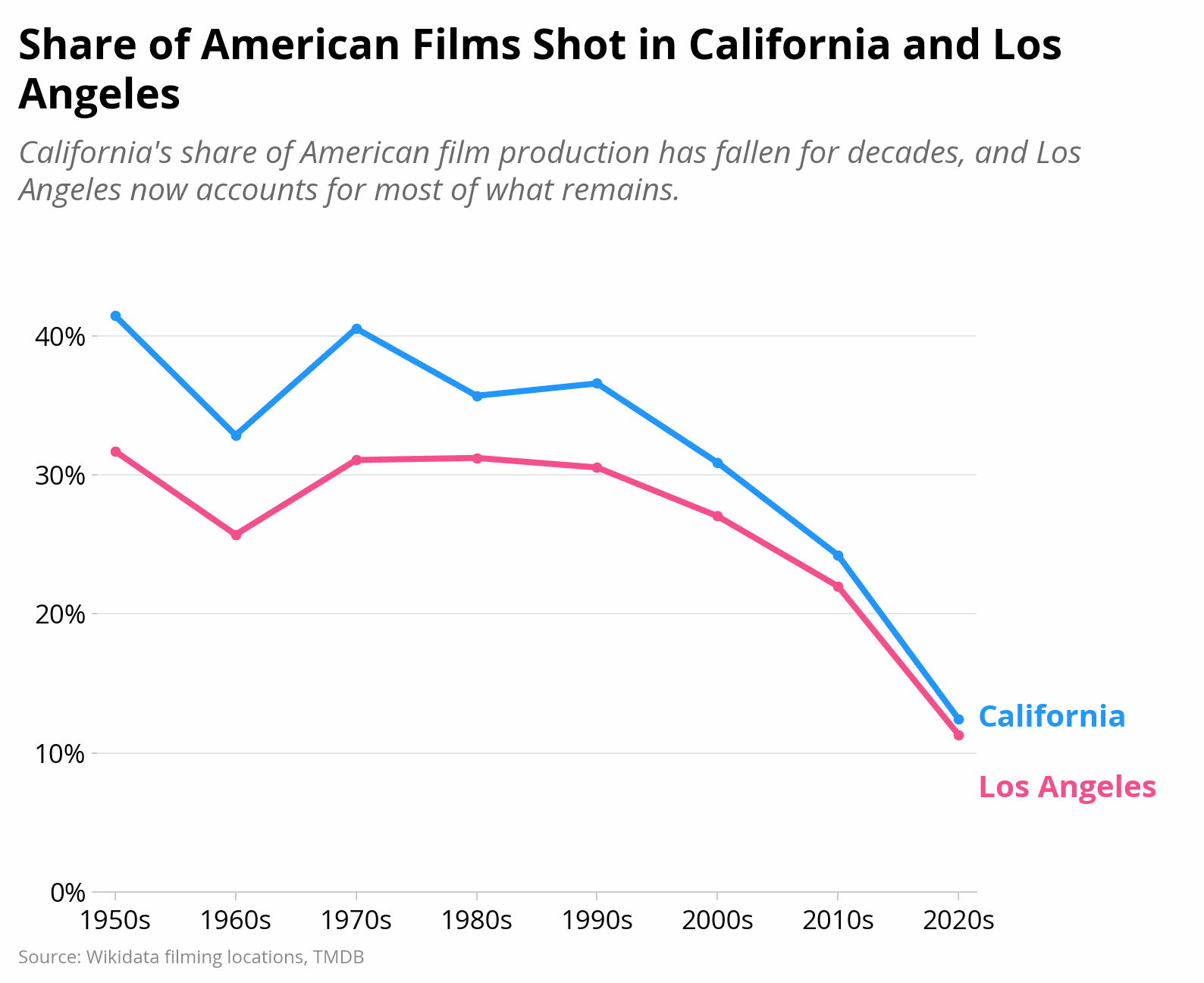 Figure: The share of US films shot in California has steadily declined since the 1950s. Of the remaining in-state share, Los Angeles accounts for the majority. Source: statsignificant.com
Follow the Money: Where Film Dollars Go
Tax credits operate on a simple principle: shoot your movie here, and we will refund a percentage of what you spend. Georgia, Canada, the UK, Hungary, and other jurisdictions began outbidding one another like vendors at an open market—offering 30%, 35%, or 40% back.
How dramatic are these savings? Parris calculated average cost savings across budget tiers. A blockbuster costing over $200 million saves an average of $64 million by filming in Vancouver, $56 million in Atlanta, $53 million in Budapest or Prague, and $49 million in London. Even mid-budget films ($50M–$100M) save around $17 million in Vancouver.
For a film costing upwards of a hundred million dollars, tens of millions in savings dictate where the cameras roll. Money saved on tax incentives can fund bigger stars or more elaborate visual effects. Consequently, a clear rule has emerged: the bigger the budget, the less likely a film is shot in the US. For movies costing $50M–$100M, 48% are filmed entirely within the US; for $200M+ blockbusters, that number drops to 22%.
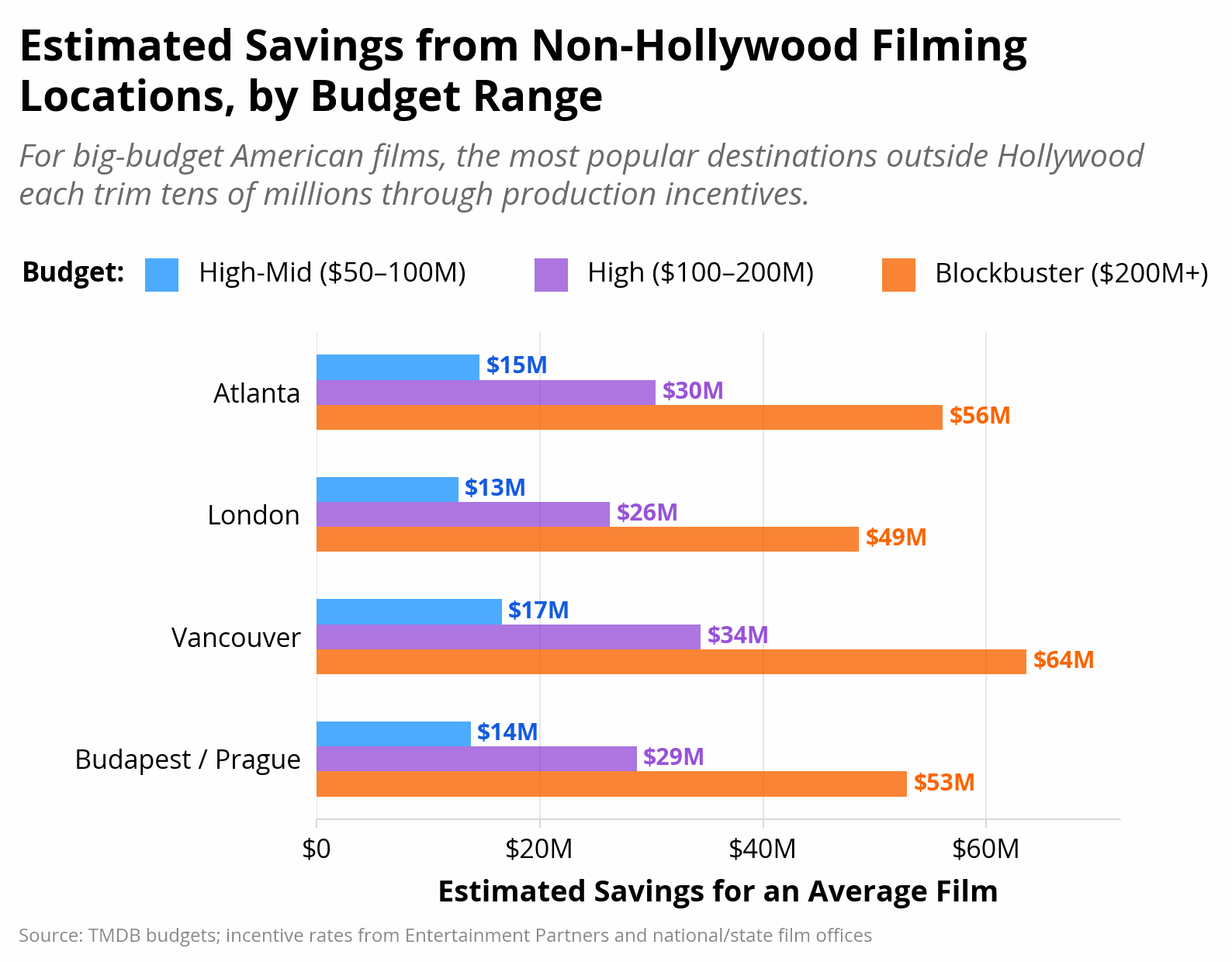 Figure: A blockbuster budgeted over $200M saves an average of $64M in Vancouver and $56M in Atlanta. Source: statsignificant.com
Furthermore, this bidding war has no finish line. Commenters on Hacker News pointed out that Disney recently moved Marvel productions from Atlanta to the UK simply because the British tax breaks were richer. Even cities that built their film industries on tax subsidies are being undercut by cheaper destinations. It is a classic race to the bottom: subsidies escalate, production follows the cash, and loyalty exists nowhere.
Location, Location: Does Story Setting Match Shooting Location?
While the balance sheets look cleaner, visual authenticity takes a hit.
Modern American cinema increasingly decouples a story’s setting from its actual filming location. Parris’s historical data reveals that in the mid-20th century, nearly 70% of American films were shot where their stories took place. By the 2020s, that figure plummeted to 40%. Toronto’s skyline regularly doubles for New York, Prague stands in for any European capital, and a streaming rom-com set in Manhattan might actually be filmed in New Orleans.
Do moviegoers actually notice or care? Parris conducted an empirical test: across three budget tiers, he compared audience ratings for films shot on location versus those shot elsewhere. The results across all three tiers were identical: no measurable difference.
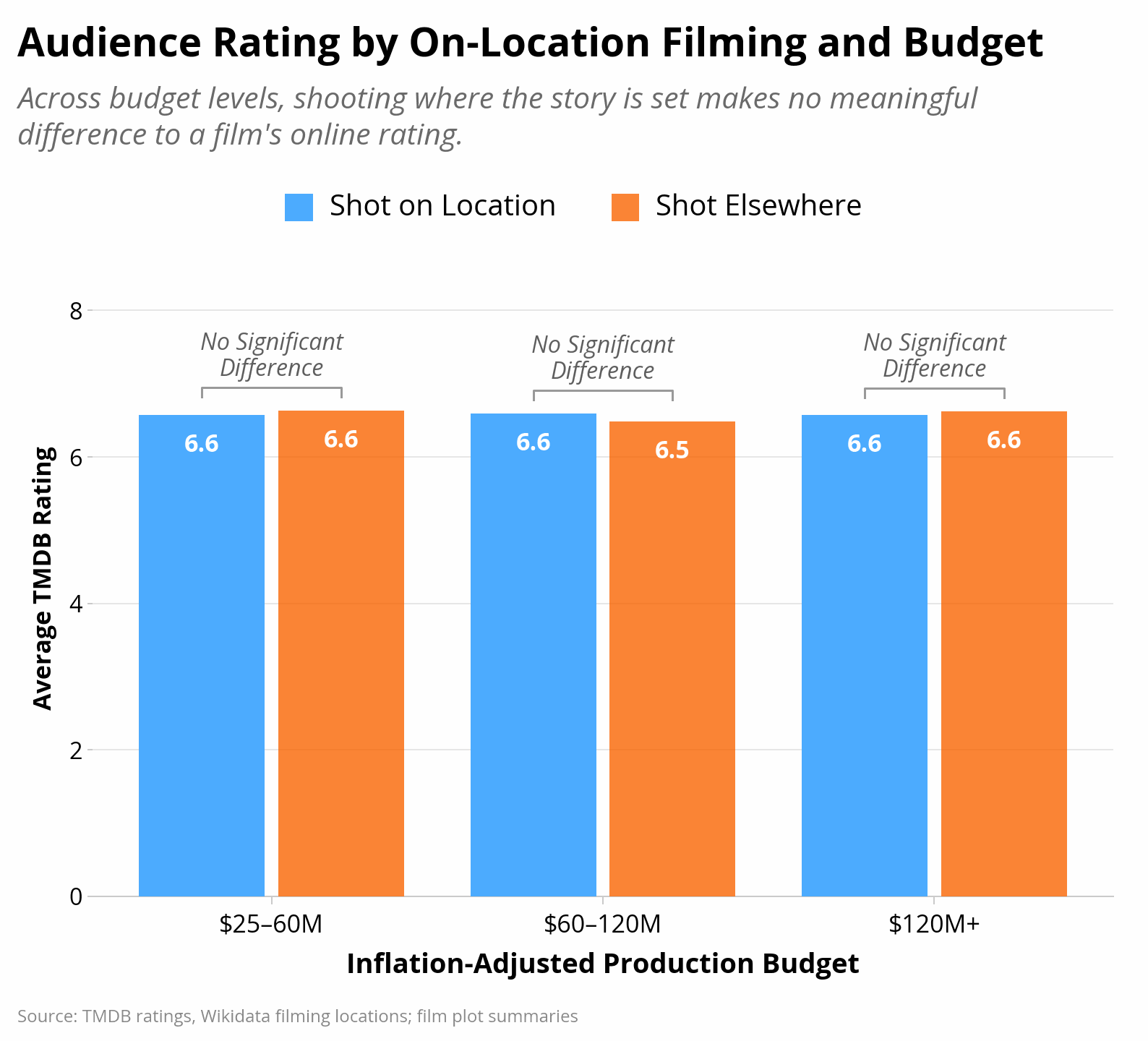 Figure: Across all budget tiers, whether a film is shot in its actual narrative setting has no measurable impact on audience ratings. Source: statsignificant.com
Have Movies Gotten Worse? The Two-Camp Debate
This raises a broader question: Is the perceived decline in Hollywood film quality attributable to leaving Hollywood? Online discussions split into two main camps:
| Camp | Core Argument | Typical Claims |
|---|---|---|
| The Quality Camp | Quality declined due to creative bankruptcy | Sequels, remakes, and IP recycling dominate; ROI overrides creative risk; AI-generated “slop” is proliferating |
| The Cost Camp | Quality shifts stem from cost structures | Soaring real estate and living costs are the root cause; tax credit races force productions to follow subsidies; no city can retain filming in a globalized market |
Both sides offer compelling observations. The Quality Camp points to release slates: risky, original narratives are scarce, replaced by safe sequels and reboots. The Cost Camp points to the ledger: Los Angeles is the third most expensive city in the United States. Production crews, post-production teams, and VFX houses migrate wherever costs are lower. According to US industry reports, California lost roughly 42,000 film and television jobs between 2022 and 2024.
Economists refer to this phenomenon as “cost disease.” In labor-intensive fields like filmmaking, productivity gains are minimal, yet real estate and labor costs rise relentlessly. Studios must either cut headcount or relocate to cheaper markets. As Parris bluntly puts it: trace Hollywood’s crisis back to its root, and it comes down to one word—rent.
Streaming has added another layer: films launch globally on day one, accessible to viewers anywhere. To an audience streaming at home, the specific city on screen matters less than ever. “For whom” and “where” carry shrinking weight in production greenlight decisions.
What This Means for Moviegoers
Back to the audience perspective. Sitting in a theater, what you see on screen remains largely unchanged: a Vancouver crew still produces a thoroughly American movie—featuring American actors, conveying American stories, just using foreign soundstages and tax subsidies. Most viewers cannot spot Toronto disguised as New York or Prague disguised as Paris, and rating data confirms that reality.
What has fundamentally shifted is behind the scenes: the carpenters, electricians, makeup artists, and grips who built their livelihoods on LA soundstages have seen their jobs migrate alongside the subsidies. The movies endure, and audiences keep watching; but the “City of Cinema” is quietly transforming into an administrative corporate office for the global film trade.
This shift is neither purely tragic nor celebratory; it is simply a protracted migration. The house remains standing, but the inhabitants have changed. Whether the move was wise or comfortable remains to be seen—the data tells the story, and time will deliver the verdict.
Reference links:
- Stat Significant: How Hollywood stopped making movies in Hollywood
- HN Discussion (item?id=49082937)