3.7kg Quick-Release Kit and the Physical Costs of Mechanics
At EUROBIKE 2026, ASUS unveiled the Oxiis E250G1, a modular drive kit weighing 3.7 kg. Resembling a bento box, this quick-release device clamps onto the rear wheel of a bicycle to deliver up to 500W of peak assist power. With a minimal installation barrier and an estimated price tag of $2,000, the product quickly sparked heated debates across technical communities.
The economic logic of converting traditional bikes into e-bikes without replacing the entire bicycle seems to open new doors for lightweight electrification. However, rather than opting for modern mid-drive or hub motors, ASUS chose friction drive—a technology that first emerged two decades ago. The unyielding laws of physics place this engineering compromise between portability and efficiency under severe scrutiny.
Regarding hardware specifications, the Oxiis E250G1 provides a rated output of 250W with a 500W peak power, paired with a removable 158.4 Wh / 36V battery pack. The entire system supports 100W USB-C PD fast charging, reaching a full charge in 2 hours and delivering up to 50 km of assist range in eco mode. A wireless cadence sensor and a smart brake taillight round out the kit’s sensing ecosystem.
From a spec perspective, the 158.4 Wh battery capacity is only one-third that of conventional e-bikes (which typically range between 400Wh and 700Wh). This indicates that ASUS made a radical trade-off between range and total weight, relying on light overall weight and modest cadence assistance to achieve a theoretical 50 km range. Broad compatibility allows it to fit wheel sizes from 16 to 29 inches and tire widths up to 60mm, attempting to cover road, mountain, and folding bikes with a single universal design.
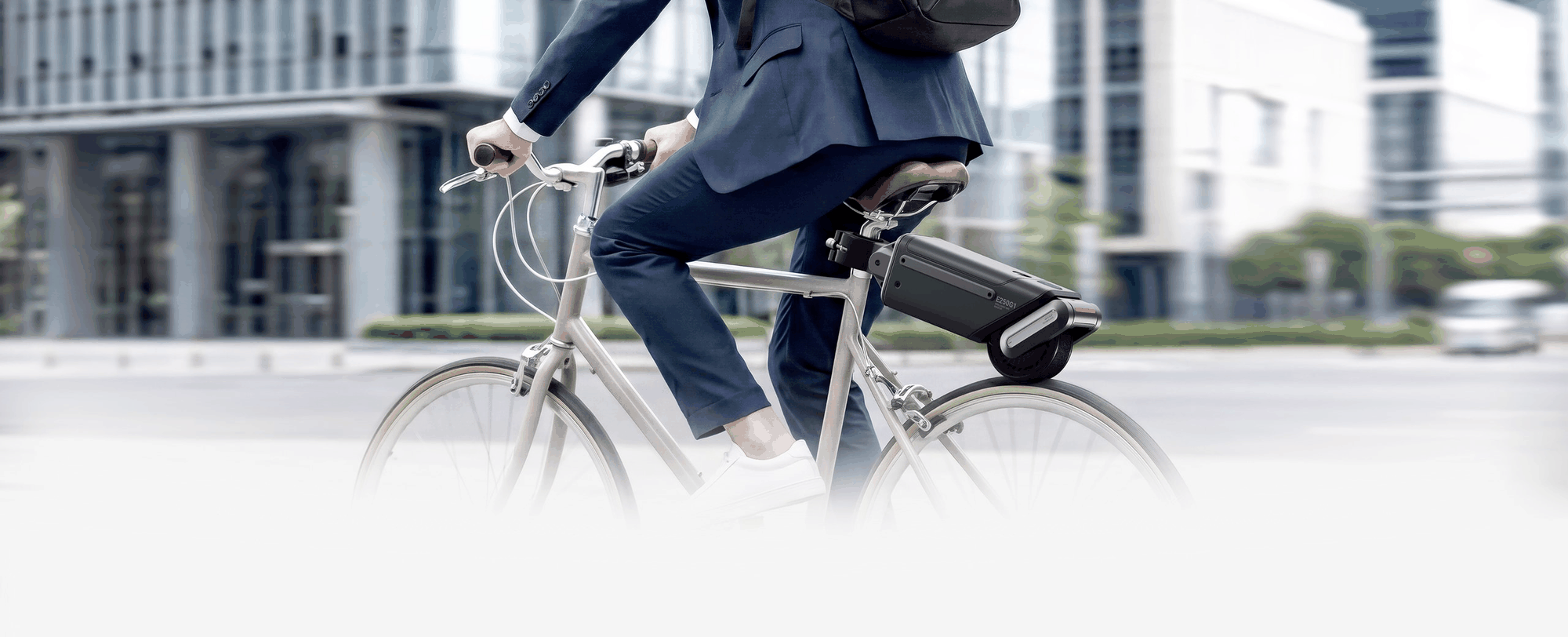 Figure: Oxiis E250G1 overall design and quick-release mechanism. Source: ASUS Official Website
Fatal Weaknesses of Friction Drive: Wear, Slippage, and Efficiency Loss
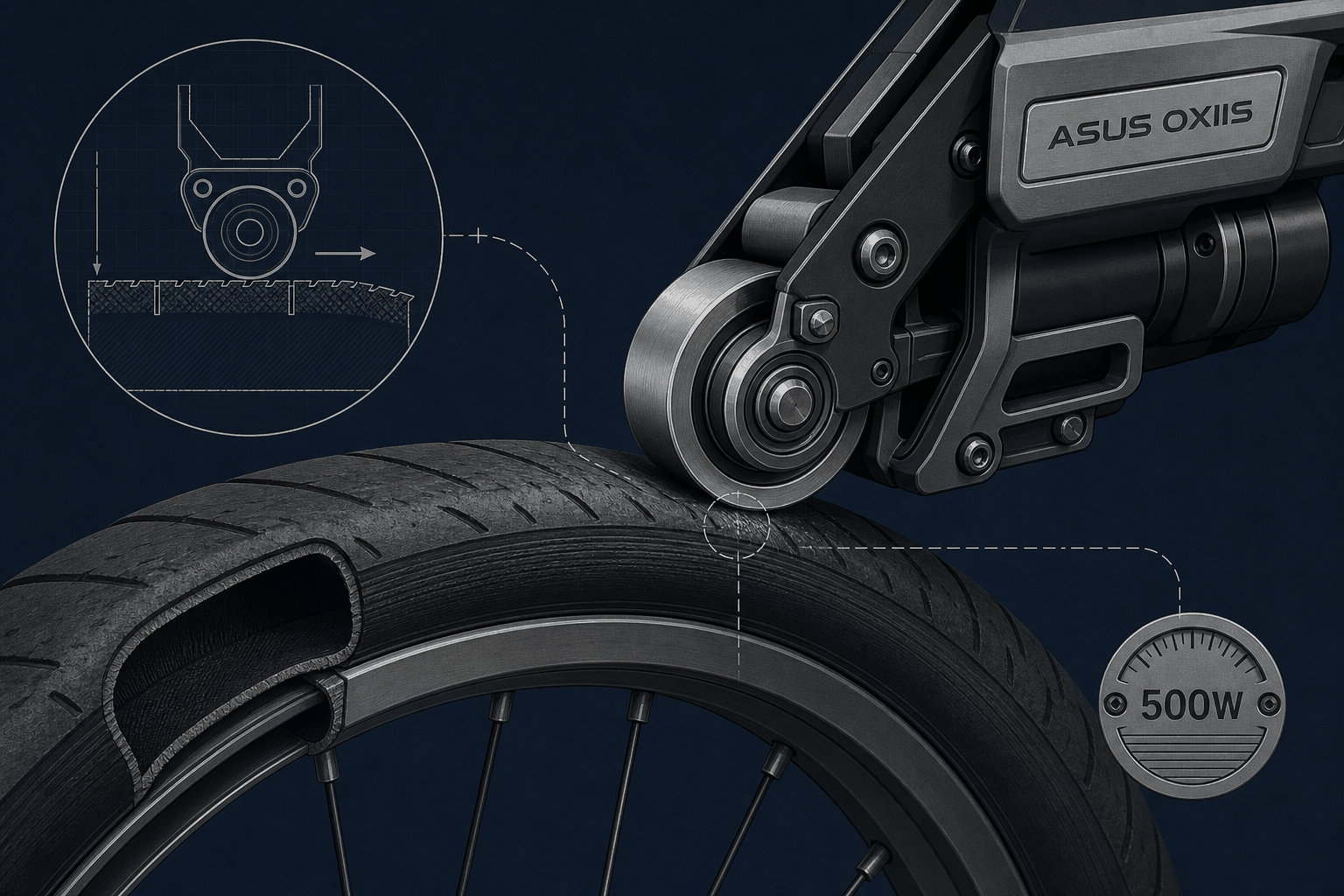
The mechanical principle of friction drive is strikingly simple: a roller mounted on the motor head presses directly against the rubber of the bicycle’s rear tire, driving the wheel through friction created by the roller’s rotation. This design completely eliminates complex chainrings, bottom bracket modifications, or wheel relacing, achieving non-destructive quick-release installation. However, direct mechanical contact introduces inevitable physical drawbacks.
In technical discussions on Hacker News, several experienced cyclists pointed out three core disadvantages of friction drive. First, high-speed rotation and pressure from the metal roller accelerate tire wear significantly. Second, on rainy, muddy, or wet roads, a film of water dramatically lowers the friction coefficient between the roller and rubber, causing severe slipping and free-spinning.
A more critical bottleneck lies in mechanical transmission efficiency loss. Physical testing indicates that deformation friction between roller and tire creates additional energy loss, yielding an overall efficiency roughly 20% lower than internal gear or hub motor drives. A 20% efficiency drop means that one-fifth of the battery energy is wasted as heat at the contact surface—a heavy burden for a micro-battery with already limited capacity.
Two decades ago, friction drive appeared briefly in early e-bike conversion projects before quickly being phased out by hub motors. The mechanical contact between rubber and hard metal rollers in open environments is highly vulnerable to tire pressure, tread pattern, and moisture. While ASUS improved power delivery smoothness using smart cadence sensing and algorithm tuning, the physical costs of friction remain unavoidable.
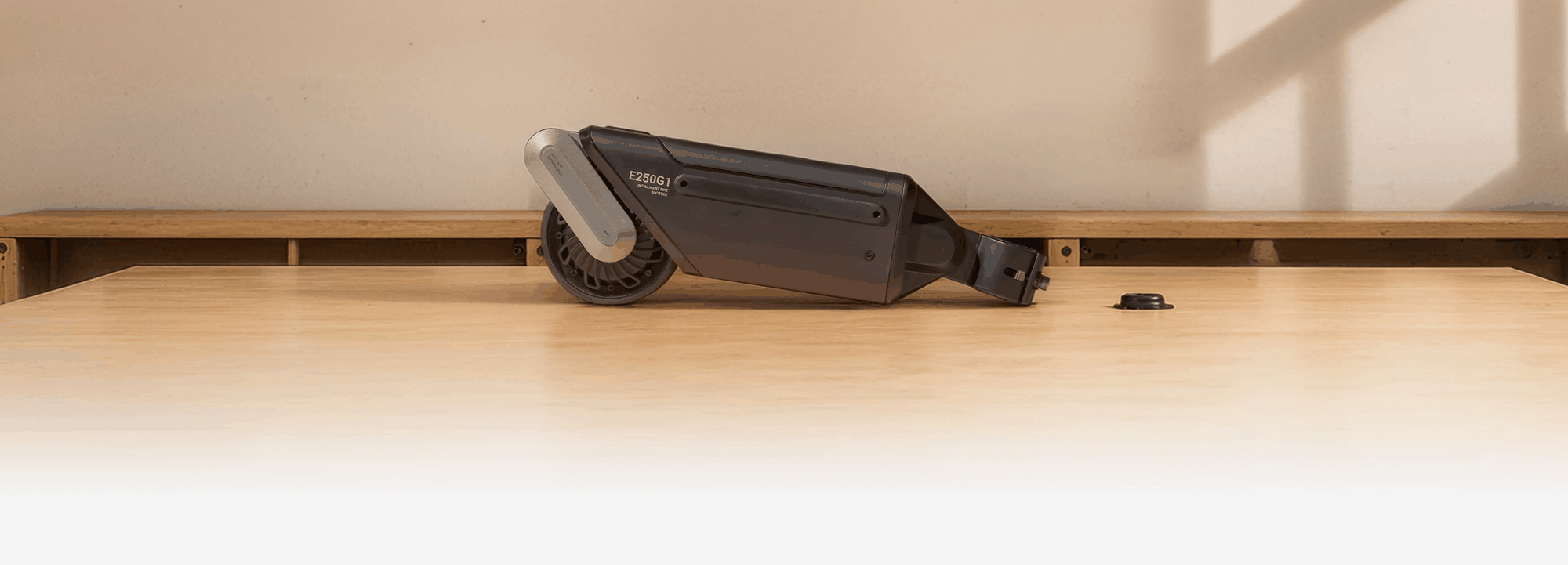 Figure: Oxiis E250G1 kit structure and drive roller. Source: ASUS Official Website
The $2,000 Price Tag and Premium Conversion Kit Dynamics
If friction drive represents a physical compromise in hardware design, the estimated $2,000 price tag pushes that compromise into an awkward commercial position. In today’s European and North American e-bike markets, $2,000 can purchase a fully equipped complete e-bike with a mature hub motor. Consumers typically expect conversion kits to offer high cost-effectiveness, but this pricing breaks the traditional money-saving logic.
Comparing the broader conversion market reveals distinct price-to-performance tradeoffs across different technical approaches. For instance, the competing Bimotal Elevate kit meshes directly with the rear brake rotor, completely resolving tire wear and wet-weather slipping. Although priced at a staggering $4,000, it provides a highly reliable engineering solution. By contrast, ASUS’s product sits in a middle price tier while retaining the mechanical shortcomings of a lower-end drive format.
ASUS’s $2,000 pricing narrows its target audience to a tiny niche: cycling enthusiasts who own high-end bikes worth thousands of dollars and refuse to replace the frame. For average commuters, spending $2,000 to attach a tire-wearing box to an old bike makes far less sense than purchasing a fully integrated and optimized complete e-bike.
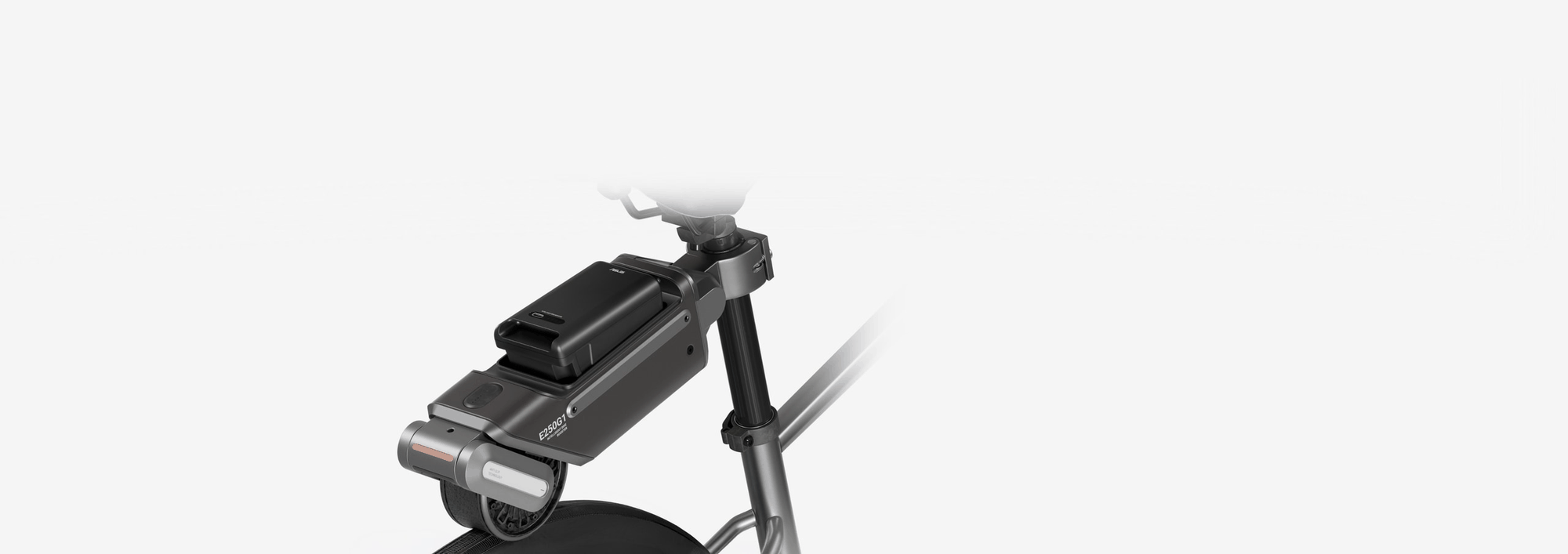 Figure: Battery and smart taillight installed on rear bicycle rack. Source: ASUS Official Website
Anti-Theft Needs and Regulatory Constraints in Urban Use Cases
Setting aside value-for-money limitations, the Oxiis E250G1 demonstrates unique engineering utility in specific urban scenarios. In major metropolises like New York and London, high-value e-bikes face extreme risks of street theft. The 3.7 kg quick-release design allows riders to lock a lower-value traditional frame outdoors while detaching the core electrical components—motor and battery—to carry inside a backpack.
This strategy of separating high-value electrical components from the bike frame offers an alternative security solution for city commuters. At the same time, the product positions itself precisely within legal compliance boundaries. In the European Union, regulations cap e-bike assist speeds at 25 km/h; exceeding this limit reclassifies the vehicle as a moped requiring licensing and insurance.
ASUS’s 250W rated power and 25 km/h software speed limit allow it to legally enter European bike lanes without additional vehicle certification. This highlights that the quick-release hardware design prioritizes legal compliance and anti-theft peace of mind rather than extreme power output.
Technical Compromises in the Conversion Kit Wave
ASUS’s debut at EUROBIKE 2026 signals the traditional IT hardware giant’s official entry into the bicycle accessory market. Moving away from the arms race of complete vehicle integration toward modular quick-release kits reflects an exploration of flexible mobility forms.
However, friction drive remains a technological solution heavily stamped by its historical origins. By trading tire longevity, transmission efficiency, and all-weather adaptability for high vehicle compatibility and extreme installation convenience, it highlights a fundamental rule of engineering: every convenience comes with energy and mechanical trade-offs.
The Oxiis E250G1 demonstrates ASUS’s manufacturing caliber in miniaturized power electronics and battery packaging. Yet faced with physical mechanics, the tug-of-war between conversion costs and user experience never ceases. When a $2,000 conversion cost yields wet-surface slippage and mechanical wear, friction drive kits remain a transitional option for niche requirements rather than the main evolutionary path for e-bikes.
Due to the author’s background and perspective, the assessment of friction drive performance above relies primarily on public materials and community rider feedback. Long-term wear data across varied road conditions awaits further hands-on verification.
Reference Links:
- ASUS Official Product Announcement
- Hacker News Community Discussion (item?id=49268580)
- EUROBIKE 2026 Exhibitor Technical Briefing