Breaking a 74-Year Defense: When a Vanished Epidemic Returned to the City
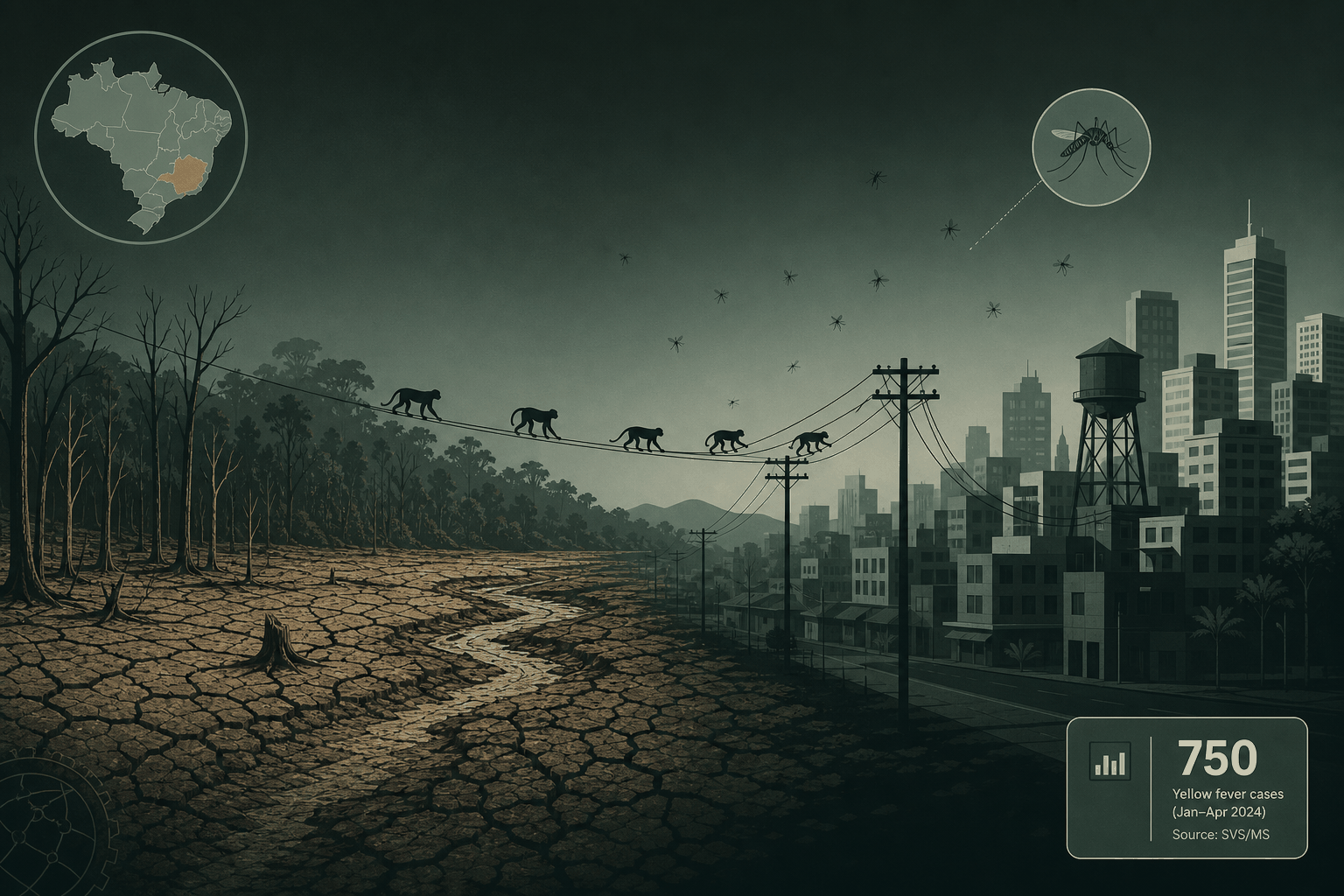
In late 2016, in the state of Minas Gerais, Brazil, months of unrelenting heat and drought cracked farm fields and emptied reservoirs. Residents hanging laundry on their balconies suddenly spotted groups of wild marmosets—small primates typically restricted to the canopy of tropical rainforests—appearing along power poles and water tanks near residential areas.
Soon after, local hospitals faced a sharp influx of feverish patients. Presenting with jaundice and unyielding high fever, these individuals were quickly diagnosed with Yellow Fever (an acute viral infectious disease caused by the yellow fever virus, leading to jaundice, organ failure, and death in severe cases). Since 1942, when Brazil cut urban transmission chains through mass vaccination and mosquito control, yellow fever had been absent from Brazilian cities for 74 full years.
The outbreak, which persisted from 2016 through 2019, ultimately infected over 2,000 people and killed nearly 750. Nearly 750 deaths—equivalent to the total loss of life from two fully loaded commercial airliner crashes—demonstrated that an urban safety net built over decades of vaccination and insecticides had been torn apart by an unexpected force.
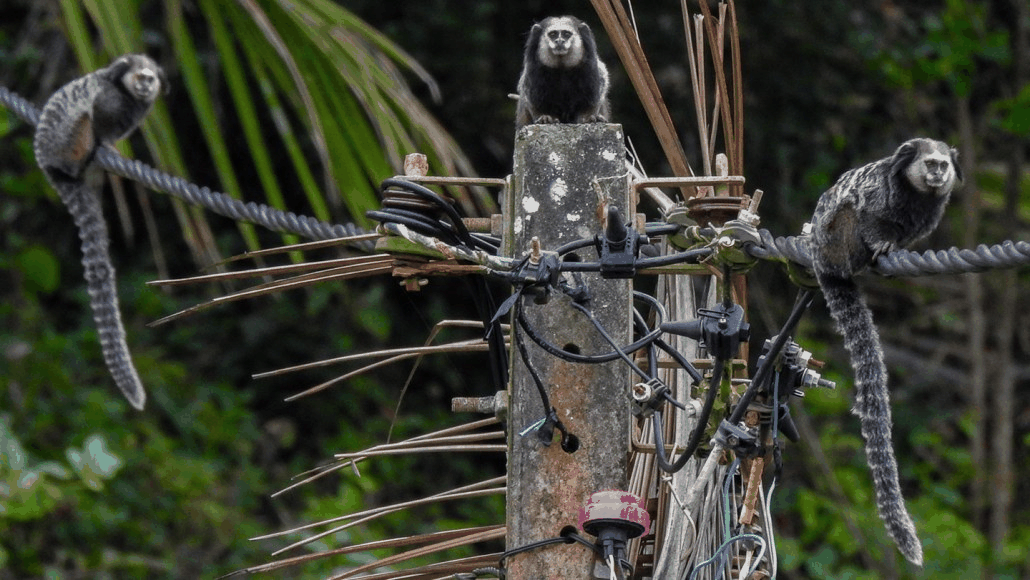 Figure: Wild marmosets on power lines in a Brazilian city, forced out of the forest in search of water. Source: Science News / Anaïd Cárdenas-Navarrete
A Once-in-a-Century Drought Alters the Routes of Beasts and Mosquitoes
Intuition suggests that hot, dry weather evaporates standing water, drying up mosquito breeding grounds and wiping out epidemics. However, a powerful El Niño in 2015 triggered an extreme drought across Central and South America that slightly exceeded a once-in-a-century severity event.
As deep-forest streams dried up and water in tree hollows completely evaporated, howler monkeys and marmosets living deep in the canopy were forced to migrate toward town edges in search of survival, seeking open tap water and outdoor water barrels in human residential zones. Accompanying these wild animals were Haemagogus mosquitoes—wild forest mosquitoes that primarily inhabit the forest canopy and feed on wild primates.
The severe lack of water did not halt mosquito activity. To prevent their own dehydration, Haemagogus mosquitoes drastically increased their biting frequency on both animals and humans, turning water scarcity directly into a driver for more aggressive viral vectors.
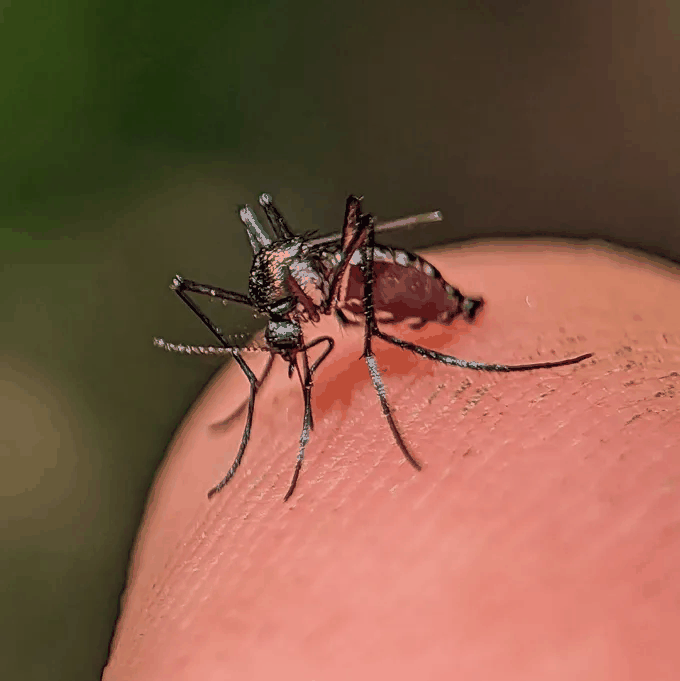 Figure: A Haemagogus forest mosquito on a fingertip. Drought spurred it to bite animals and humans more frequently. Source: Science News / Jean Martins, iNaturalist, CC BY-NC
Computer Models Unmask the Hidden Killer: The Primary Vector Was Not Aedes aegypti
Historically, the culprit behind urban yellow fever was Aedes aegypti (a mosquito species widely distributed around urban residences that breeds in artificial water containers and bites humans). Yet prior to this outbreak, Brazil had conducted extensive insecticide spraying to control the Zika virus, keeping urban Aedes aegypti populations at historic lows.
To solve this mystery, research teams led by Jamie Caldwell of Princeton University and Joelle Rosser of Stanford University published a study in Science Advances on August 14, 2026, constructing a computer simulation system that combined animal migration, climate data, and mosquito biting dynamics. The researchers fed different transmission hypotheses into the model and compared the outputs against actual infection data from Minas Gerais.
The simulations clearly demonstrated that the modeled epidemic curve matched real-world data only when incorporating both “monkey migration into cities” and “increased forest mosquito biting frequency.” Sick or dying wild monkeys acted as an early warning signal of viral spread, while Haemagogus forest mosquitoes followed the wild monkeys to town borders, seamlessly transmitting the yellow fever virus across species to humans.
A Spark Meets Tinder: The Compound Effect of Deforestation and Low Immunity
Evaluating these findings, Stanford researcher Joelle Rosser emphasized that while drought acted as the spark, the conditions for a wildfire were already in place. Decades of deforestation had brought urban borders and wildlife habitats directly against one another, eliminating natural buffer zones.
At the same time, because Brazil had experienced no urban yellow fever for nearly 70 years, residents in coastal cities far from the Amazon rain forest had lowered their guard, causing vaccination rates to drop significantly. When virus-carrying monkeys and thirsty forest mosquitoes arrived at the city gates, an unvaccinated population became highly explosive tinder.
This mechanism of drought accelerating disease transmission has precedents in other pathogens. For example, West Nile virus (a virus circulating primarily between birds and mosquitoes that occasionally infects humans via bites to cause encephalitis) spreads more readily during drought because limited water sources force infected birds and dense mosquito populations into cramped, shared spaces.
From Once-in-a-Century to Once-in-40-Years: Climate Rewriting the Epidemic Map
University of Florida researcher Sadie Ryan warned that as global climate change accelerates, extreme droughts previously considered once-in-a-century events could become a once-in-40-years reality. Disaster-level droughts that earlier generations experienced once in a lifetime could now occur multiple times during a person’s midlife years.
Traditional public health defenses have concentrated on mosquito eradication during rainy seasons, assuming that increased standing water presents the primary risk for mosquito breeding and viral transmission. Brazil’s major outbreak serves as a global wake-up call: extreme drought can also forge entirely new viral transmission pathways by altering ecological behavior.
Drought did not kill the virus; instead, it drove infectious disease straight into populated urban areas. As climate change continues to rewrite the boundaries between humanity and nature, re-evaluating animal behavior and disease surveillance during dry spells has become an unavoidable imperative for public health.
References:
- Science Advances Paper: Drought dynamics explain once in a century yellow fever virus outbreak in Brazil with implications for climate change
- Science News Report: How drought pushed Brazil’s monkeys and mosquitoes into cities and sparked yellow fever