Molecular Biology in the Movie Trailer
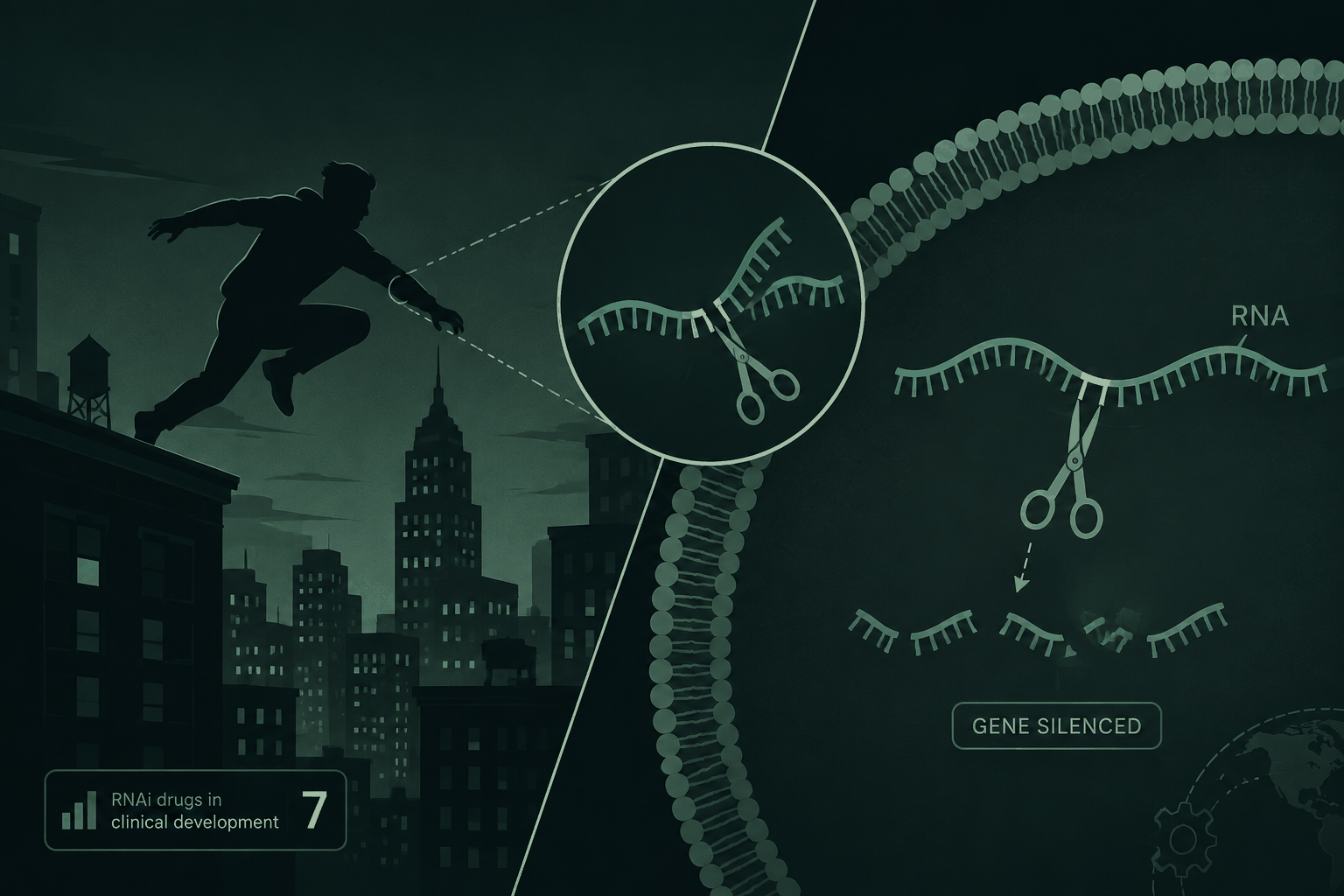
Audiences watching the trailer for Spider-Man: Brand New Day encountered an unexpectedly technical line of biology. The protagonist, Peter Parker, experiences a new genetic mutation triggered by a spider bite, causing uncontrollable new abilities to sprout. Seeking a remedy, he turns to Bruce Banner, who once created a suppressor device for the Hulk. Looking at the micro-injection device designed by Banner, Parker casually asks: “You’re using target-specific short interfering RNA, right?”
This jargon-filled dialogue is far from pure screenwriter fantasy. The chemical key used on screen to shut down superpowers has a clear, real-world engineering counterpart in modern medicine.
 Figure: Still from Spider-Man: Brand New Day. Source: Science News / Sony Pictures
The cinematic premise of disabling biological traits via chemical molecules aligns perfectly with the logic of contemporary gene therapy. In the real world, drugs based on small RNA fragments that suppress specific gene expression have already entered clinical practice.
Shredding the Genetic Messenger: How 21 Bases Halt Protein Production
To understand how Spider-Man’s superpowers can be switched off, one must return to the cell’s standard process for manufacturing proteins. DNA inside the nucleus holds the genetic blueprint. When synthesizing proteins, DNA first transcribes mRNA (messenger RNA, the molecular messenger cells use to convey protein synthesis instructions). Messenger RNA carries these instructions into the cytoplasm to the ribosomes, which read the blueprint and assemble proteins.
The siRNA (short interfering RNA, short fragments of RNA designed to enter cells and order disease-causing genes to stop production) mentioned in the dialogue serves as a highly efficient weapon to disrupt this assembly line. While mature messenger RNA typically spans hundreds or thousands of bases, siRNA is only 21 to 22 bases long. These 21 short bases act like a precision-cut key tailored to a specific lock.
Once injected from an exogenous source into a cell, siRNA binds to RISC (RNA-induced silencing complex, the cell’s internal molecular scissors complex that assembles and cleaves target RNA). With the help of RISC, the siRNA locks onto the target messenger RNA according to base-pairing rules and precisely shreds it.
Deprived of complete messenger RNA instructions, the cellular ribosomes can no longer synthesize the corresponding protein. This mechanism of using small RNA molecules to intercept and degrade messenger RNA is known as RNAi (RNA interference, a gene-silencing mechanism where cells utilize small RNA molecules to precisely degrade specific messenger RNAs). The target gene itself remains undamaged, but its protein production line is forcibly shut down.
From Lab to Clinic: 7 Gene-Silencing Drugs Already Approved
The technology used by Dr. Banner in the movie to suppress superpowers has undergone decades of rigorous pharmaceutical development in reality. In early research, short interfering RNA molecules were easily degraded by enzymes in human blood and struggled to cross cell membranes to reach target sites. Research teams, including immunologist Judy Lieberman at Boston Children’s Hospital and scientists at Alnylam Pharmaceuticals, subsequently solved these targeted delivery hurdles through chemical modifications and lipid nanoparticle encapsulation.
In 2018, the U.S. FDA (Food and Drug Administration) approved patisiran, the world’s first siRNA drug. Developed to treat hereditary transthyretin-mediated amyloidosis (hATTR), the drug significantly reduces toxic protein deposits in patients by cleaving abnormal transthyretin messenger RNA.
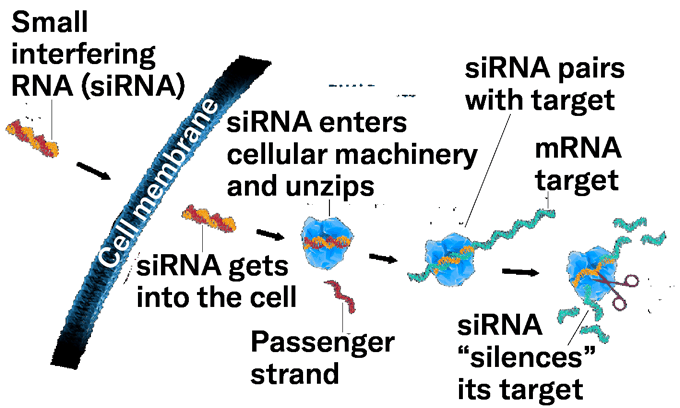 Figure: Diagram of the RNA interference (RNAi) mechanism. Source: Science News / Alnylam Pharmaceuticals
To date, at least seven siRNA gene-silencing drugs have been approved by the FDA worldwide, including givosiran, lumasiran, and inclisiran. Clinical data shows that certain chemically modified siRNA therapeutics require only a single subcutaneous injection every six months. Administering just two doses a year can continuously block the synthesis of disease-causing proteins for months at a time.
From treating rare diseases to targeting cardiovascular risk factors, RNA interference therapy has become a cornerstone of modern precision medicine. The custom injection Dr. Banner crafts for Spider-Man in the film operates on the exact same molecular mechanism as the medications administered to patients in hospitals today.
Real-World Bottlenecks in Tuning Superpowers: Why Reversal Isn’t Instant
Applying similar technology to complex physiological modifications like Spider-Man’s presents multiple technical bottlenecks in real life. Anastasia Khvorova, a chemical biologist at UMass Chan Medical School, notes that while suppressing mutant protein synthesis with siRNA is theoretically feasible, Spider-Man’s superpowers are likely governed by multiple synergistic genes.
To completely block these powers, researchers would need to design a cocktail formulation containing multiple siRNA molecules. Because genes rarely work in isolation in the human body, forcibly shutting down a specific set of signaling pathways could inadvertently disrupt normal physiological and metabolic functions.
Recovery time presents another inescapable variable. Biomedical scientist Gane Ka-Shu Wong at the University of Alberta and Judy Lieberman point out that short interfering RNA drugs cannot completely eliminate every trace of a target protein; they can only reduce output to extremely low levels. When Spider-Man decides to stop treatment and restore his abilities, his cells require time to transcribe new messenger RNA and assemble fresh proteins. From stopping injections to fully recovering superpowers, the body typically needs hours or even days—it cannot be toggled instantly like a mechanical switch.
Furthermore, the vast majority of siRNA drugs approved to date rely on liver metabolic receptors for uptake, concentrating their effects within liver tissue. Delivering short interfering RNA with high precision to organs throughout the entire body—such as muscle, nerve, or skin tissue—remains one of the central hurdles in modern gene delivery.
From the Silver Screen to Real-World Medicine: Where Sci-Fi Meets Genetics
The plotline has sparked widespread discussion precisely because it aligns with the real trajectory of life sciences. Spider-Man seeking Dr. Banner to solve his genetic predicament is, at its core, an experiment in gene expression regulation based on RNA interference.
A 21-base short interfering RNA can precisely recognize and shred messenger RNA, halting specific protein production at its source. The injectable therapies saving rare-disease patients in hospital clinics and the fictional micro-device shutting down superpowers on screen share the exact same principles of molecular genetics.
Sci-fi screenwriters drew their resolution directly from cutting-edge technologies already in clinical use. In an era where life sciences are rapidly iterating, cinematic superpower inhibitors and real-world precision gene therapies have established a clear, undeniable logical bond.
Reference Links:
- Science News Coverage
- Alnylam Pharmaceuticals Official Technical Documentation
- FDA Drug Approval Records