
The exact same screenshot of an ad disguised as an iOS system dialog was submitted for human review and cleared twice as “not going against Google’s policies.” Yet when fed into Google’s own multimodal model, Gemini, the creative was slapped with an immediate “DISAPPROVED” classification in seconds, accompanied by three distinct policy violation citations. Two evaluation mechanisms under the very same corporate roof delivered completely contradictory verdicts.
Two Appeals Fail Against a Single Screenshot
On September 13, 2026, developer Chris Greening twice reported a deceptive scam ad mimicking an iOS system alert on YouTube to Google. In both instances, Google returned official notifications stating the material complied with all guidelines. But when he fed the identical screenshot into Google’s own large language model, Gemini, the result was starkly different. Within seconds, the system generated a comprehensive, precise indictment of the creative. The showdown between human review and frontier AI lays bare the deep irony embedded in modern platform governance.
The creative Chris encountered inside the YouTube mobile app was a textbook example of deep UI impersonation. Prominently displayed across the ad was the warning “iPhone Storage is Full,” accompanied by a threatening subtitle cautioning that failure to free up space immediately would cause device features to malfunction. Below sat two standard iOS-styled buttons labeled “Yes” and “No.” Having recently dealt with low storage warnings on his own iPhone, a momentary lapse in concentration led Chris to tap the ad. It was an exceptionally precise context hijacking, demonstrating how effectively scammers exploit user psychology and device states.
Realizing he had been baited, Chris promptly submitted a formal report through standard channels. Google quickly returned its initial review determination: “We found that the ad doesn’t go against Google’s policies, which prohibit certain content and practices that we believe to be harmful to users and the overall online ecosystem.” This canned boilerplate rejected the user’s judgment outright. Chris switched accounts and asked acquaintances to submit duplicate reports. The second response arrived verbatim.
The specific reasoning behind both rejections remains opaque. With hundreds of millions of ad creatives flowing through the network daily, human reviewers cannot realistically inspect every asset in depth—an explanation Chris noted in his write-up and found plausible. Sophisticated disguises easily slip past fatigued eyes under rubber-stamp review quotas. This rigid workflow reveals how traditional defenses collapse when confronted with industrialized scam networks. Scammers manipulating operating system UI to harvest clicks routinely bypass manual review pipelines.
 Figure: YouTube ad disguised as an iPhone storage alert. Source: atomic14
Gemini Flags It in Seconds, Human Review Approves It Twice
Stymied by the manual appeals process, Chris ran a straightforward experiment: he uploaded the screenshot featuring the counterfeit iOS buttons directly to Gemini and instructed the model to evaluate the asset against advertising guidelines. The response was immediate and unequivocal: “Classification: DISAPPROVED.” At that moment, multimodal AI demonstrated overwhelming superiority in perceptual verification.
Gemini did not merely return a binary flag; it articulated three comprehensive grounds for disqualification:
- Misleading Ad Design: The model noted that the creative explicitly mimics an operating system dialog modal (“iPhone Storage is Full”) using standard iOS typography and container styling.
- Non-Functional / Deceptive UI Components: The “Yes” and “No” buttons were identified as static visual click-traps designed to redirect users to a landing page rather than performing any legitimate system control.
- Deceptive Fear-Based Tactics & Unverified Claims: Gemini flagged the copy “If you don’t free up space soon, some features may not work properly,” defining it as fabricated panic intended to coerce app installations.
Multimodal models excel at decomposing UI elements and intent far beyond what outsourced review assembly lines can manage. Gemini even provided actionable enforcement recommendations: immediately disapprove the creative, flag the advertiser’s account for Misrepresentation, and initiate a suspension workflow for repeat infractions. A textbook compliance audit was generated in seconds at zero marginal cost. Yet Google’s human review apparatus had brushed aside these blatant fraudulent signals twice.
Chris summarized the absurdity on his blog: “Google’s own model rejects the ad in seconds, yet Google’s review process approved it twice.” He closed with a blunt plea: “Come on, meatbags - use some of the amazing AI tools you have access to.” On one side stands a tech titan fielding world-class AI models; on the other, regular users besieged by predatory ads. Between them lies an immense governance chasm, sustained by commercial interests that tolerate obvious abuse.
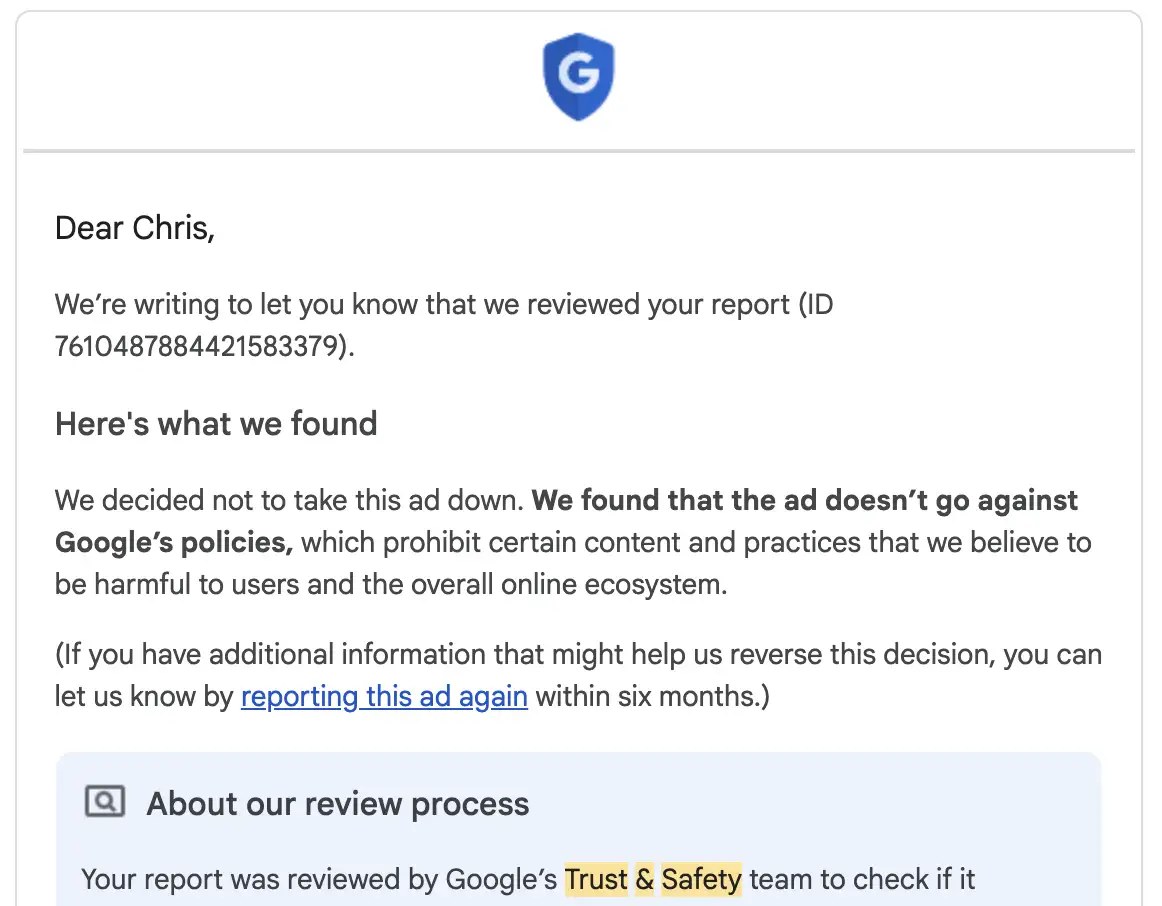 Figure: Google review response stating the ad “doesn’t go against policies.” Source: atomic14
Stupidity or Malice: Who Is Blocking the Ad Takedown?
Confronted with these contradictory outcomes, Chris offered a charitable interpretation rooted in Hanlon’s razor: “Never attribute to malice that which is adequately explained by stupidity.” Under this framework, review headcount simply cannot keep pace with the influx of advertising submissions. Outsourced teams adhere to mechanical checklists, and individual reviewers under crushing quotas lack the time to verify subtle iOS styling details.
As platform scale expands, organizational entropy inevitably ossifies operational procedures. Millions of creative assets enter the queue every single day. Auditing all of them with highly qualified human analysts would impose unsustainable operational costs. The resulting compromise is a porous perimeter defended by nominal review protocols. Framing systemic dereliction as mere operational incompetence is a familiar form of engineer resignation.
Yet attributing back-to-back clearances solely to bureaucratic inertia feels incomplete. When an in-house multimodal model can expose the deception in seconds, the technical bottleneck has ceased to exist. The model runs on production clusters, the APIs are established, and the policy heuristics are fully mapped. Technical limitations are not what prevent Google from modernizing its ad shield.
The persistent refusal to integrate advanced AI verification into core advertising pipelines points to institutional resistance elsewhere. Engineering teams can roll out automated classifiers with ease, but monetization units often represent the steepest barrier to deployment. On this balance sheet, user safety collides directly with ad inventory yield. Any operational change that meaningfully raises the bar for ad acceptance risks evaporating substantial volumes of monetizable ad impressions.
Monetization Anxiety Through the Eyes of a $100M Advertiser
A vibrant discussion on Hacker News (item?id=49686445) shed light on the economic realities operating beneath the surface. Webmasters and digital advertisers weighed in with perspectives far colder than Hanlon’s razor, analyzing the fractured defense from the standpoint of paid traffic acquisition.
One participating webmaster recounted how Google AdSense had funneled thousands of scam popups onto his website for months. These ads routinely featured high-pressure alerts claiming users had committed violations and demanding immediate $100 fines. The traffic originated from free cloud subdomains on platforms like azurestaticapps.net, netlify.app, and herokuapp.com. Threat actors systematically abuse trusted cloud infrastructure to bypass initial reputation filters, rotating subdomains daily while Google treats these hosting providers as top-level domains, blocking site owners from banning them wholesale. Every click flowing through this pipeline registers as billable network revenue.
Another candid perspective came from an advertiser claiming to have spent over $100 million on Google Ads. He described Google as aggressively squeezing ad revenue through unprecedented measures, driven by two compounding pressures: compensating for commercial anxieties in the ongoing AI race, and funding capital expenditure bills for infrastructure and compute clusters. While anecdotal, these community observations present a coherent economic calculus: massive data center expansions demand unrelenting top-line cash flow.
If these accounts hold weight, relaxed enforcement standards find an immediate financial explanation: every scam ad generates lucrative cost-per-click revenue, whereas aggressive filtering damages quarterly ad numbers. While this remains community conjecture—public records confirm only that the model rejected the creative in seconds while human review cleared it twice—the economic incentives are difficult to ignore.
Who Enforces the Criteria Dictates the Defense
Chris Greening’s experience serves as a trenchant technical metaphor. From an engineering standpoint, multimodal AI can already dissect UI spoofing, parse deceptive copy, and map infractions directly to advertising policies. Capability is no longer the bottleneck in trust and safety. The real obstacle is the platform’s commercial willingness to purge toxic inventory. As long as that willingness is absent, state-of-the-art models will remain sidelined from core enforcement pipelines.
In the institutional tug-of-war over whether ad inventory stays live, executive priorities outweigh algorithmic capability. If enforcement systems are designed primarily to provide liability shields during public relations crises, automated tools will be relegated to advisory roles. Technical sophistication cannot bridge a deficit in organizational intent. Advanced models simply become high-tech camouflage for outdated business incentives.
The ultimate authority governing enforcement criteria determines whether AI moderation serves as a genuine consumer safeguard or an alibi for revenue protection. So long as advertising revenue must bankroll staggering AI research and compute invoices, fraudulent UI modals will continue to slip through. They will remain live across apps, waiting for the next distracted user to tap. In this cat-and-mouse game, the entity controlling the trap is the exact same one handing out the cheese.
Reference Links: