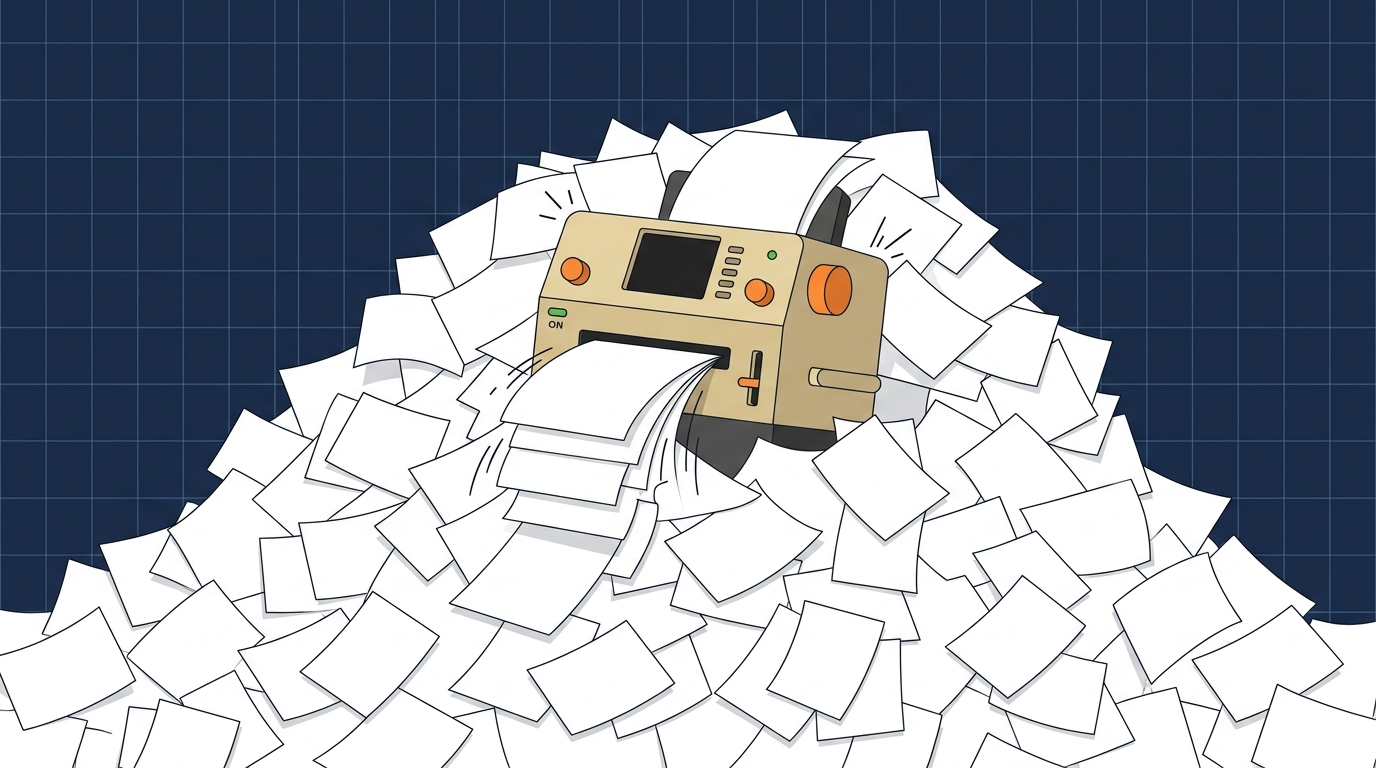
One day in September 2026, a project called OpenJev shot to the top of Hacker News, racking up 521 points and 235 comments. By conventional metrics, this should have been a triumphant product launch. But opening the thread revealed a strange spectacle: not one of the top ten comments engaged with the product’s actual functionality—everyone was eviscerating its landing page.
521 Points and 235 Comments—All Spent Roasting the Webpage
The top comment pulled no punches: “AI-generated sites are always a visual disaster: endless slop copy, ubiquitous buzzwords, zero regard for usability.” The second comment drew an analogy from academia: modern AI output reads like a term paper from an anxious student—instead of editing ruthlessly for clarity and focus, it does the exact opposite, stuffing in every conceivable detail under the assumption that the reader has no choice but to wade through it.
The jarring mismatch between the score and the discussion was the real story. 521 points proved the post had traffic, yet the community collectively bypassed the product itself, aiming all fire at the fact that it “looked like it was generated by AI.” Commenters brought up classic, no-nonsense web design for comparison—Berkshire Hathaway, McMaster-Carr, Craigslist. McMaster-Carr’s print catalog is practically a textbook on taxonomy, and they ported that utilitarian philosophy directly onto the web without decorative fluff. A few voices defended OpenJev: if you build a bare-bones minimalist landing page, people complain that they read the whole thing and still have no idea what it actually does.
Yet the debate quickly transcended the merits of a single landing page. Lurking beneath that 521-point thread was the real dilemma: now that AI has made the production of outward form virtually free, what is “looking like a product” actually worth?
When the Cost of Form Drops to Zero, the Signal Fails
A polished webpage, well-structured documentation, an elegant executive summary—historically, these artifacts served as a reliable signal: someone had invested real effort and thought. The cost of production was the collateral backing the strength of that signal. When AI compressed the marginal cost of producing polish down to near zero, that collateral vanished. A glossy presentation no longer separates serious craftsmanship from careless generation; it has degenerated into cognitive noise.
On that same day, several other threads converged across technical communities toward the exact same conclusion. McSweeney’s Internet Tendency ran a satire titled “We Must Create the Shit Machine,” which collected 89 points on Lobsters. Mimicking the keynote cadence of big-tech product reveals, it framed building “a machine that produces shit” as an urgent, inevitable human necessity—packaged with an umbrella that only blocks part of the splatter, and a terms-of-service agreement disclaiming all liability for the consequences. The top comment on Lobsters was a one-liner: “What do you mean ‘must’? We already built it.” The second comment was even more concise: “The shit machine could never write this.”
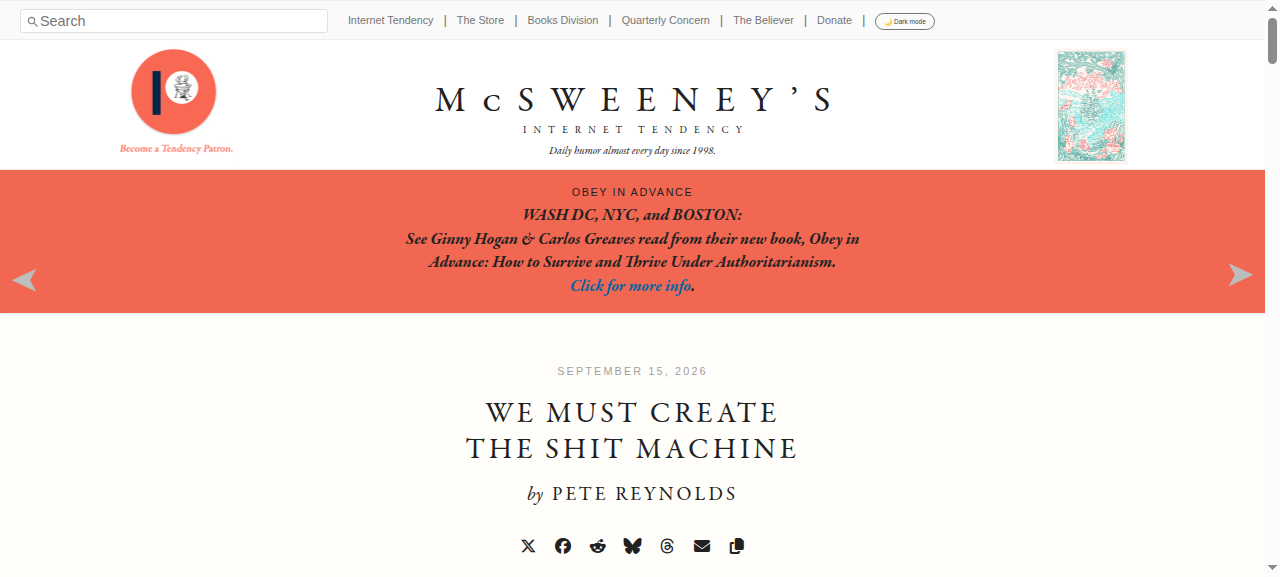 Figure: McSweeney’s satirical piece. Source: McSweeney’s Internet Tendency
The satire resonated because it hit the community’s collective nerve: developers do not lack an understanding of what AI can generate; what they crave is a release valve to finally shout, “enough.”
A 350-Point Writing Guide’s First Rule: Never Use Words the Model Gives You
Another post made waves the very same day, pulling in 350 points and 238 comments: an essay titled “How to Write with an LLM” by a seasoned systems engineer on sockpuppet.org. His thesis was razor-sharp: “Readers can detect LLM-generated words with parts-per-trillion precision. No matter how much you polish or humanize it, to most readers, LLM-generated text doesn’t count as writing—it counts as output.”
The author laid down two uncompromising rules. First: never use a single word the LLM suggests to you, even if it seems better than your own. Second: avoid model sycophancy and praise—its compliments tempt you to double down on raw first-draft impulses, precisely when you should be rewriting, rethinking, and gutting whole paragraphs. The author emphasized that these rethinks are the truly “load-bearing” elements of personal style. His approach: write the entire draft yourself first, and only then deploy the model as a strict copy editor—asking it to spot logical gaps or typos, but never letting it dictate vocabulary or phrasing.
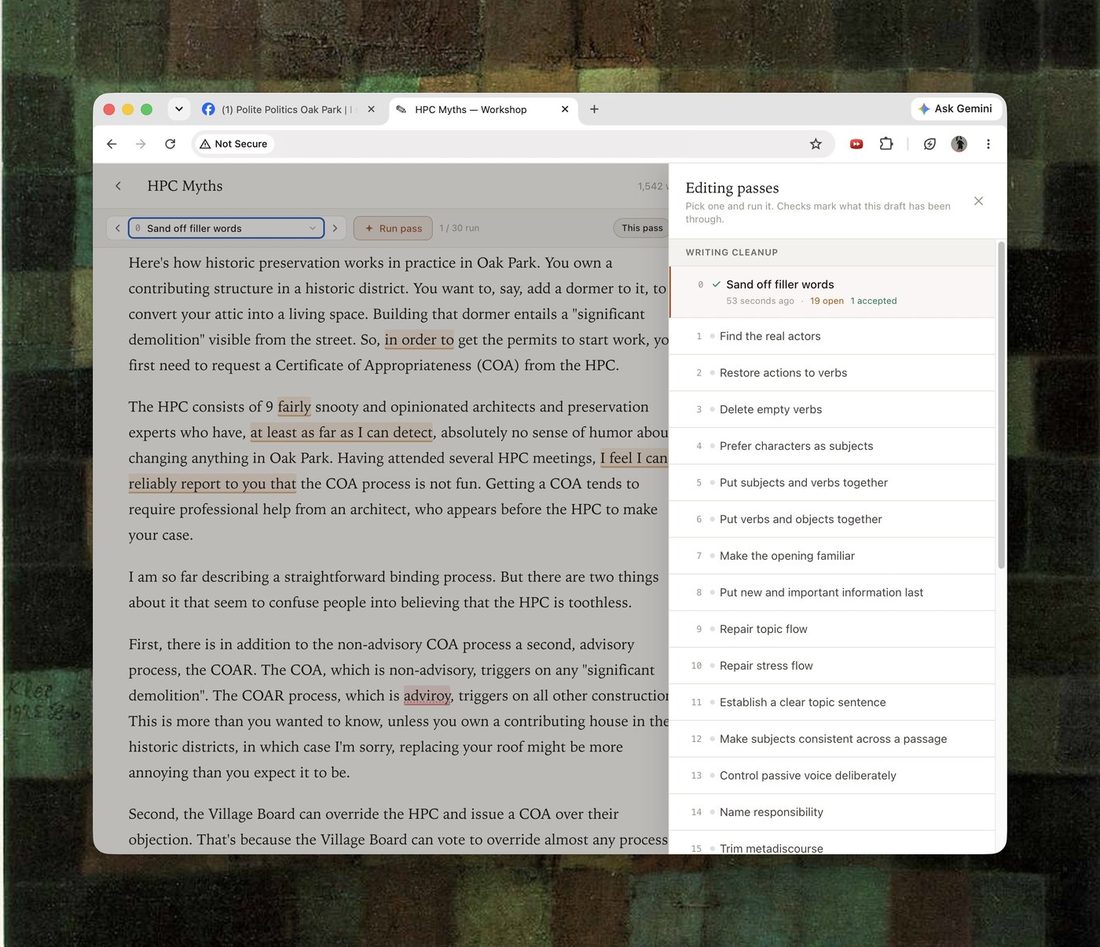 Figure: Custom interface built by the author to manage verbatim copyediting workflows. Source: sockpuppet.org
The ensuing discussion took this methodology into pragmatic territory. Some noted that looping an LLM back into drafting becomes a massive time sink: “You edit until you trigger a Ship of Theseus paradox, and you would have been better off just writing it yourself.” Others pointed out that providing a concrete style sample is far more effective than vague prompts like “make it concise and professional,” followed by asking sentence-by-sentence, “can this sentence be cut?” The most trenchant comment exposed the underlying absurdity: readers are increasingly using AI agents to digest what you write, so you might as well adopt that analytical lens to scrutinize your own prose before publishing.
This dynamic reveals a symmetric dilemma: writers are using AI to generate text, while readers are using AI to summarize it. Both sides are outsourcing their cognitive labor to the machine, yet the cost of verification has not been absorbed by the model—it has merely been displaced.
Sucking Out the Joy: 75% of the Workday Spent Dealing with AI
A veteran security engineer echoed this exhaustion in a blog post titled “Everybody’s Lost Their Minds,” which soared to the top of Lobsters with 191 points and 63 comments. In his words, more than 75% of his working day is now consumed directly or indirectly by AI-related issues, “sucking out most of the joy of my job.” He observed that internal emails from colleagues increasingly resemble the breathless prose of LinkedIn influencers, complete with single-sentence paragraph breaks.
He highlighted an even deeper structural problem: frontier AI labs are rushing out endless security research “initiatives” and open letters, redirecting dozens of top-tier security engineers exclusively toward hunting AI vulnerabilities—burning through tens of millions of dollars in engineering hours. Yet in cybersecurity, finding bugs was never the bottleneck; fixing, verifying, and deploying patches is. A stark mismatch has emerged between where massive resources are being funneled and where real-world operational bottlenecks actually lie.
A top-rated comment on Lobsters dissected an emerging cultural rift: anti-AI sentiment coalesced rapidly on Lobsters (whose user base skews toward experienced systems engineers), while Hacker News leaned in the opposite direction. A follow-up comment explained the underlying mechanics: Lobsters aggressively moderates off-topic noise and promotional fluff, whereas Hacker News acts as an institutional bulletin board where Y Combinator startups enjoy preferential visibility. The two platforms operate under fundamentally different filtering incentives.
Hallucinated Intel and Vibe Proofs: Redefining What Counts as True
On that very day on Hacker News, a report revealed that the U.S. military had narrowly avoided a critical operational incident triggered by an AI-generated, hallucinated intelligence report (earning 342 points and 275 comments—the most commented thread of the day). Meanwhile, Dan Abramov’s post “I proved Conway’s conjecture with vibe” (197 points, 174 comments) explored the flip side of the same coin: the epistemic validity of a mathematical proof relies entirely on human verifiability; if the verification step is itself offloaded to a model, the very definition of “proof” begins to dissolve.
These disparate episodes converge on a single underlying architecture: AI has collapsed the cost of production, but the cost of verification remains entirely unchanged. Generating an intelligence memo now costs next to nothing, but verifying that it isn’t an hallucinated fantasy takes just as much human expertise as before. A mathematical proof can be synthesized in seconds, but auditing every step for logical rigor still demands precious hours from human mathematicians. A slick landing page can be assembled in minutes, but determining whether there is real substance beneath the veneer still forces readers to expend their own attention.
Efficiency gains on the producer side have simply translated into a crushing audit burden on the consumer side. Who pays the bill for verification remains an open question. Some argue this is the next technical hurdle for AI tooling to solve; others—as Dan Luu put it in another trending post that day—remind us that “there is no point at which you can turn off your brain.”
The collective backlash sweeping through technical circles in September 2026 is not merely a generic “AI is harmful” reaction. It reflects a much colder reality: now that form has been thoroughly devalued, human attention is being fundamentally repriced based on “who built it, and who stands behind it.”
References:
- Hacker News Discussion (OpenJev)
- sockpuppet.org: “How to Write with an LLM”
- McSweeney’s Internet Tendency: “We Must Create the Shit Machine”
- netmeister.org: “Everybody’s Lost Their Minds”
- Lobsters Discussion
- danluu blog
- Dan Abramov: “I Proved Conway’s Conjecture with Vibe”


