Open the compass app on a smartphone, and the needle reliably points north. We rarely pause to consider that Earth is enveloped in an invisible magnetic shield—deflecting high-energy cosmic rays and preserving the stability of our atmosphere. Beyond the solar system float thousands of exoplanets. Do they too possess magnetic protective shields? Astronomers have pursued this fundamental question for decades.
Faint Signals Across 63 Light-Years: Catching a Planetary Magnetic Fingerprint
On September 15, 2026, a research team led by Dr. Yvette Cendes submitted their findings to the preprint server arXiv (paper 2609.16720), followed by coverage in Science News on September 22. The target was the young star system Beta Pictoris, located 63 light-years away. At that distance—roughly 600 trillion kilometers, or nearly four million times the distance from Earth to the Sun—even the fastest human spacecraft would take hundreds of thousands of years to arrive.
Using the 64-dish MeerKAT radio telescope array in South Africa, researchers detected faint radio bursts. Crucially, the signal exhibited circular polarization, where the orientation of the electromagnetic waves rotates in a circle. In radio astronomy, circularly polarized emission is the distinct signature of auroral activity driven by charged particles interacting with a strong magnetic field. For the first time, humanity had directly captured the magnetic signature of a world orbiting another star.
Cutting Through Stellar Noise: Pinpointing the Signal to Beta Pictoris b
Prior searches for exoplanet radio waves had repeatedly hit a wall. The core obstacle was the host star itself, which blasts out overwhelming radio noise—akin to trying to detect the faint buzz of a firefly amidst a raging thunderstorm miles away. Separating a planet’s delicate signal from stellar bombardment proved notoriously difficult.
The breakthrough came from Dr. Yvette Cendes and her colleagues at the University of Oregon. Utilizing the high angular resolution and sensitivity of MeerKAT, the team cleanly isolated and astrometrically localized the radio waves directly to the giant planet Beta Pictoris b, completely ruling out stellar interference. As Cendes emphasized: “We can rule out the star, and … we can say that it’s from this one particular planet.”
Beta Pictoris b is a massive gas giant with roughly 10 times the mass of Jupiter. While Jupiter could swallow 1,300 Earths, Beta Pictoris b packs the equivalent of some 13,000 Earth masses. Having formed just 23 million years ago, it is a cosmic toddler compared to our 4.6-billion-year-old Sun.
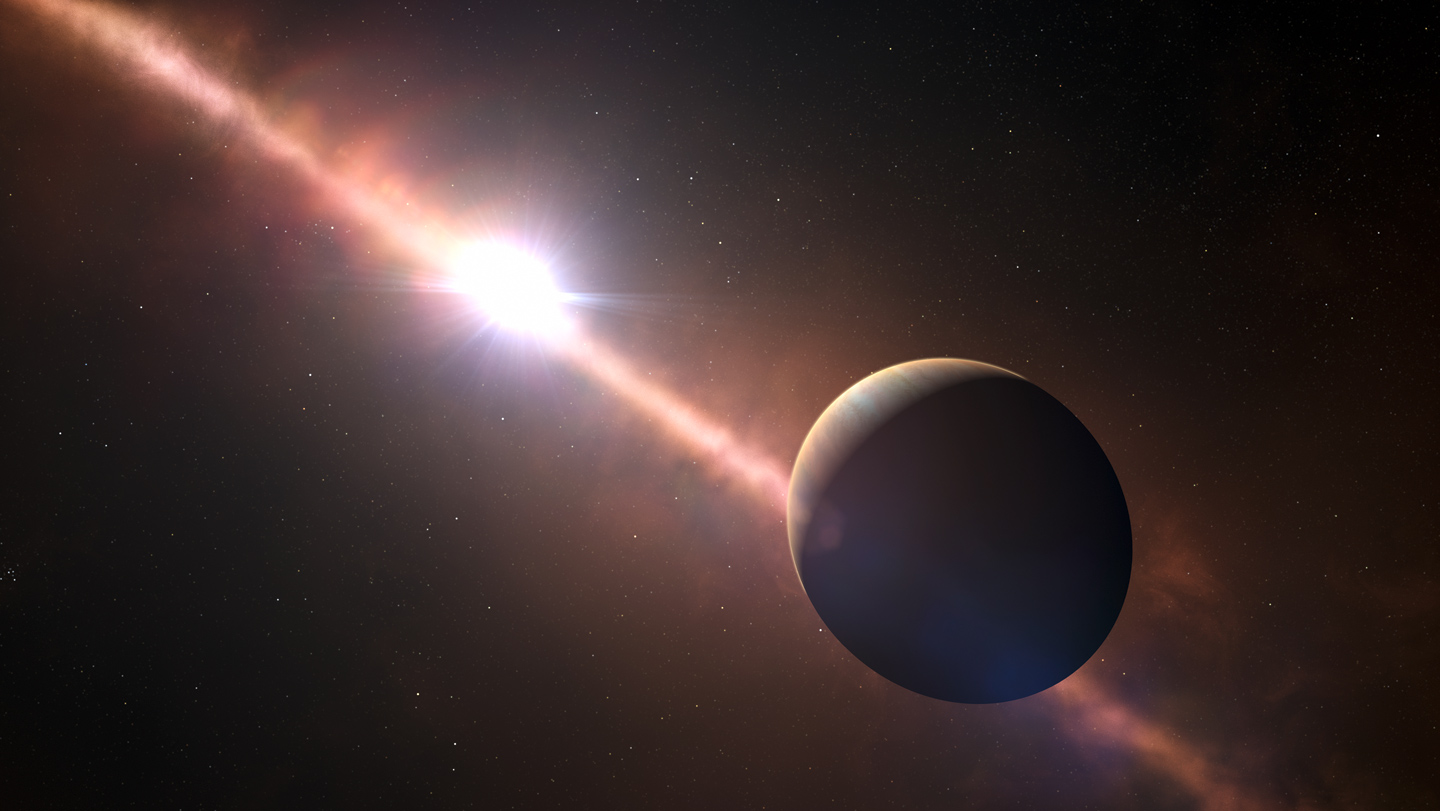 Image: Artist’s impression of the young giant planet Beta Pictoris b in front of its bright host star. Source: Science News
Over 2,000 Times Earth’s Field: Aurora Emissions Reveal an Enormous Dynamo
Detecting these radio waves not only confirms the existence of a magnetic field, but also reveals its astonishing intensity. Earth’s surface magnetic field averages about 0.5 gauss, while a typical refrigerator magnet measures a few tens of gauss. In our solar system, Jupiter reigns supreme with a surface field of about 4.3 gauss. By analyzing the radio emission frequency, astronomers determined that Beta Pictoris b boasts a magnetic field exceeding 1,000 gauss.
“It’s an incredibly, incredibly strong magnetic field, much stronger than anything in our solar system,” Cendes noted. When energetic charged particles are trapped by such an intense field, they spiral along magnetic field lines at relativistic velocities, releasing coherent radio waves through electron cyclotron maser instability.
This phenomenon has a familiar parallel closer to home. At the poles of Jupiter, Saturn, and Earth, charged particles stream down into the upper atmosphere, igniting vibrant auroras accompanied by radio emissions. What MeerKAT heard across 63 light-years was precisely this exoplanetary auroral song, heralding an immense magnetic dynamo.
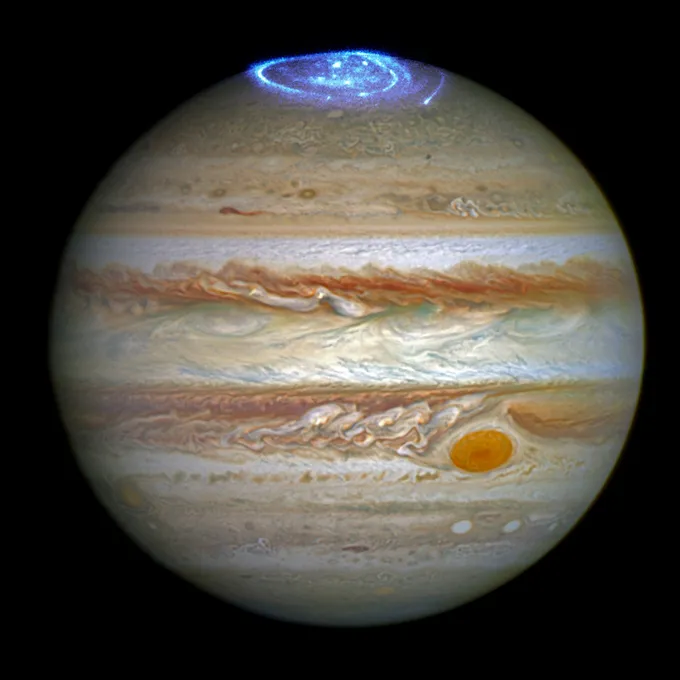 Image: Ultraviolet composite showing brilliant blue auroras circling Jupiter’s northern pole. Source: NASA, ESA, and J. Nichols / University of Leicester
Awaiting Peer Review and Rotation Pulses: The 8-Hour Verification Test
The discovery sparked immediate excitement across the astronomical community. “This result, if it holds up in peer review, is an incredibly exciting advancement,” remarked astronomer Joe Callingham of the University of Amsterdam, who was not involved in the research. “It would be a fantastic result.”
Callingham highlighted the definitive verification test that lies ahead. To conclusively seal the auroral interpretation, astronomers will watch for periodic pulses as the planet rotates. Beta Pictoris b has an estimated rotation period of approximately eight hours. Detecting radio bursts synchronized to an 8-hour cycle would prove that the auroral hotspot is swinging in and out of view. While that periodic modulation remains to be confirmed, Callingham noted: “So TBD, but, compelling. It’s probably auroral.”
From Gas Giants to Rocky Worlds: Magnetic Shields and the Search for Habitability
Capturing radio waves from a gas giant marks a watershed moment for deep-space astronomy. Massive gas giants serve as the ultimate proving ground for observation techniques. The next frontier is detecting the magnetic shields of terrestrial, Earth-sized worlds. Exoplanets like Proxima Centauri b, situated just four light-years from our Sun, sit in stellar habitable zones where the presence of a protective magnetic field dictates whether an atmosphere—and life—can survive severe stellar winds.
The first capture of exoplanet radio waves grants humanity a direct glimpse into the invisible magnetic machinery of other solar systems. Auroral radio waves serve as an indelible fingerprint, proving that Beta Pictoris b is shielded by a field thousands of times more potent than Earth’s. Sixty-three light-years away, this cosmic broadcast reminds us that magnetic shields are not unique to our celestial neighborhood: throughout the vastness of space, unseen fields are silently guarding distant worlds.
References:
- Science News Report
- arXiv Preprint Paper (2609.16720)