New iPhones Stuck on the Activation Screen
On the morning of November 17, 2026, countless users unboxing new iPhones ran straight into the same roadblock: Unable to Activate. The hardware was fine; the bottleneck sat squarely on Apple’s end. Throughout the day, the disruption rippled across iPhone, iPad, Mac, Apple Watch, and Apple TV. Even physical Apple Store retail locations were unable to process purchases or accept returns.
Apple’s system status dashboard—effectively an online health check where healthy services display green dots and degraded systems are flagged—initially listed six outages: App Store, Apple Music, iCloud Account & Sign-In, AppleCare on Device, App Store Connect, and Xcode Cloud. Among these, iCloud Account & Sign-In proved catastrophic: buying apps requires sign-in, activating new hardware requires sign-in, and once this prerequisite gateway collapsed, downstream services tumbled like dominoes.
Beyond what the official page reflected, reports from users painted a much broader picture: Apple News, Apple Pay, Apple Card, Apple Support, Sign in with Apple, TestFlight, and others quickly surfaced, adding at least ten more names to the ledger. On Reddit’s r/Apple_Employees, internal staff noted that systems across retail stores and corporate offices were similarly down. Tallying them all together, the number of disrupted services comfortably exceeded twenty.
On the outage-tracking platform Downdetector, incident volumes for the App Store, iCloud, and Apple Support spiked simultaneously. Crowd-sourced reporting curves like these routinely jump ahead of corporate disclosures: long before the vendor delineates the blast radius, users have already cast their votes with their phones.
Apple Excludes Cyberattacks, Pointing to an Internal Update
Apple did not deflect blame onto malicious actors. In a straightforward statement provided to Bloomberg reporter Mark Gurman, the company stated: “An internal update this morning caused disruptions to some services, and most of our systems are now back up and running.” Crucially, Apple explicitly ruled out a cyberattack—a statement carrying significant weight, swiftly pulling the narrative away from reflexive speculation about high-profile hacks. Here, an “internal update” points to configuration tweaks or backend software rollouts across Apple’s own data center servers. It is fundamentally distinct from pushing an app update to consumer handsets—much more akin to rewiring a physical retail store right during business hours.
By 5:24 PM Eastern Time, US media reported that core consumer-facing services had largely recovered, with Apple pledging to restore remaining systems as swiftly as possible. For mainstream users, the incident wrapped up before dinner. Yet the real long tail lingered at the other end of the ecosystem: services serving developers recovered far more sluggishly.
How does a single internal update topple over twenty services? The answer lies buried in system architecture: modern hyperscale platforms share common foundational dependencies—authentication, identity management, and configuration distribution. The moment an update destabilizes a shared foundational dependency, the blast radius erupts from a single point into an entire platform-wide cascade.
In site reliability engineering, there is an enduring adage: the force that brings down production is almost always your own deployment pipeline. Adversaries are dangerous, but when an entire ecosystem goes offline simultaneously, attackers are rarely the headline act.
Two Separate Status Dashboards, Inconsistent System Boundaries
When a major incident strikes, anyone seeking to determine what is broken and what has returned must consult Apple’s own infrastructure. But Apple operates two separate status dashboards: one designed for developers, and one meant for general consumers. The two inventories fail to line up. For example, HomeKit—the smart-home layer that coordinates connected lights and smart door locks—appears only on the consumer dashboard. The homeowner troubleshooting a light switch that won’t respond and the developer troubleshooting a broken build pipeline must search across two distinct portals for fragmented answers.
The timeline introduces another telling disparity. By the morning of November 18 Beijing Time—the day after the initial disruption—the developer status dashboard still listed seven degraded services: Developer ID Notary Service (responsible for signing off on macOS binaries), three App Store Connect portals, Sales and Trends, Apple Music Connect, and Apple Music for Artists. Another two services on the same page were marked as resolved. Consumer-facing services had returned the prior evening, but developers were left holding the tail of the outage—reminding the industry that post-incident recovery bills are almost always settled first on the developer’s back.
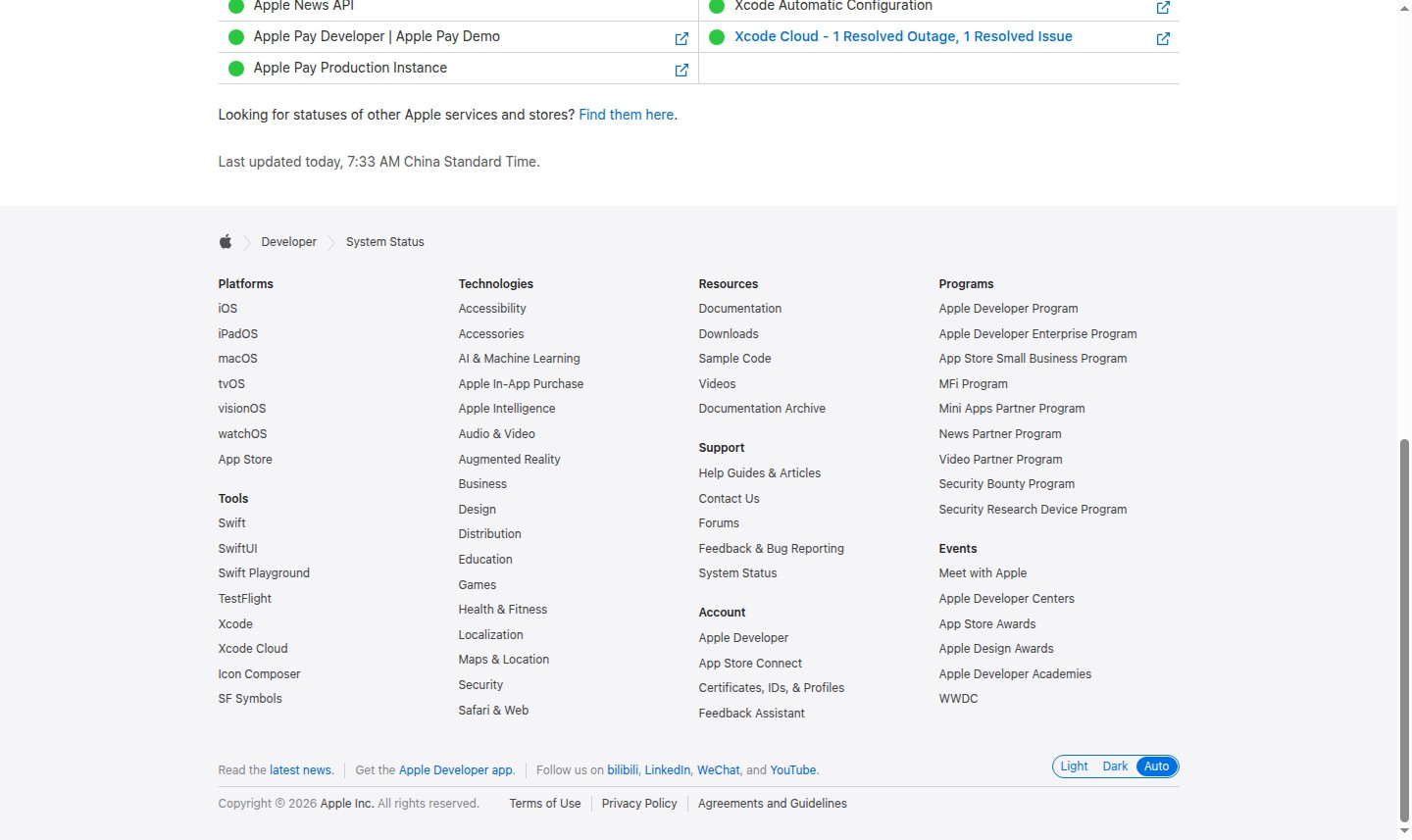 Image: Apple’s Developer System Status page still displaying multiple degraded services in the aftermath, separating active outages from resolved systems. Source: Official Apple System Status screenshot
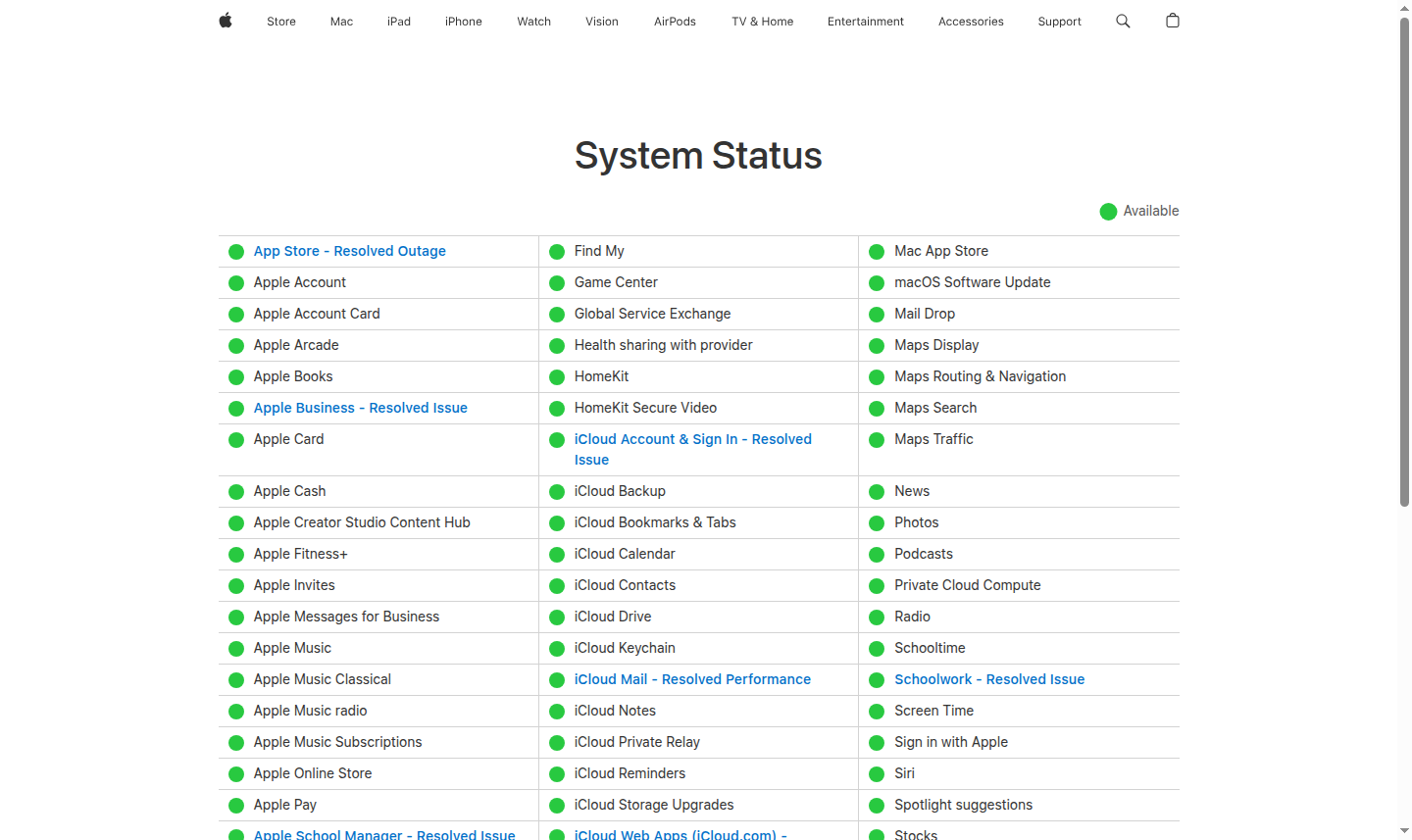 Image: The consumer-facing System Status dashboard. The inventories differ between versions; HomeKit appears exclusively on this page. Source: Official Apple System Status screenshot
The consumer board organizes services around mainstream user touchpoints, leaving both dashboards talking past one another. This misalignment highlights an even more fundamental truth: even internally, Apple appears to lack a unified operational definition of what constitutes a “system.” With two distinct audiences reading two divergent reports, neither group can assemble a coherent picture of the true operational boundary.
Only One Megaphone, and the Provider Holds It
The structural dynamic of this outage is emblematic of our computing era: once everyone concentrates their workloads onto a handful of mega-clouds—individuals and enterprises alike—the unilateral authority to explain failures defaults to the service provider. Personal photo libraries and memos live on iCloud; engineering build pipelines reside on Xcode Cloud. As centralization deepens, only a single party is positioned to speak for the infrastructure. End users possess no datacenter access, no access logs, and no secondary out-of-band monitoring channels; whatever narrative the provider publishes becomes the only truth available. The initial explanation came from Apple, and the definitive closing line ruling out a cyberattack also came from Apple. While Apple may be the only entity qualified to make that determination, the inevitable compromise is clear: from start to finish, the audience has only one voice to listen to.
To be fair, Apple’s operational handling ranks relatively well within the tech industry: primary consumer services were restored within hours, the company ruled out external attacks without equivocation, owned up to an internal update, and kept status boards continuously rolling. Many platforms in similar binds opt for stonewalling, offering little beyond a vague “some users may be experiencing issues.” But the structural distribution of communication remains unchanged. Telemetry services like Downdetector surge during every incident precisely because they serve as the sole independent control group—a grassroots counter operating outside the official narrative.
This outage involved no malicious adversaries—merely an internal update and two status pages that could not agree. Whoever controls the infrastructure controls the megaphone. This time, Apple handled the megaphone candidly and claimed responsibility with reasonable speed. In doing so, however, it laid bare a quieter reality: from start to finish, there is only ever one megaphone in the room.
Reference Links:
- Apple Developer System Status
- Apple System Status (Consumer)
- Bloomberg: Reporting by Mark Gurman
- Downdetector Incident Tracking Data
- r/Apple_Employees Community Discussion