
Carrying a 6-Gram Backpack from Britain to Arctic Tundra
Taking a long-haul commercial flight leaves most human passengers exhausted after dozen-hour journeys cramped in narrow seats. Crossing ten thousand kilometers takes modern jetliners tens of tons of aviation fuel. Yet on intertidal mudflats, a pigeon-sized shorebird makes virtually the same transoceanic crossing relying entirely on its own wings.
The bird is a bar-tailed godwit (Limosa lapponica), a long-billed, long-legged wader that feeds in coastal estuaries. In November 2026, an individual named Phil touched down back on the mudflats of The Wash along the eastern coast of England. Phil had just concluded an epic 11,000-kilometer round trip journey to and from central Siberia.
Before embarking, researchers from the Wash Wader Research Group fitted Phil with a miniature solar-powered satellite tag. The device weighs a mere 6 grams—about the weight of a £1 coin—representing only about 2% of the bird’s total body weight, akin to an athlete carrying an ultralight waist pouch. This tiny sensor provided scientists with their very first complete, high-resolution tracking record of an individual godwit overwintering in Britain.
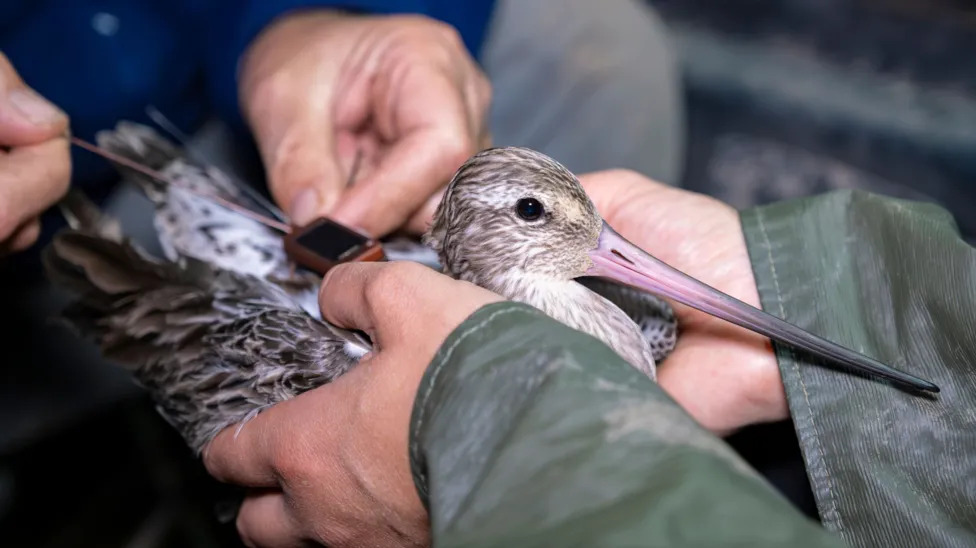 Photo: Researchers holding the tagged bar-tailed godwit. Source: BBC (Photo by Ben Andrew)
Binge-Eating in the Wadden Sea: Doubling Body Weight to Survive
Every January, battered by freezing winds over The Wash, Phil overwinters among tens of thousands of waterbirds. As temperatures begin rising in early March, the godwit crosses the North Sea and lands in the Wadden Sea—a massive expanse of tidal mudflats and coastal wetlands in northwestern Europe. This vast multinational coastline serves as the single most vital refueling hub along its entire flyway.
During a two-month stopover at the Wadden Sea, Phil had a single, all-consuming priority: feast voraciously. Probing its slender, gently upturned bill deep into the intertidal mud, it hunted ragworms and small bivalve mollusks. Before launching toward the Arctic, bar-tailed godwits nearly double their body weight, ballooning from around 200 grams to over 400 grams. For a 60-kilogram human adult, that would be the equivalent of skyrocketing to 120 kilograms within just eight weeks.
The thick fat reserves built up through this hyperphagia provide the sole fuel source for the journey to the Arctic. In late May, Phil departed the Wadden Sea, flying continuously toward the Taymyr Peninsula in north-central Siberia—a vast tundra wilderness jutting into the Arctic Ocean. There, perpetual midnight sun and seasonal explosions of insect larvae furnish protein-packed sustenance for rearing newly hatched chicks.
 Photo: A large flock of bar-tailed godwits foraging on mudflats in the Wadden Sea. Source: BBC (Photo: Getty Images)
Crossing Arctic Seas: Three Remote Norwegian Outposts as Stepping Stones
Once fledglings learn to fly, the harsh Arctic winter sets in rapidly. While ornithologists have long known that godwits return to Western Europe each autumn, the precise return route had remained a mystery. For decades, researchers relied almost entirely on metal leg bands. Ringing recoveries were exceedingly rare, dependent on chance encounters by coastal birdwatchers.
The tracking transmitter on Phil’s back unveiled a completely unexpected journey. Immediately after breeding, Phil flew straight over the frigid waters of the Arctic Ocean toward the northern coast of Norway. Out across that misty, icy expanse, Phil made pinpoint landings on three remote coastal islands. Following brief stopovers to feed and rest, the bird headed south, refueled briefly once more in the Wadden Sea, and landed safely back on the eastern coast of England in November.
The entire round-trip clocked in at roughly 6,800 miles (approximately 10,900 kilometers). By comparison, a nonstop flight between London and Los Angeles covers around 5,440 miles—Phil flew over 1,300 miles further. Bar-tailed godwits are legendary for their endurance; an Alaskan subspecies holds the world record for nonstop flight at 13,559 kilometers. Phil’s journey demonstrates that British wintering populations face challenges across oceans and tundras that are just as rigorous.
Break One Link in the Mudflat Chain, and the Entire Flyway Collapses
Phil’s flight path forms an integral thread within the East Atlantic Flyway, a globe-spanning migratory corridor linking the Arctic, Europe, and Africa. Each autumn, millions of migratory birds traverse this aerial highway. Dr. Nigel Clark of the Wash Wader Research Group underscored that this tracking study vividly demonstrates the deep connection between British bays and the broader international flyway network.
To casual observers, coastal mudflats are often dismissed as bleak, muddy, barren wastelands. But for bar-tailed godwits, they serve as irreplaceable service stations along a global avian superhighway. Jeff Kew, a conservation adviser at the Royal Society for the Protection of Birds (RSPB), warned that migratory shorebirds depend utterly on a chain of intact wetland habitats. If even a single site along the route is reclaimed or developed, the entire ecological relay breaks down.
Had Phil failed to feed adequately in the Wadden Sea, building up sufficient fat in two months would have been impossible. Underfueled birds that take off risk collapsing into the ocean or freezing on the tundra. In light of these vital links, the chain of east coast wetlands in England—from the Humber Estuary down to the Thames—has been nominated for UNESCO World Heritage status. Protecting local coastal estuaries directly preserves ecological vitality thousands of miles away in the Arctic.
A 6-Gram Sensor Solves the Mystery: Targeted Action for Shorebird Conservation
For decades, international shorebird conservation was stymied by critical gaps in knowledge. Without knowing exactly where migrating flocks stopped along their paths, conservation boundaries on maps remained broad and imprecise. Conservation officer Beth Dean highlighted that satellite tracking pinpoints the exact locations birds rely on, allowing limited conservation resources to be deployed directly where protection matters most.
This breakthrough was made possible by miniaturization in tracking engineering. Traditional satellite tags capable of long-range transmissions weighed dozens of grams, limiting their use to large birds like swans and geese. Attaching such bulky gear to a small wader would severely impair flight and drain energy. Modern solar-powered tags weighing just 6 grams capture the entire journey without compromising the bird’s flight capabilities.
Phil is now resting comfortably on the mudflats of Norfolk in eastern England, sheltering against winter tides alongside thousands of fellow waders. The tiny solar tag on Phil’s back remains active, quietly recording every movement across the rising and falling tides. Phil’s odyssey illustrates both the remarkable resilience and the extreme vulnerability of migratory shorebirds. Preserving this multi-thousand-mile epic relies on safeguarding every single muddy, nutrient-rich estuary along the way.
References:
- BBC News: Bar-tailed godwit Phil returns to England’s east coast
- RSPB News Announcement
- The Guardian Coverage