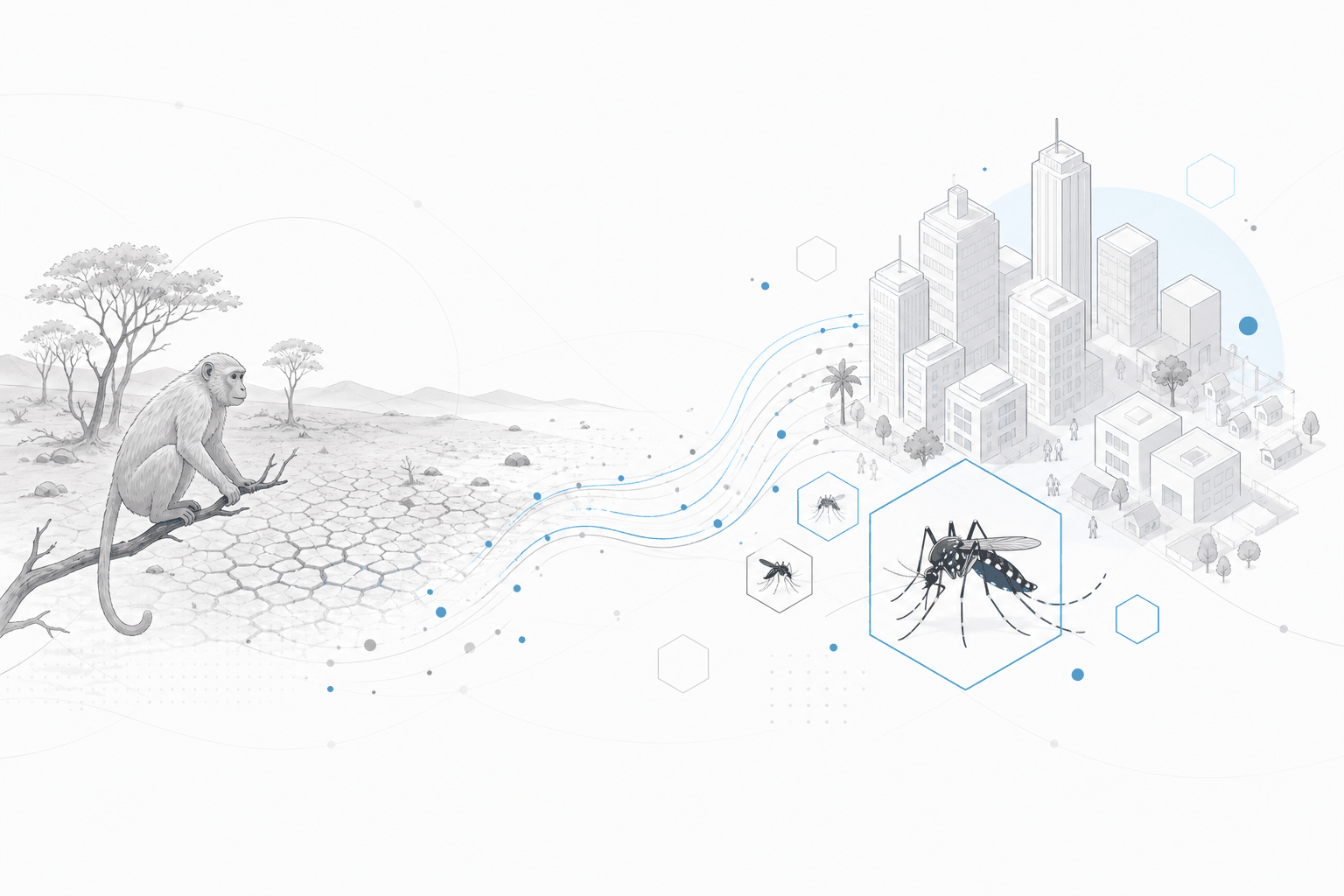
Wild Monkeys on Power Lines: The Return of an Urban Plague Idle for 74 Years
In late 2016, residents of Minas Gerais, Brazil, began noticing unusual visitors in their neighborhoods. Howler monkeys (large canopy-dwelling primates known for their loud calls) and marmosets (small, long-furred monkeys), typically native to deep tropical forests, were climbing into urban streets along high-voltage power lines and residential rooftops.
Shortly thereafter, local hospitals experienced a surge of patients presenting with high fever, jaundice, and organ failure. Yellow fever—an acute viral hemorrhagic disease transmitted by mosquitoes that causes characteristic yellowing of the skin and eyes—had returned in a major outbreak across Brazil.
Between late 2016 and 2019, the epidemic resulted in more than 2,000 confirmed human cases and nearly 750 deaths. Brazil had not seen an urban yellow fever outbreak of this magnitude since 1942. For 74 consecutive years, the vast majority of urban residents and young healthcare professionals had never encountered the virus firsthand.
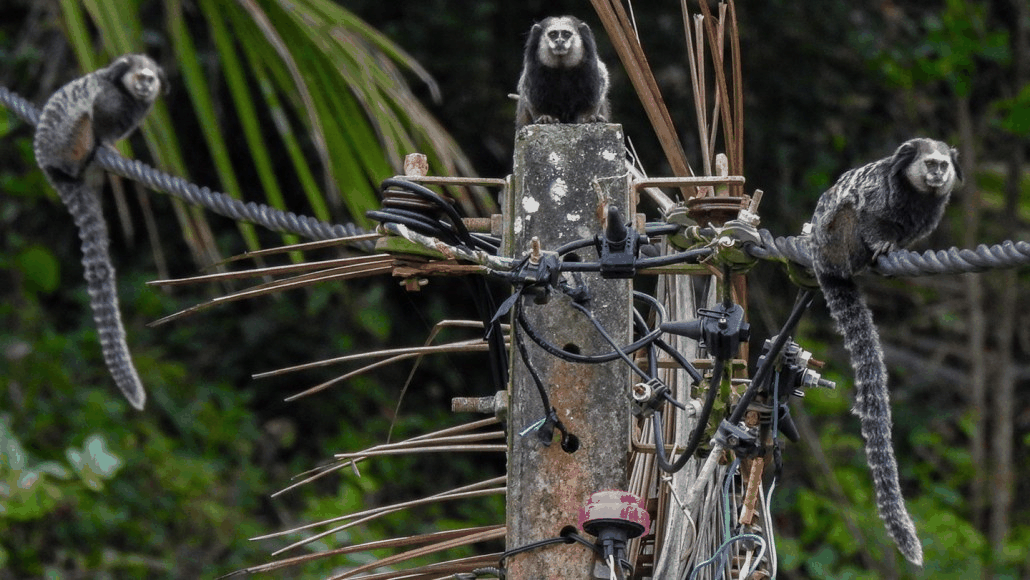 Figure: Marmoset on urban power lines. Source: Science News / Ana I. Cárdenas-Navarrete
Mass mortality among wild primates often serves as an early warning signal for yellow fever dissemination. Frequent sightings of monkey carcasses on city streets indicated that the virus, long sheltered in remote forests, had breached ecological boundaries and begun spreading through densely populated urban areas.
Drought as the Catalyst: How Extreme Dry Spells Force Forests into Cities
Tracing the origins of the crisis leads back to the 2015 El Niño event—an abnormal warming of sea surface temperatures in the equatorial Pacific Ocean that triggers extreme weather patterns globally. The powerful El Niño caused severe drought across central and southern Brazil, reaching an intensity that exceeded once-in-a-century historical benchmarks.
Prolonged drought rapidly dried up forest streams and tree-hole water reserves, severing the daily water supply for wildlife. To survive, canopy-dwelling howler monkeys and marmosets migrated in groups toward the forest edges, following tree branches and utility lines into human communities to drink from garden ponds, outdoor faucets, and drainage gutters.
Migrating alongside wild primates were wild mosquitoes of the genus Haemagogus—tree-canopy dwellers that primarily feed on non-human primates and serve as the primary vector for jungle yellow fever.
The extreme drought also altered mosquito physiological behavior. Under desiccating conditions, mosquitoes sharply increased their biting frequency to prevent dehydration. As virus-carrying monkeys entered urban neighborhoods and wild mosquitoes bit hosts more frequently, the virus seamlessly accomplished cross-species spillover in human population centers.
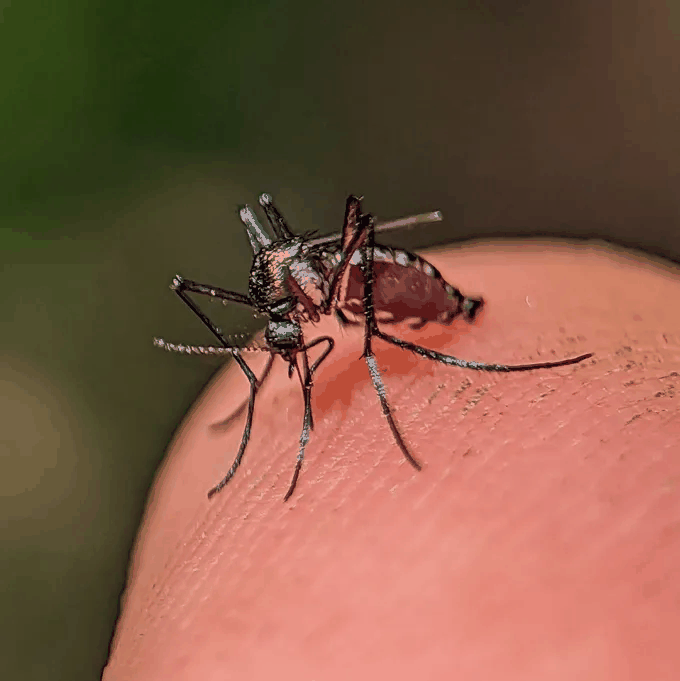 Figure: Haemagogus forest mosquito perching on a fingertip. Source: Science News / Jean Martins, iNaturalist, CC BY-NC
Uncovering the Root Cause: A Novel Transmission Chain Defying Conventional Wisdom
When the outbreak began, public health experts initially suspected that Aedes aegypti—the urban mosquito responsible for spreading dengue and yellow fever in domestic settings—was driving transmission. However, subsequent field sampling revealed that Aedes aegypti populations had been heavily depleted by prior mosquito-control campaigns against Zika, making them incapable of sustaining such a rapid expansion on their own.
To clarify the true transmission pathway, Dr. Jamie Caldwell of Princeton University and Dr. Joelle Rosser’s team at Stanford University launched a collaborative investigation. The researchers combined wild primate mortality logs, confirmed human case records, and detailed meteorological drought data from Minas Gerais between 2016 and 2019 to build computational epidemiological models.
The team tested multiple hypotheses within the simulation. Models evaluating changes only in mosquito population sizes or only in human mobility generated epidemic curves that deviated significantly from observed real-world data.
The simulation results revealed that predicted infection trends matched actual epidemiological data only when the model accounted for both wild animal migration into cities and drought-induced increases in mosquito biting rates. Computational modeling confirmed that extreme drought was the primary domino that set the entire transmission cascade in motion.
Accelerating Climate Shifts: Once-in-a-Century Droughts Becoming the New Normal
Joelle Rosser, a researcher at Stanford University, noted that extreme drought acted as the spark for the outbreak, while low local vaccination coverage and ecological degradation from deforestation served as pre-stacked tinder. When the spark landed on the dry wood, an urban epidemic dormant for decades ignited instantly.
Sadie Ryan, a vector ecologist at the University of Florida, warned that severe droughts previously categorized as once-in-a-century events could become frequent occurrences—occurring as often as four times in 400 years under accelerating global warming. As severe droughts occur with greater frequency, the ecological coincidences driving similar viral spillovers will happen much more often.
This climate-driven mechanism is not unique to South America. During dry seasons in North America, West Nile virus—which circulates primarily between birds and mosquitoes—also shows heightened transmission. Scarcity forces infected birds and mosquitoes to congregate around limited remaining water holes, substantially elevating transmission probability.
The research findings were published on August 14, 2026, in Science Advances. Nikos Vasilakis, a virologist at the University of Texas Medical Branch, emphasized that this study represents a crucial milestone in demonstrating how climate change alters infectious disease transmission pathways.
Building Defenses: Adaptation Strategies for Emerging Transmission Pathways
Brazil’s multi-year yellow fever crisis was ultimately contained through widespread vaccination drives and rigorous vector control measures designed to destroy mosquito populations and interrupt breeding grounds.
Nevertheless, the outbreak serves as a stark warning for global public health. Rapid climate shifts are rewriting the geographical distribution of pathogens, eroding the ecological barrier separating human settlements from wilderness.
The impact of drought extends far beyond dried farmland and water shortages. When forest wildlife is forced into human communities to survive, pathogens concealed in the wild gain new entry points into urban populations. Extreme drought triggering a yellow fever outbreak underscores how climate shifts reshape viral transmission routes, as animals seeking water force forest ecosystems into cities and create cross-species contact. Drought does not merely cause thirst; it drives forest viruses straight into urban centers.
Reference link: