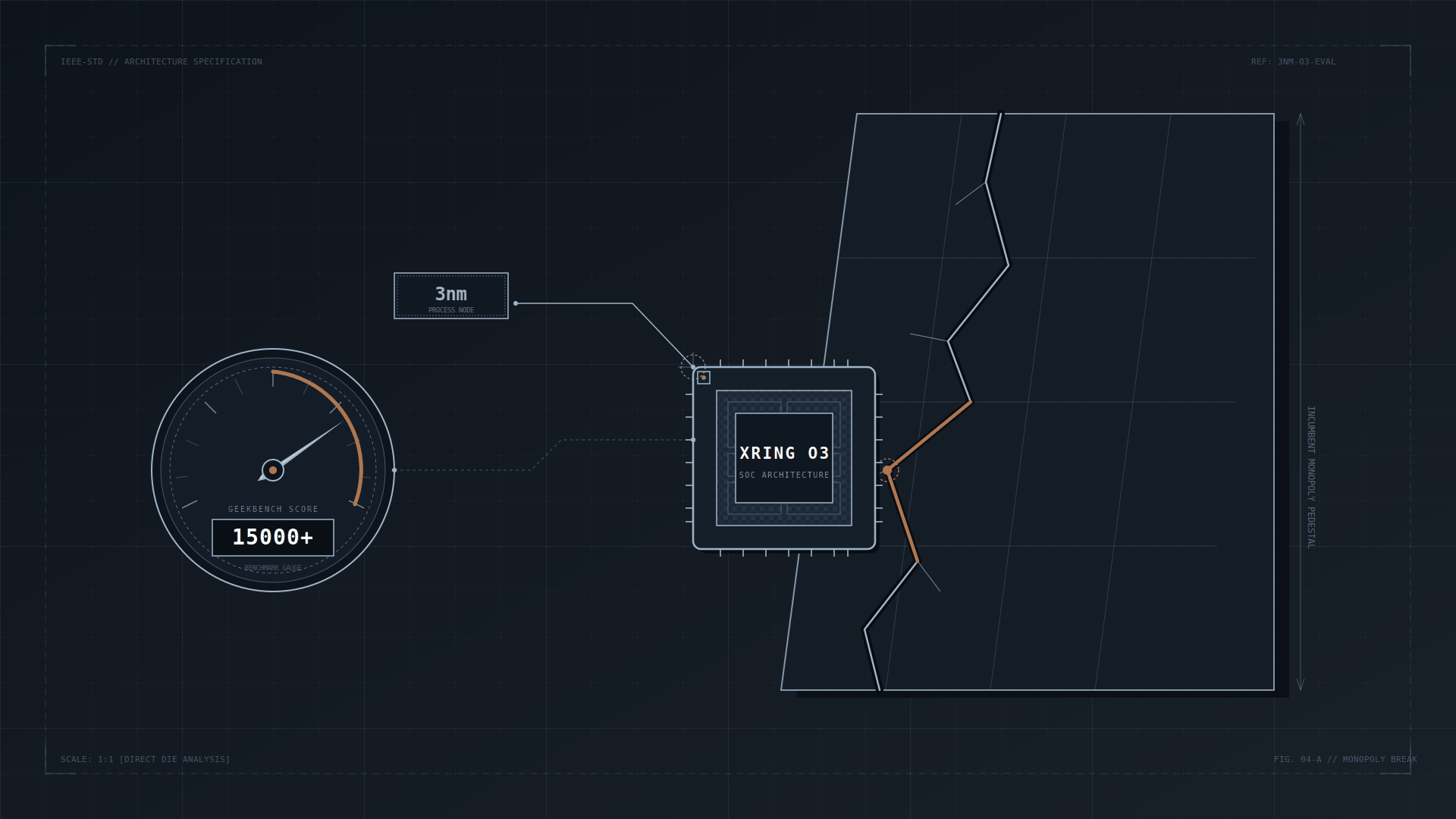
A leaked Geekbench 6 record shared by tech leaker Ice Universe has sent shockwaves through the semiconductor industry: Xiaomi’s custom processor, codenamed Xring O3, achieved a single-core score of 3,945 and a multi-core score of 15,221. In the mobile domain, a multi-core score exceeding 15,000 has never been seen in a production smartphone chip. This result matches Apple’s latest flagship A-series processors in single-core performance while building a nearly 30% lead in multi-core throughput.
For years, the single-core performance crown in mobile CPUs was Apple’s exclusive domain, with the Android ecosystem relying primarily on ARM’s Cortex designs balanced for power efficiency. The explosive raw capability displayed by the Xring O3 signals that the most aggressive microarchitectural innovations in the ARM ecosystem are shifting toward Chinese OEM labs. Even as thermal throttling under real-world workloads and mass production yields remain to be validated, the technical hegemony over high-end mobile silicon has suffered a structural rift.
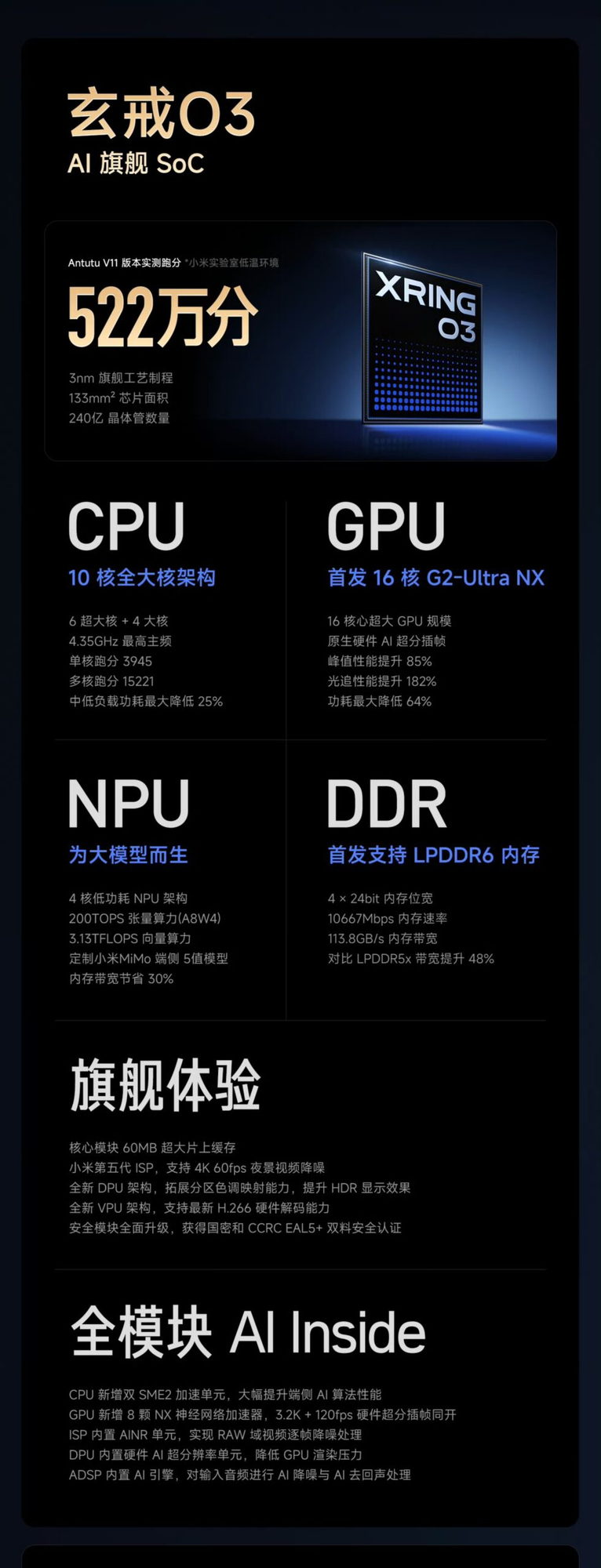 Figure: Official specs and benchmark overview of Xiaomi Xring O3. Source: NokiaPowerUser / Xiaomi
Benchmarks Match Apple: The Scorecard Shocking the Chip Industry
After examining the data, Daniel Lemire, computer science professor at the University of Montreal and former Twitter engineer, publicly noted that the single-core performance of this chip roughly matches Apple, while its multi-core output is decisively superior. Benchmark testing reflects a processor’s peak compute throughput under standardized instruction workloads. A single-core score of 3,945 means application startup and complex single-threaded responsiveness hit the industry ceiling, while the 15,221 multi-core score provides abundant headroom for local, on-device LLM inference.
Over the past decade, Apple maintained an unbeatable record in mobile CPU single-core performance thanks to massive R&D spending and custom microarchitectures. Although Qualcomm and MediaTek frequently pushed multi-core and GPU performance, they remained constrained by the thermal and power demands of generic client devices, exercising restraint on single-core aggressiveness. By stepping in directly to design ultra-large cores as a smartphone manufacturer, Xiaomi has disrupted the long-standing reliance on third-party off-the-shelf reference designs.
The performance surge brought by this architectural customization is reshaping the competitive landscape for mobile devices. When a handset maker possesses the capability to rival Apple in raw CPU compute, traditional upstream supply-chain models face unprecedented disruption.
Desktop-Class Specs: 60MB Cache and 21 Execution Ports
According to technical details published by NokiaPowerUser and public sources, the Xring O3 is fabricated on TSMC’s advanced 3-nanometer (N3P) process node and integrates an astounding 24 billion transistors. Its primary ultra-large core, dubbed C1-Ultra, natively supports ARM’s latest SME2 (Scalable Matrix Extension 2) and SVE2 (Scalable Vector Extension 2) instruction sets. Fitting 24 billion transistors onto a 3nm die indicates an exceptionally high tolerance for chip area and transistor budgets.
What has left silicon engineers even more astonished is the sheer width of the microarchitecture’s front end. The C1-Ultra core features up to 21 execution ports, six of which are dedicated to 128-bit SIMD (Single Instruction, Multiple Data) vector operations. By comparison, mainstream desktop CPUs from Intel and AMD typically feature between 12 and 16 execution ports. This means that within a single clock cycle, this mobile processor can dispatch and execute more micro-operations in parallel than most desktop CPUs.
The cache architecture adopts an equally aggressive expansion strategy. The total chip-wide cache of the Xring O3 reaches an extraordinary 60 MB, outstripping even mainstream thin-and-light laptop chips. If CPU cores are factory assembly lines running at high speeds, an ultra-large cache acts as a massive raw material warehouse built directly outside the workshop door, dramatically reducing memory latency. The combination of a 60 MB cache and a 21-port ultra-wide dispatch architecture is a classic heavy-duty design that sacrifices die area for single-cycle execution efficiency.
Why Apple and Qualcomm Are Feeling the Pressure
In the traditional smartphone supply chain, merchant silicon vendors like Qualcomm must cater to hundreds of device models across different price points and thermal envelopes, naturally favoring conservative and compromised microarchitecture choices. Apple held its single-core advantage precisely due to full hardware-software integration: lucrative product margins allowed it to absorb immense custom R&D costs and giant die sizes.
Xiaomi’s custom silicon path replicates this exact integration advantage. Shipping over 100 million smartphones annually, Xiaomi can aggressively skew transistor allocation toward the specific needs of its OS scheduler, camera ISP pipelines, and local AI models. This degree of customization freedom is a strategic weapon unattainable through off-the-shelf chip purchases.
The high-end smartphone market has entered a zero-sum phase where incremental camera sensor updates and screen refresh rate bumps no longer excite consumers. Custom flagship SoCs have become the decisive battleground for defining top-tier product differentiation. As Chinese vendors demonstrate the ability to design world-class CPU cores from scratch, the long-held monopoly of overseas giants in high-end mobile silicon faces a genuine challenger.
Winning on Benchmarks: Can Real Devices Hold Up?
While benchmark numbers are thrilling, sober engineering warnings cannot be ignored. Industry analysts point out that Geekbench tests are typically conducted under ideal cooling conditions or on open test benches, representing short burst peak output. Inside an enclosed smartphone body less than 8mm thick, sustained performance, overall power consumption, and thermal management face brutal realities.
The transistor overhead from 21 execution ports and 60 MB of cache elevates the power baseline alongside peak compute. If the phone’s thermal module cannot dissipate heat fast enough, thermal throttling will trigger within seconds, causing real-world experience to fall short of theoretical scores. Furthermore, TSMC’s 3nm wafer prices are sky-high; packing 24 billion transistors onto a large die creates immense yield and unit cost challenges.
The chip is expected to power Xiaomi’s next-generation flagship phones, though specific models and release schedules remain unannounced. Peak laboratory benchmark scores establish the ceiling of architectural potential, but thermal management and power scheduling inside the device will dictate commercial success.
The Myth of High-End Silicon Monopoly Is Shattering
The true significance of the Xring O3 benchmark leak lies in proving that the barrier to designing top-tier ARM silicon is not insurmountable. Ultra-wide execution pipelines and massive cache subsystems—long regarded as the crown jewels of processor design—are being pushed into mass production by Chinese hardware makers with extraordinary execution speed.
From early peripheral PMICs and image signal processors to fully custom prime CPU cores, Chinese semiconductor design has traversed a long and pragmatic path. While real-world power balance, OS tuning, and yield stability remain to be tested by the market, the perception that high-end mobile SoCs belong exclusively to a select club of legacy giants has officially been shattered.
The mobile processor landscape is shifting from a single pole toward multi-player competition. This technological breakthrough across 3nm fabrication and cutting-edge microarchitecture guarantees that the upcoming flagship smartphone battle will be fiercer than ever.
Reference Links:
- NokiaPowerUser: Xiaomi Xring O3 Chipset Leaks with Monster Geekbench Score
- Ice Universe Leak Tweet
- Prof. Daniel Lemire’s Personal Technical Analysis
- Official Geekbench 6 Benchmark Database