
On October 9, 2026, Emeryville-based Oxide Computer announced a $445 million Series D financing round. A hardware venture selling rack-scale on-premises cloud infrastructure began paying federal income taxes this spring, followed by this massive capital infusion. This is not another speculative frenzy in the AI arms race. For Oxide, the primary bottleneck has shifted from whether enterprise customers will buy to whether the company can tie up sufficient capital in component inventory and contract manufacturing before delivery.
Paying Income Taxes Breaks the Hardware Startup Survival Barrier
This spring, Oxide co-founders snapped a commemorative photo celebrating a rare milestone: the company had finally begun paying corporate income taxes.
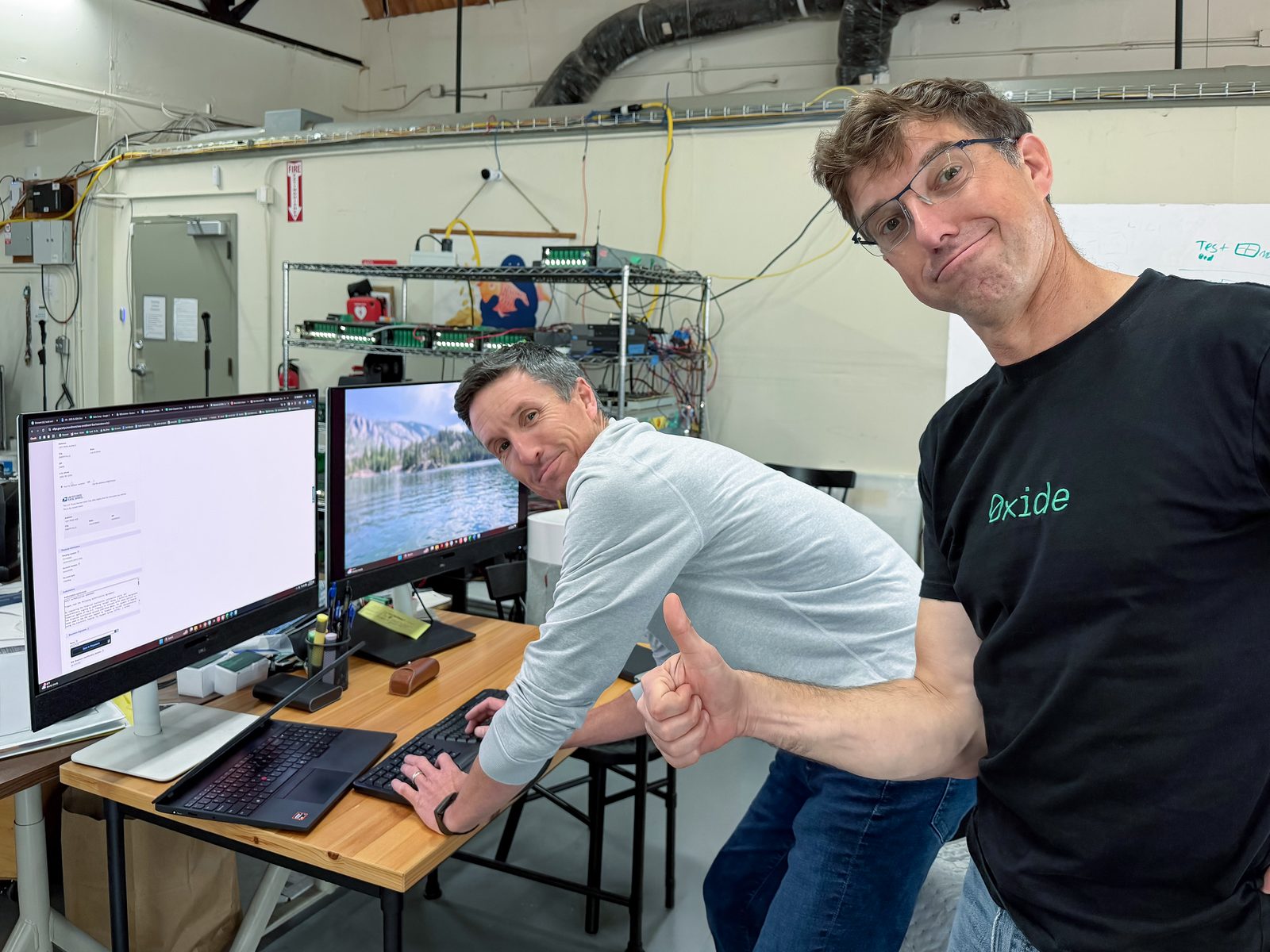 Figure: Co-founders celebrating the tax milestone. Source: oxide.computer
In the conventional Silicon Valley investment narrative, startups rely on successive equity rounds to subsidize research, development, and operating expenses that run years ahead of revenue. The vast majority of tech ventures never pay corporate income tax. On paper, they post zero net profits; every dollar earned is immediately plowed back into aggressive expansion as operational costs. As Bryan Cantrill and Steve Tuck pointed out, Oxide’s taxable profit stems from the core operational business of selling computers. After accounting for steep component bills of materials, contract manufacturing fees, and engineering payroll, the sale of integrated rack systems achieved genuine positive cash flow. Enterprise buyers are spending real money on these massive black cabinets, and those sales are generating sustainable margins.
The unforgiving reality of hardware manufacturing lies in cash flow timing. Cash must be spent upfront to procure silicon wafers, memory modules, and sheet metal chassis, followed by assembly and rigorous validation. Only months later, once the hardware is shipped and deployed at a customer facility, does the revenue return. Throughout its seven-year history, Oxide has remained steadfast in building a single integrated product line: rack-scale, fully owned, full-stack cloud infrastructure for the enterprise. Delivering units while achieving positive pre-tax earnings demonstrates that on-premises infrastructure—a category long declared obsolete by hyperscale cloud giants—has carved out defensible, highly profitable ground in specific enterprise sectors.
$445 Million as Manufacturing Working Capital
The Series D was led by Eclipse. Oxide previously secured a $100 million Series B and a $200 million Series C, bringing total capital raised close to $750 million. Back during the Series C, management explicitly spoke about de-risking the business from a capital perspective to safeguard the company’s long-term independence and runway. This latest $445 million infusion further reinforces the balance sheet with a substantial safety buffer.
A formidable order backlog is the immediate catalyst behind this capital round. In a fast-growing hardware enterprise where incoming demand outstrips available production capacity, companies must deploy substantial liquidity to lock in upstream component allocations and assembly line throughput months in advance. Cash outlays for bill of materials and fabrication must occur long before finished systems are delivered to end customers. This physical tempo cannot be abstracted away by software code. Without committing capital upfront to secure supply chains, production lines stall for lack of parts, and accumulated customer demand risks converting into cancellations.
The leadership team has been unequivocal about how the capital will be used. While Oxide’s retained earnings and cash flow cover current booked orders, the backlog has reached a critical threshold. Without outside funding, taking on new enterprise demand would force the company into operational retrenchment. Given management’s aversion to structural vulnerability—where macroeconomic shocks or unexpected events could instantly freeze cash flow—the new capital is dedicated to scaling manufacturing capacity, executing on existing backlogs, and providing a stable cushion to accept new enterprise orders.
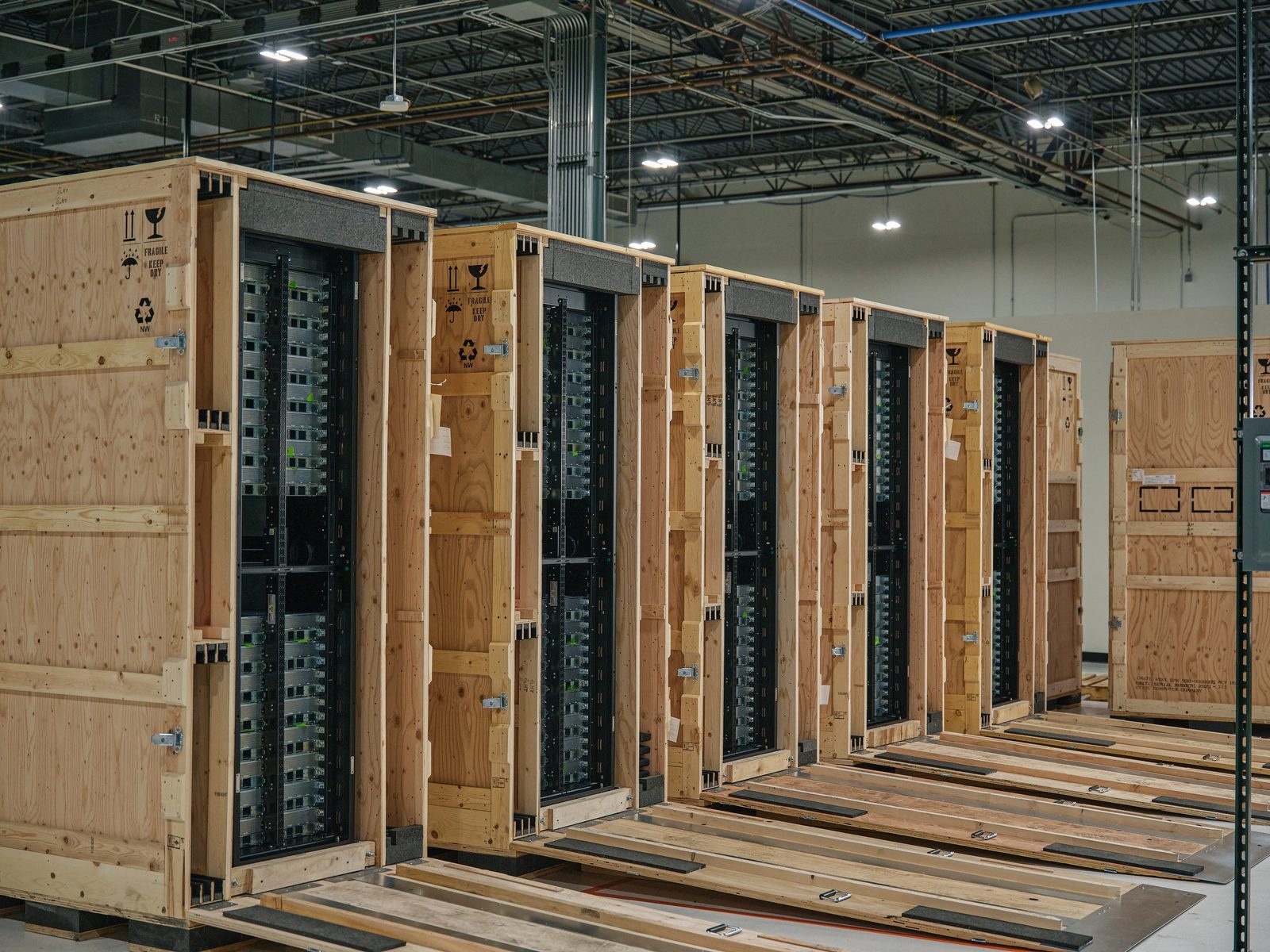 Figure: Six boxed Oxide racks lined up on the warehouse floor. Source: oxide.computer
AMD Backs the Strategic Enterprise Systems Outlet
The roster of Series D investors reads like a directory of patient, long-horizon capital. Alongside lead investor Eclipse, existing backers including USIT, Riot Ventures, Jane Street, Friends and Family Capital, and Counterpart all participated. Atreides Management, recognized for deep-tech convictions and having tracked Oxide for two years, joined as a new institutional shareholder. More significantly for the broader computing ecosystem, AMD joined as a strategic investor.
AMD’s direct involvement cements a deep upstream integration. One of Oxide’s pivotal architectural decisions from the outset was standardizing entirely on AMD EPYC processors. Beyond operating as a component vendor, AMD has supplied direct engineering collaboration for platform enablement software. When a leading semiconductor provider writes significant equity checks for a downstream rack-scale system developer, the strategic value extends well beyond financial returns. Navigating pricing leverage against hyperscale cloud providers requires AMD to foster independent, high-performance systems outlets capable of running dense enterprise workloads. This capital bridge from silicon to end-to-end infrastructure provides Oxide with structural stability while securing a dedicated enterprise vehicle for AMD as private cloud investments rebound.
Bounded Workloads Offer an Escape from the Public Cloud Premium
From an industry perspective, Oxide’s burgeoning order backlog sheds light on the realities facing a specific cohort of enterprise customers. These organizations operate with clearly bounded workload parameters: they know precisely how much compute they run and how much data they store on a daily basis. For them, moving core workloads entirely to usage-metered public clouds makes little financial sense. While hyperscalers deliver immense value through elasticity, that elasticity comes bundled with steep premiums on network egress and compute capacity. When an enterprise can forecast its baseline computing envelope, buying a turnkey, integrated rack appliance outright comfortably beats the compounding cost of public cloud rentals over a three-to-five-year operational lifecycle. Oxide has captured this exact demographic. Demand for infrastructural control remains potent, proving that the public cloud has not consumed every corner of enterprise computing.
The Order Backlog: High Demand Meets Production Minefield
A massive order backlog remains a structural double-edged sword. On one hand, it validates undeniable market appetite. On the other, it lays bare the delivery bottlenecks and throughput constraints that emerging hardware vendors must navigate during scale-up phases. Customer patience is finite; unfulfilled commitments eventually turn into stranded opportunities. Furthermore, approaching $750 million in cumulative equity financing places immense expectations on the executive team. Moving forward, Oxide must maintain formidable revenue scale and margin growth to validate its high valuation trajectory.
Seven years in, Oxide remains entirely concentrated on a single integrated rack-scale architecture. Operating a single product line reflects both extraordinary strategic discipline and concentrated technological risk. A flaw in a node redesign, protracted component shortages, or a critical architectural defect in the underlying system software would deal an outsized blow to such a capital-intensive model.
With $445 million in fresh capital, Oxide has purchased the time and inventory buffer required to navigate its immediate manufacturing hurdles. Between paying corporate income taxes and contending with explosive enterprise demand, this seven-year-old hardware pioneer has demonstrated that on-premises cloud infrastructure has reclaimed a durable, profitable foothold where workload boundaries are clear.
Reference Links:
- oxide.computer blog announcement