On November 3, 2026, the status for CVE-2026-98432 on Ubuntu’s official security tracker remained firmly marked as “Vulnerable.” Carrying a critical CVSS score of 9.8, upstream fixes for this Linux kernel flaw had already been merged into the stable tree back on October 5. Nearly a month later, while Debian and Arch had long since rolled out security advisories and patches, countless production servers running Ubuntu were still waiting on official updates.
The delay triggered an intense crisis of confidence across the sysadmin and DevOps community. Tech blogger chalmovsky highlighted the situation in a detailed write-up, pointing out that none of the supported Ubuntu LTS releases had received standard repository patches. To defend against imminent remote probing and scanning, he ultimately chose to drain his services and pull the machines entirely offline until migration could be completed.
The defensive window has been drastically compressed by advancing offensive tooling. Just 12 days after the vulnerability was made public, an AI research team developed a zero-interaction remote privilege escalation chain. AI tooling has shrunk exploit synthesis down to mere days, turning distribution-level validation cycles that take weeks into a critical security bottleneck. Canonical finds itself caught in a structural conflict between agile patch response and exhaustive hardware certification.
Patches Stalled in the Proposed Pocket as Warnings Mount Across LTS Releases
Empirical telemetry indicates that Ubuntu’s remediations remain stuck in an intermediate holding pattern. Both 24.04 and 22.04 LTS show fixes progressing, yet updated kernel packages reside solely in the -proposed pocket. Older releases like 20.04 and 18.04 LTS are marked directly on official tracker pages as vulnerable.
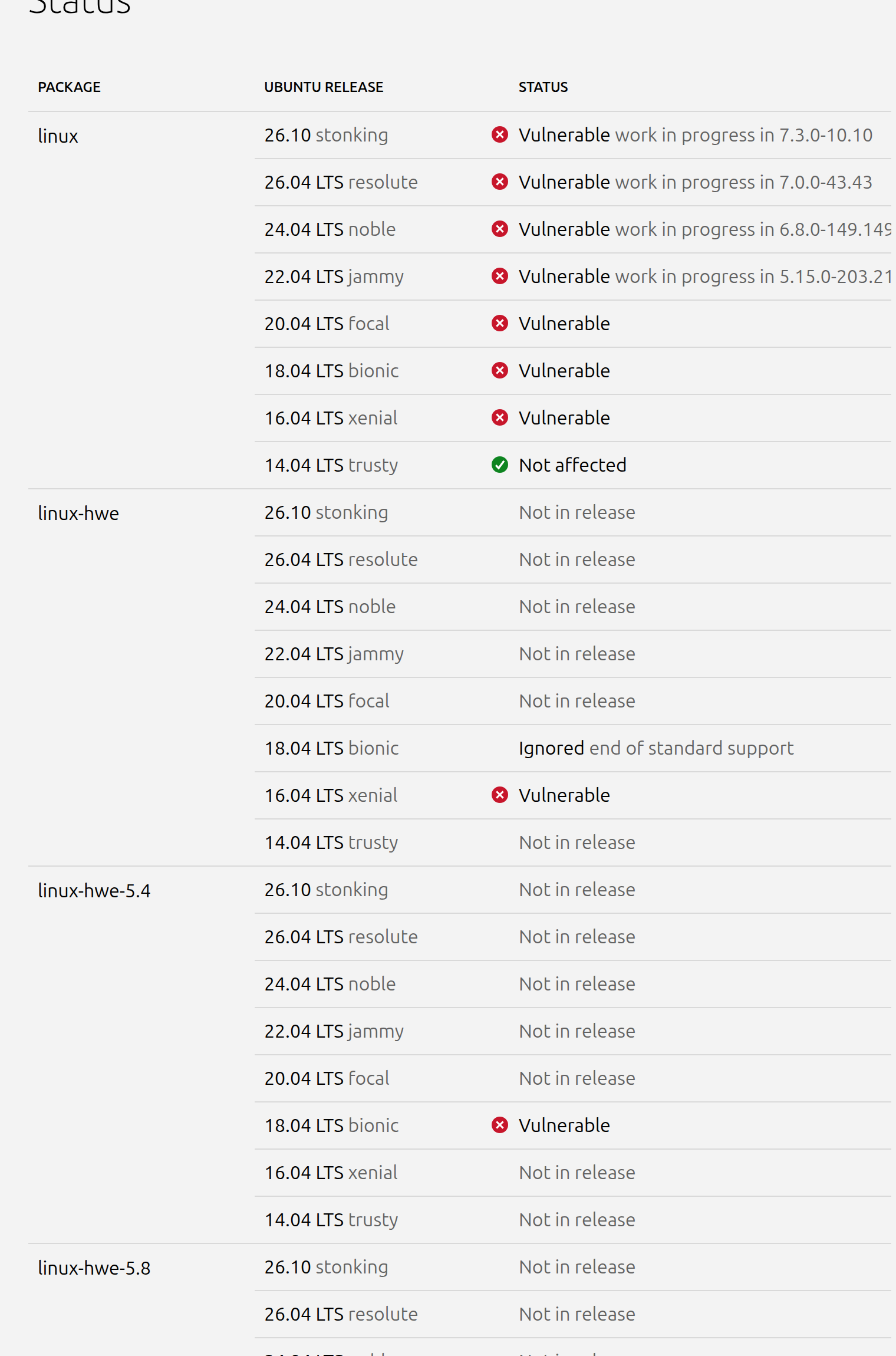 Figure: Ubuntu’s official security status page. Mainstream LTS releases are either marked Vulnerable or still in development. Source: Ubuntu Security Team
Placing candidate packages in the pre-release pocket represents Canonical’s current workaround. The team recommended that administrators urgently requiring protection manually enable -proposed to pull the kernel. However, pre-release repositories bundle numerous unvetted package updates; enabling the pocket on production servers introduces uncontrollable stability risks. For enterprise environments subject to strict compliance, this stopgap is practically unfeasible.
The divergence becomes even more glaring in cross-distribution comparisons. The upstream kernel organization publicly assigned the CVE on October 15; Debian published DSA-6568-1 and DLA-4841-1 the very next day. Community-driven distributions across DistroWatch followed suit within a week. Canonical, backed by commercial enterprise support, ended up being the slowest actor in the ecosystem.
Handshake Race Triggers Use-After-Free, Granting Remote Root via Raw Packets
The vulnerability stems from the TCP protocol stack’s lifecycle management of request sockets. When a client initiates a connection with IPv4 options in the SYN packet, the kernel stores those options in a request socket to assemble the SYNACK. Upon successful completion of the handshake, tcp_v4_syn_recv_sock() transfers the options pointer directly to the newly instantiated child socket.
Crucially, this transfer of pointer ownership occurs without memory duplication. When a retransmitted SYN is processed via tcp_check_req(), it reads the exact same options under an RCU read lock. Back in Linux 4.4, the global listener socket lock was removed, eliminating mutual exclusion during concurrent socket lookups.
The absence of locking leads to an asynchronous lifecycle mismatch. If the child socket is closed prematurely, inet_sock_destruct() invokes standard kfree() to free the options structure. Meanwhile, a concurrent core executing ip_options_build() continues to read the already freed memory, resulting in a textbook Use-After-Free (UAF).
Patching the flaw required altering just two core deallocation calls. Upstream maintainer Eric Dumazet introduced a fix replacing the direct free with kfree_rcu(). By deferring reclamation past the RCU grace period, concurrent readers safely exit before deallocation, severing dirty memory access. Upstream merged this handful of lines within hours, yet downstream enterprise distribution stalled for three full weeks.
AI Synthesizes Remote Exploit in 12 Days, Upending the Defense Timeline
The concurrency bug quickly escalated into an automated weapon. On October 27, Anthropic revealed that their team, leveraging Claude models, successfully crafted a full remote root exploit chain from scratch. The journey from vulnerability disclosure to working exploit code took just 12 days.
The exploit chain systematically dismantled standard kernel hardening measures. By transmitting malformed packets to a target port listening on MPTCP, the attack coerced the kernel into reading attacker-controlled memory. The sequence bypassed KASLR through an initial memory leak before hijacking callback function pointers to gain root execution.
This development radically resets the defensive calculus for kernel security. Historically, engineering such remote exploits required months of manual low-level debugging; modern AI-driven toolchains now compress weaponization to a matter of days. The timeline for exploit weaponization now runs ahead of enterprise patch deployment.
Under such speed, conventional mitigations fall short. Canonical’s security team noted that while MPTCP served as the transport vector in published exploits, the underlying flaw is rooted in core IPv4 options handling. Disabling MPTCP merely defeats specific script variants. Dropping IPv4 options at the firewall level breaks legitimate network services, leaving a patched kernel as the only viable remediation.
Two Thousand Certified Rigs Lengthen QA Cycles as Hardware Matrices Slow Security Delivery
In response to criticism over the delay, Canonical defended its rigorous engineering and quality assurance standards. As foundational infrastructure software, subtle kernel regressions can cause catastrophic outages in production fleets. Internal policy mandates that candidate kernels complete regression suites across more than two thousand certified hardware platforms before promotion to standard repositories.
This extensive hardware ecosystem inherently stretches turnaround cycles. Ubuntu spans public clouds, edge ARM devices, and enterprise storage arrays. Each testing iteration consumes immense compute and calendar time to verify system stability.
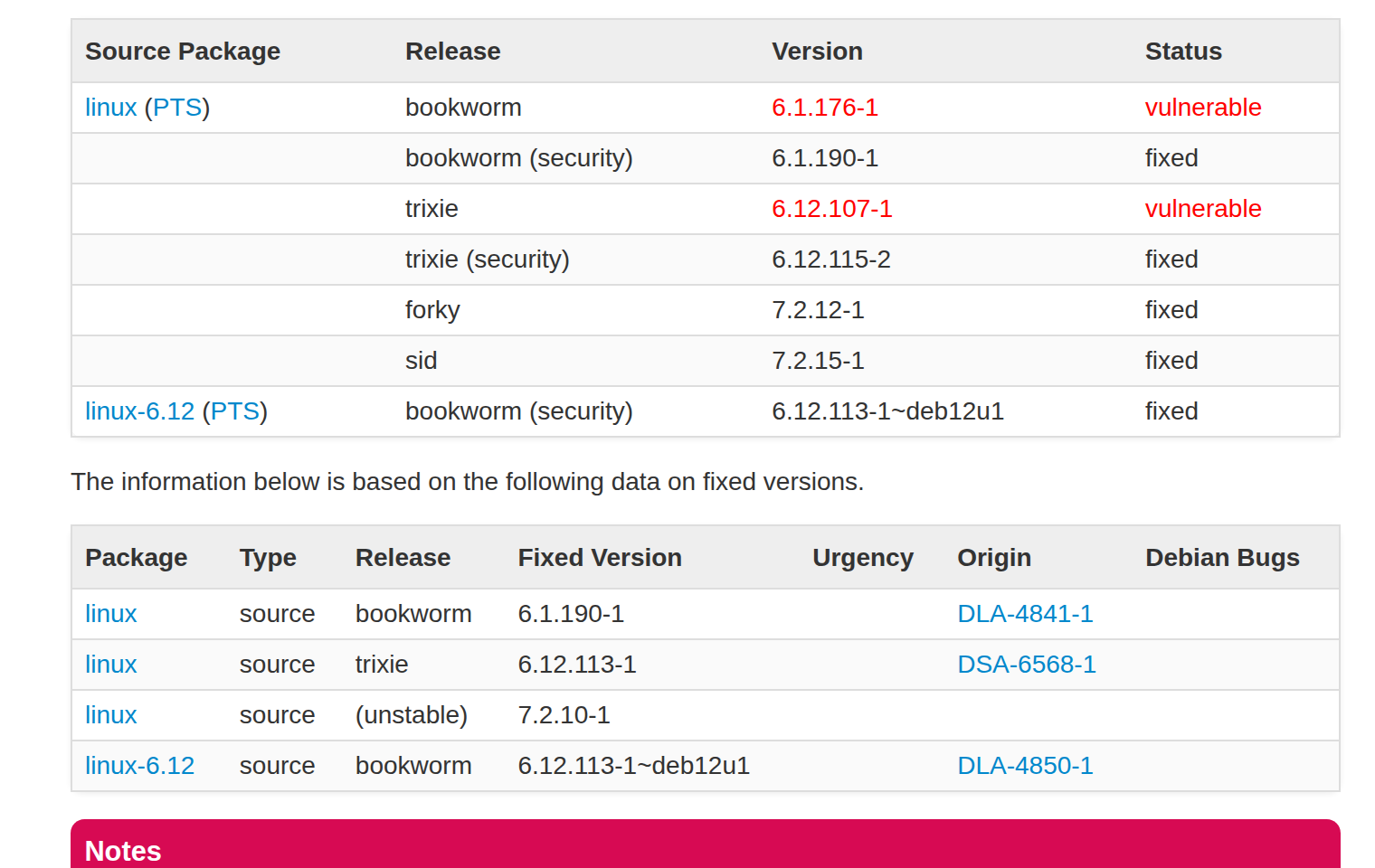 Figure: Debian Security Tracker page. Both bookworm and trixie stable branches were marked fixed the day following vulnerability disclosure. Source: Debian Security Team
Debian, by contrast, operates on an agile, volunteer-driven triage model. The Debian security team distributes kernel fixes through independent DSA and DLA channels, bypassing exhaustive enterprise hardware matrices. Debian users achieved immunity within 24 hours of disclosure, highlighting a fundamental divergence in governance philosophy.
Commercial Subscriptions Lag Behind Community Agility: Enterprises Need Tiered Delivery Channels
The three-week exposure window uncovers a structural contradiction in commercial Linux distribution. Canonical promises enterprise-grade security SLAs under its Ubuntu Pro subscription. Yet when a genuine CVSS 9.8 remote flaw hit production systems, paying enterprise customers were left running vulnerable kernels alongside free-tier users. Commercial commitments were trapped by rigid operational procedures.
Instructing administrators to enable -proposed in production violates core operational doctrine. Alongside the urgent kernel fix, the repository pulls in dozens of unrelated pre-release packages. Triggering updates risks introducing untested library conflicts, easily turning a security vulnerability into a catastrophic service outage.
Traditional stable release release engineering can no longer keep pace with AI-accelerated threat cycles. When machine intelligence lowers the barrier to exploit synthesis, demanding multi-week validation across thousands of hardware models resembles waiting for routine building permits while the structure is ablaze. Enterprise security demands decoupled, tiered update channels that separate urgent vulnerability patches from routine hardware certification suites.
The stark contrast between Ubuntu and Debian underscores the trials facing foundational software in the AI era. Stability remains paramount, but inflexible deployment gates leave critical infrastructure dangerously vulnerable. Defense must adapt to match the velocity of exploit weaponization—modern distributions must rethink and restructure their delivery pipelines.
Reference Links:
- Ubuntu Security Tracker Page
- Debian Security Advisories DSA-6568-1 and DLA-4841-1
- Akamai Security Research: Deep Dive into Linux Kernel TCP Stack Remote UAF
- Canonical Official Blog: Notice on CVE-2026-98432 Fixes in Proposed Pocket