
On October 13, 2026, at the AI Engineer Summit in New York, Revolut Head of Infrastructure David Abitbol shared detailed telemetry and financial figures from the fintech unicorn’s internal AI migration. The digital bank, supporting roughly 2,000 software engineers, canceled its commercial closed-source API subscriptions and deployed 56 Nvidia B200 GPUs to host the open-weight GLM-5.3 model on-premises.
The hardware transition triggered an immediate financial impact. Monthly aggregate inference spend plummeted to one-tenth of previous figures, stabilizing blended inference costs at roughly $0.30 per million tokens. Internal sampling metrics revealed that actual coding time dropped by around 60%, while end-to-end delivery cycles accelerated by roughly 70%. Derived from observational correlation before and after deployment, these numbers capture the organizational velocity unleashed when tooling is ubiquitous.
The definitive ROI of self-hosting open weights lies in eradicating the psychological rationing driven by token scarcity. When metered pay-per-token pricing is replaced with predictable hardware depreciation, developers gain the freedom to iterate and fail without friction. In exchange, Revolut’s internal platform team had to take on low-level systems tuning, sandbox containerization, and telemetry governance.
Metered Billing Forced Engineers to Ration Tokens
Revolut’s foray into generative AI started with peripheral productivity tasks. Teams first wired up Gemini for documentation retrieval and technical specifications, yielding measurable gains in coding speed and delivery turnarounds. As workflows deepened across the development pipeline, they adopted Claude Code for complex business logic, multi-file refactoring, and tricky debugging.
However, commercial closed-model invoices ballooned at an alarming rate. Engineers resolving elusive defects initiated long agentic sessions, burning massive amounts of token budget. Because shipping throughput failed to scale linearly with API costs, leadership stepped in with individual usage quotas.
Capping usage instantly distorted developer behavior. Engineers began rationing prompts, hesitant to engage the AI assistant for anything short of critical roadblocks. Routine refactorings—like extracting a method or drafting unit tests—reverted to manual labor. Metered billing erected a quota barrier that transformed an on-demand automation assistant into a scarce resource requiring constant cost-benefit calculations.
The platform leadership recognized that agentic productivity stems from high-frequency, conversational interaction. So long as each query carries a floating price tag, engineers instinctively hold back. Unlocking continuous developer adoption required turning volatile operational expenses into fixed, amortizable capital assets.
56 B200s Slashed Blended Cost to $0.30 per Million Tokens
Revolut provisioned 56 Nvidia B200 accelerator cards in a dedicated private cluster to serve GLM-5.3. Factoring in hardware depreciation, power consumption, and network overhead, the fully amortized cost leveled out at approximately $0.30 per million tokens. Monthly inference outlays dropped to 10% of their prior closed-API peak.
Abundant local compute unleashed organization-wide utilization. Two thousand engineers began issuing frequent requests for scaffolding, legacy refactoring, and automated test generation. The 60% reduction in coding time and 70% faster time-to-delivery were direct byproducts of abolishing artificial usage caps. While Abitbol acknowledged the lack of an isolated control group, the operational acceleration on production lines was unmistakable.
A private cluster must also sustain rigorous latency thresholds under developer load. The team established a target Time to First Token (TTFT) under 3 seconds. Internal telemetry showed that whenever TTFT exceeded 5 seconds, engineers routinely lost focus and context-switched away. On throughput, a streaming rate near 200 tokens per second proved more than adequate for interactive sessions, allowing engineers to run multiple asynchronous refactoring tasks concurrently.
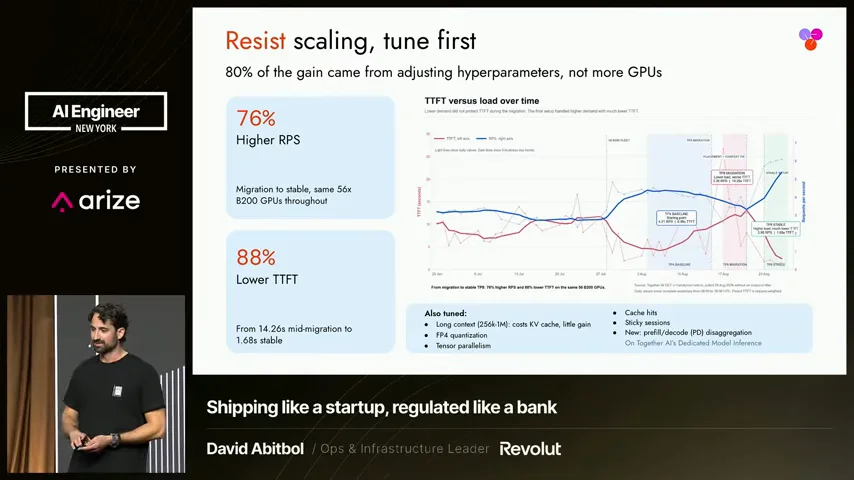 Figure: David Abitbol presenting Revolut’s 2,000-engineer coding tool migration at AI Engineer NYC 2026. Source: Official AI Engineer NYC 2026 Keynote.
VRAM Contention Forced Deep Low-Level Inference Tuning
Procuring cutting-edge silicon does not automatically guarantee high-availability service. During early rollout, the cluster suffered severe bottlenecks under peak developer concurrency. Average TTFT degraded to an unusable 14.26 seconds, accompanied by persistent request queuing.
Without adding hardware beyond the 56 cards, the team re-architected their inference serving stack. Rigorous performance tuning drove steady-state TTFT down by 88% to 1.68 seconds, while requests per second (RPS) surged 76%. The depth of systems tuning dictates whether self-hosted deployments sink or swim; low-level software optimizations generated far greater throughput gains than simply adding GPUs.
VRAM management became the decisive operational battleground. In high-concurrency serving, KV cache capacity and context window sizes naturally compete for memory. Naively allocating full context windows locks down static VRAM, severely throttling concurrent request capacity. Revolut tailored context windows to real-world developer query distributions, reclaiming substantial memory to expand the active KV cache pool.
On Nvidia’s Blackwell architecture, the team applied FP4 quantization to compress model footprints. While 4-way tensor parallelism tended to choke per-device cache headroom, transitioning to 8-way tensor parallelism unlocked significantly higher concurrent throughput across the cluster. Furthermore, multimodal requests were routed to dedicated instances, preventing heterogeneous compute workloads from fragmenting coding-model VRAM.
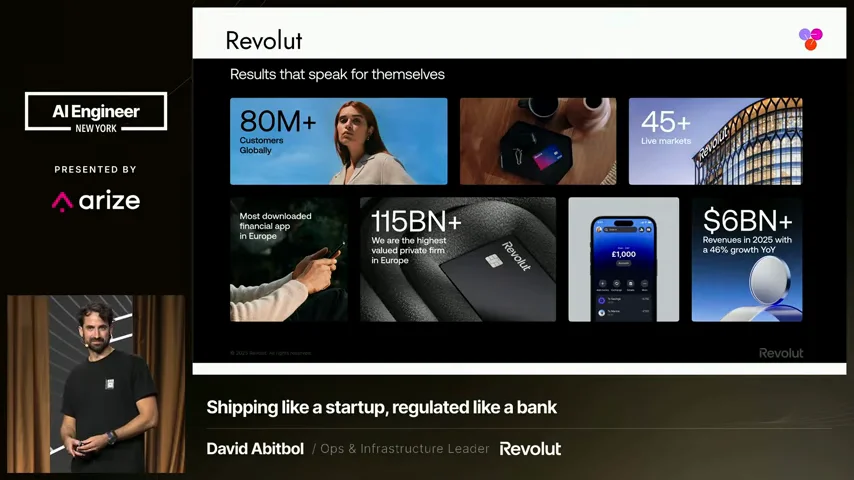 Figure: Architecture and optimization benchmarks for Revolut’s self-hosted open-weights stack. Source: Official AI Engineer NYC 2026 Keynote.
Sandboxing and Real-Time Telemetry Establish Security Baselines
Bringing model execution behind enterprise firewalls shifts full responsibility for security controls and auditability onto internal teams. For a regulated fintech managing core banking ledgers and sensitive financial data, rogue agent operations could cause severe damage if granted excessive privileges.
Revolut bypassed the fallacy of passive post-hoc auditing. Every code modification and test execution orchestrated by an agent runs inside isolated ephemeral sandboxes. Sandboxing strictly limits the filesystem and network boundaries accessible to the model; even if malicious or destructive commands are generated, the blast radius remains tightly contained.
Automated policy gates intercept risky operations attempting to touch production environments or protected branches. To counter prompt injection and untrusted input vectors, the team engineered end-to-end telemetry and observability pipelines. A local AI agent devoid of real-time auditing is functionally equivalent to running unmonitored, privileged service accounts directly inside an enterprise intranet.
Fixed CapEx Bets on Sustained Team Utilization
The debate over self-hosting LLMs remains polarized. Proponents emphasize sovereignty over weights: direct control protects against vendor price hikes, API changes, and arbitrary deprecations, while establishing fertile ground for unrestrained developer experimentation.
Skeptics point to crushing hidden operational costs. Top-tier accelerator depreciation is an unavoidable capital outlay, and open-source models must continually catch up with frontier proprietary flagships. Organizations must maintain a dedicated, highly compensated systems engineering team, driving up operational overhead.
Ultimately, the economic justification for self-hosting hinges entirely on cluster utilization. Revolut achieves $0.30 per million tokens only because 2,000 developers generate persistent, highly saturated traffic. In smaller engineering teams with sporadic query volumes, idle hardware depreciation quickly pushes the effective per-token price far above commercial API rates.
David Abitbol stressed that where weights are executed matters far more than who originally trained them. Regulatory requirements diverge wildly across financial jurisdictions, and Revolut’s architectural roadmap is backed by their specific organizational scale.
The fundamental payoff of self-hosting open weights is substituting pricing unpredictability with engineering certainty. It eliminates not just benchmark performance gaps, but the psychological hesitation developers feel before hitting Enter.
Once compute quotas disappear, autonomous coding tools truly weave into daily development rhythms. Self-hosting is not a universal panacea—but when resource barriers dissolve, engineering velocity finds an entirely higher ceiling.
References:
- AI Engineer NYC 2026: Revolut Keynote on Self-Hosting Open Models
- AI Engineer Official Technical Report