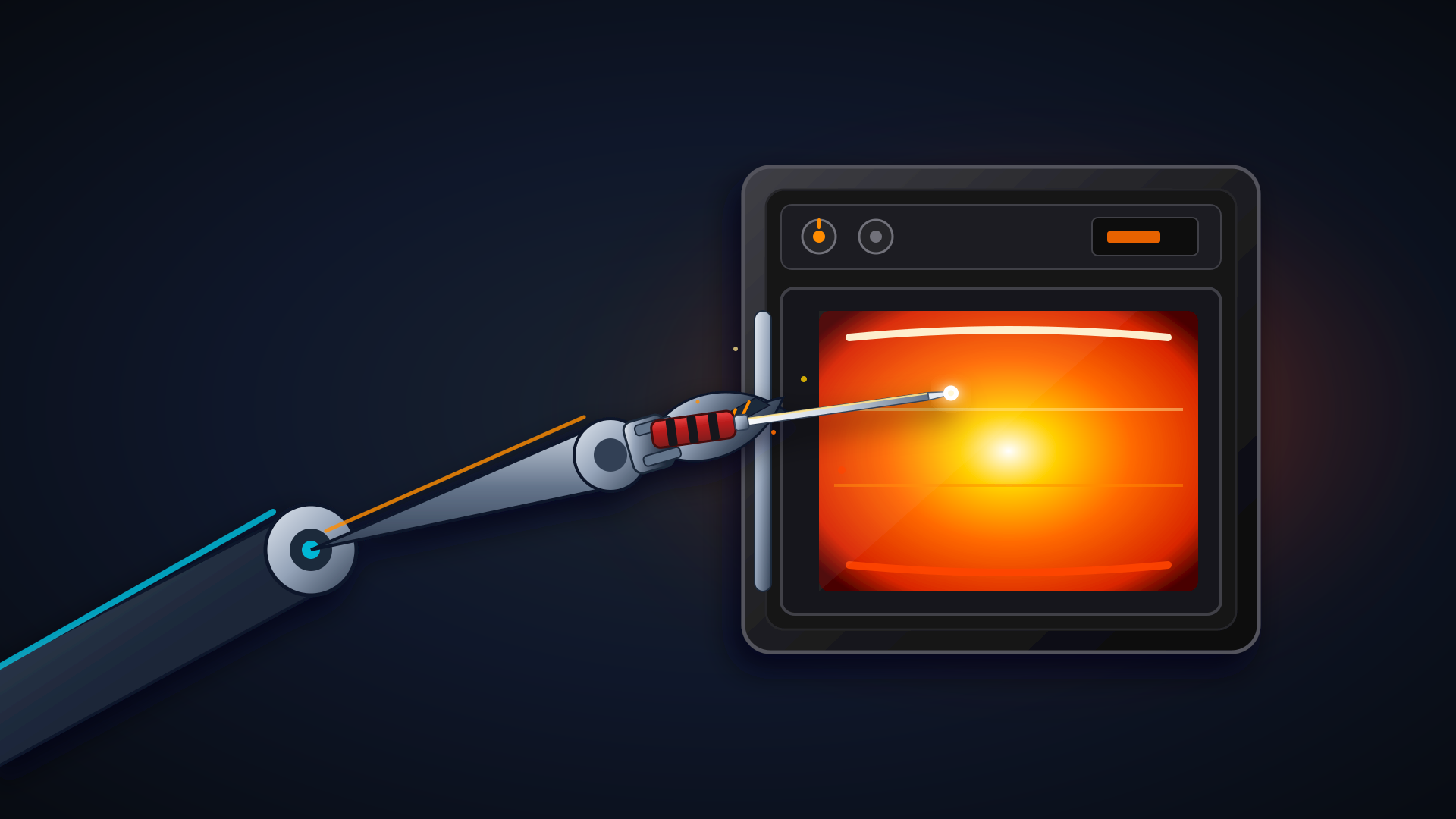
On September 22, 2026, Xiaomi unveiled its latest open-source frontier model, scoring 46.32 on the Artificial Analysis Intelligence Index v4.3. Even more striking than the benchmark score was the itemized invoice published directly on the front page of the technical report: completing the entire reinforcement learning pipeline cost approximately $850,000 for the Flash version and $2.62 million for the Pro version.
The decisive factor in the AI race is pivoting from the sheer accumulation of GPUs toward the verifiable openness of training methodologies. While proprietary model labs routinely construct deterrence behind colossal compute expenditures, Xiaomi dismantled that information asymmetry by livestreaming its complete reinforcement learning run for six consecutive days.
An $850K Bill for the Strongest Open-Source Model
MiMo-V2.6-Pro surpassed Kimi K3 and Qwen3.8 Max with an Intelligence Index of 46.32, making it the most capable open-source model currently available. In terms of API pricing, Xiaomi maintained parity with the previous V2.5 generation. Flash input costs just $0.14 per million tokens, dropping as low as $0.0028 when hitting the prompt cache.
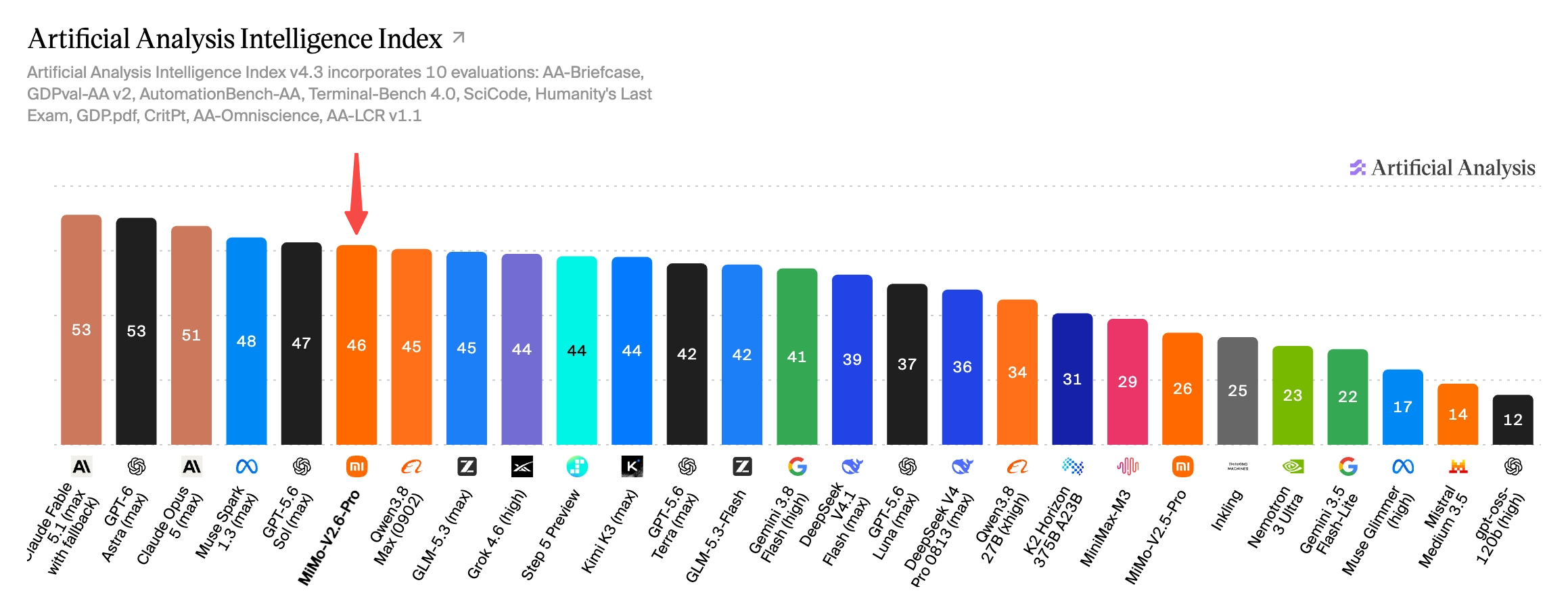 Figure: Artificial Analysis Intelligence Index bar chart, with MiMo-V2.6-Pro leading at 46.32 points. Source: Xiaomi official website
The cost structure of frontier models has undergone a fundamental shift. Capabilities that once demanded hundreds of millions of dollars to tune have now been compressed into the single-digit millions. Open-source models no longer need to bear the inflated premiums of closed-source tech giants.
During actual training, Xiaomi configured updates at 1,568 samples per step while supporting contexts of up to one million tokens. This high-throughput setup allowed the system to process between 3.5 and 3.7 billion tokens per step with sustained operational efficiency.
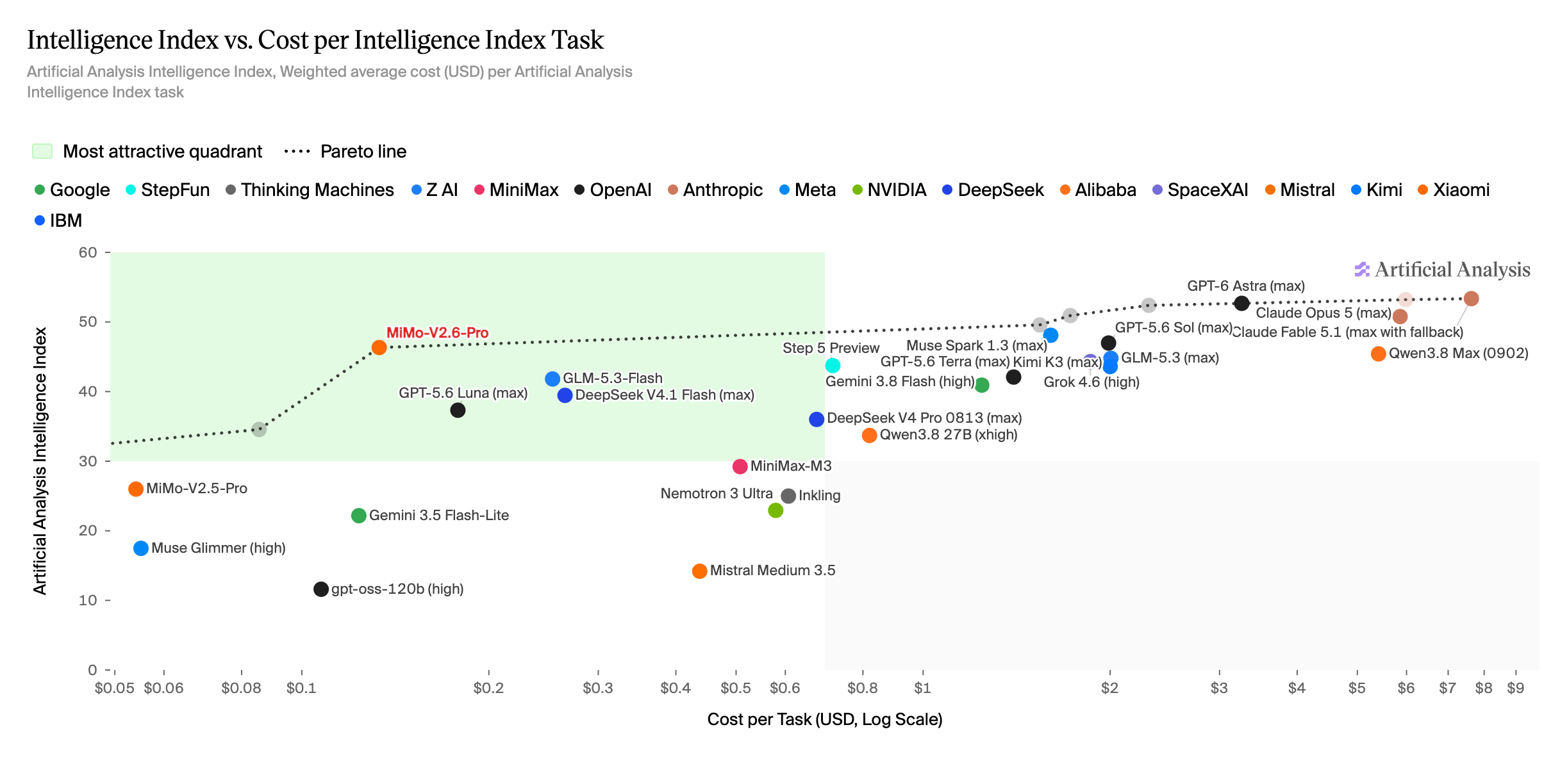 Figure: Scatter plot of Intelligence Index versus cost per task, showing Pro on the Pareto frontier. Source: Artificial Analysis / Xiaomi official website
When the ratio of data to compute is tuned properly, the price-to-performance ratio of machine intelligence grows exponentially. The Pro version landed directly on the Pareto frontier thanks to precise resource scheduling rather than brute-force hardware accumulation.
Livestreamed Training Demolishes the Closed-Source Black Box
The developer community has grown weary of closed-source labs publishing celebratory press releases stripped of technical substance. Xiaomi not only open-sourced the complete technical report and training environment, but also released the underlying reinforcement learning codebase. Over less than six days, Flash and Pro each completed 30 RL steps, generating a combined total of roughly 750,000 trajectories.
Livestreaming the entire pipeline amounts to laying all cards on the table. Anyone can scrutinize the validity of the training setup and reproduce the corresponding performance gains. Closed-source systems hiding behind API paywalls and relying on undisclosed datasets to top leaderboards are steadily losing developer trust.
To mitigate common reward hacking issues in reinforcement learning, the team engineered a four-tiered defense architecture: reward modeling, adversarial evaluation, anomaly detection, and cross-verification by independent verifiers. Furthermore, as the training scale expanded, the team proactively froze the router weights to suppress latent training drift.
Refined engineering execution matters far more than indiscriminate compute dumping. Embedding verification rules directly into the foundation ensures that the model converges in the intended direction across complex, long-horizon tasks.
Performance Curves Defy the Plateau Curse
The long-horizon software engineering benchmark DeepSWE v1.1 serves as an uncompromising litmus test for model capability. In this evaluation, the Flash version jumped from 48.8 to 65.68, while the Pro version climbed from 58.4 to 72.57. Throughout the reinforcement learning process, the curves showed no apparent plateau, maintaining a steady upward trajectory.
By comparison, top-tier closed-source competitors achieved comparable scores: Claude Opus 5 scored 74.0, and GPT 6 Astra scored 74.0. At a fraction of the cost, the Pro version approached the performance ceiling of industry leaders on highly challenging long-horizon development tasks.
Average training task pass rates saw relative improvements of 25% on Flash and 12% on Pro. With well-structured incentives in place, the exploratory capacity of models in complex environments remains far from exhausted.
Expanding Beyond Screens into the Physical World
MiMo-V2.6 does not confine its boundaries to code generation and text reasoning. In official demonstrations, the model spanned workflows from 3D scene construction and Blender modeling to closed-loop robotic arm control. It also generated interactive web frontends, composed MIDI scores, and contributed to materials science by identifying metal-organic frameworks for PFAS pollutant capture.
 Figure: Multimodal demonstration generated by MiMo-V2.6. Source: Xiaomi official website
The ultimate destination for multimodal intelligence lies in the physical realm. Once a foundation model develops an intuitive grasp of spatial and material parameters, it can directly operate robotic arms, 3D engines, and synthesis tools—moving far beyond merely offering passive advice inside a chat window.
Radical Transparency Rewrites the Rules of Competition
Discussions on Hacker News captured the essence of this release. Community praise centered overwhelmingly on transparency: the technical report candidly included benchmarks where the model underperformed, without PR polish. Debates focused primarily on hosting terms and aesthetic choices in frontend demo templates rather than the model’s core claims.
Developers vote with their feet for technical roadmaps they can trust. In an industry saturated with marketing spin, laying bare one’s weaknesses builds the most enduring credibility.
The era of closed-source giants relying on capital moats to deter competition is drawing to a close. Xiaomi turned frontier reinforcement learning into a masterclass accessible to everyone. An $850,000 bill delivered an open-source model capable of challenging the state of the art, with every equation open to public verification. That capability to withstand external audit has become a far sharper competitive weapon than any stockpile of GPUs.
References:
- Hacker News Discussion (item?id=49792730)
- Artificial Analysis Intelligence Index Evaluation Report
- MiMo-V2.6 Official Technical Report