
At $1.00 per million tokens for standard input and just $0.05 for cached reads, developers are getting access to a foundational model sporting a 1M-token context window and 600B total parameters. On October 8, 2026, StepFun rolled out the Step 5 Preview API alongside the announcement of upcoming open-source weights, yanking the debate over model capabilities squarely back into systems engineering and unit economics. When sparse architectures decouple total parameter count from compute, active parameter ratios paired with cache hit rates become the real benchmark. Step 5 lays its cards on the table: low cost in open-weight models is no longer an excuse for trailing performance, but a deliberate target engineered into the architecture. While the model demonstrates staggering burst capability in single-pass coding tasks, it still struggles with long-horizon, multi-step execution. The cost frontier has expanded; autonomous agent execution has not quite caught up.
600B Total Parameters, Just 27B Activated
The primary engineering leverage in Step 5 Preview stems from its massive sparse Mixture of Experts (MoE) architecture. A 600B parameter base retains extensive world knowledge, yet for any single token generated during inference, the model activates a pathway of just 27B parameters. This pivots the parameter arms race away from brute-force scale toward optimizing the active parameter ratio. Dropping active parameters to just 4.5% yields immediate throughput dividends and substantial compute savings.
According to three-day telemetry from OpenRouter, Step 5 achieves a median (P50) throughput of 81 tok/s, peaking at a P99 of 163 tok/s over long context windows. A massive 1M-token context window demands raw generation speed to saturate, and these 27B active parameters are engineered precisely to unblock concurrent read/write throughput. Furthermore, Step 5 natively accepts text, image, and video multimodal inputs, supporting up to 64K tokens of output. StepFun’s published scatter plot illustrates that Step 5 delivers equivalent benchmark performance at a fraction of the compute consumed by comparable peers.
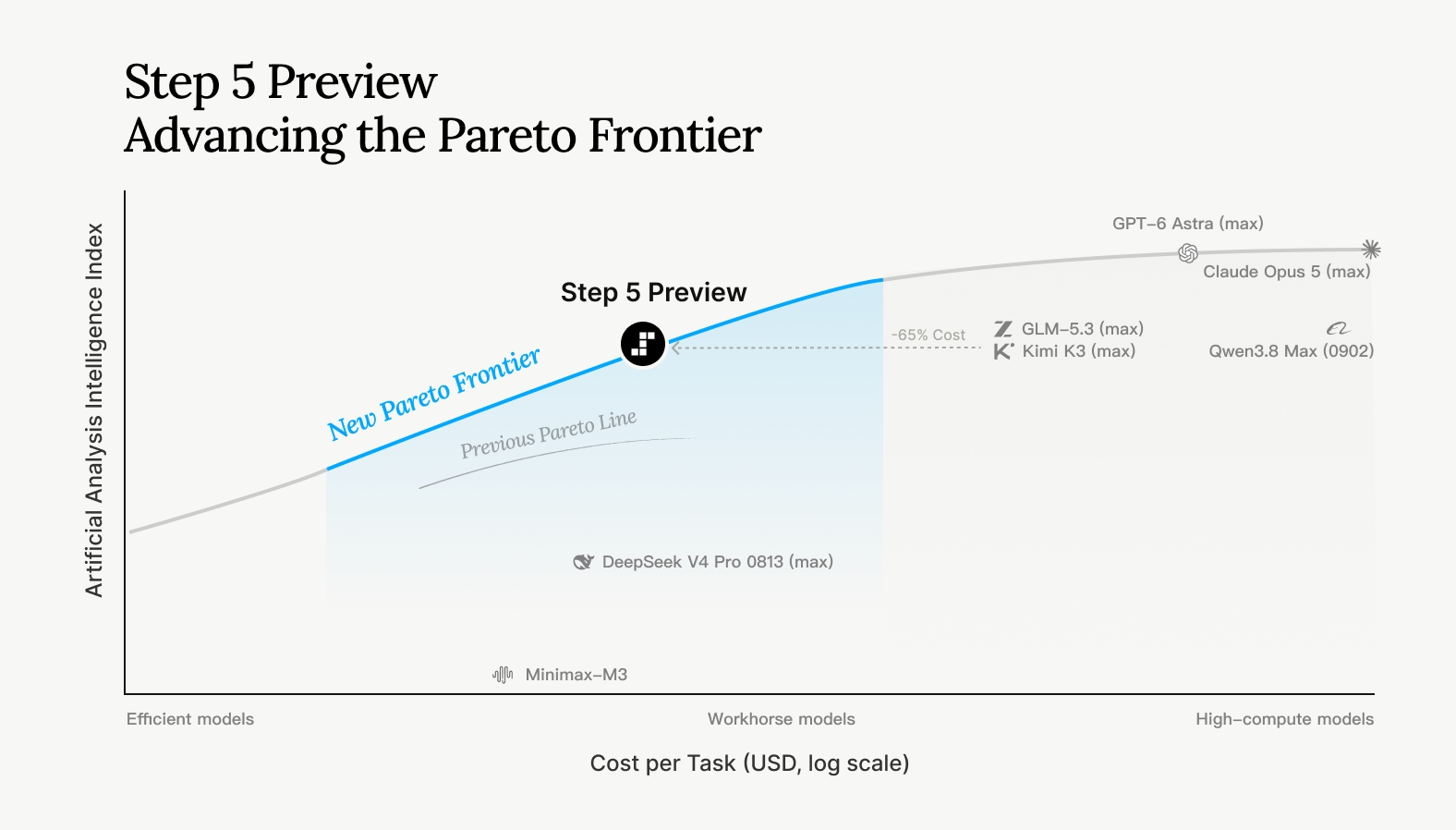 Figure: StepFun’s official “Intelligence vs. Cost per Task” scatter plot, highlighting Step 5’s cost efficiency at comparable intelligence tiers. Source: StepFun announcement
A 600B-parameter behemoth was never meant to run offline on consumer hardware. Commenters on Hacker News quickly pointed out that static weights of this scale cannot fit into the 128GB unified memory typical of high-end developer workstations. Step 5 inherently requires large-scale cloud clusters, relying on extreme sparsity to amortize server-side hardware overhead. It is, by design, an architecture tailored for cloud-native API delivery.
A 95.1% Cache Hit Rate Shatters List Prices
On OpenRouter, Step 5 lists at $1.00 per million input tokens and $2.70 per million output tokens. In isolation, these figures appear respectable but unremarkable amid ongoing API price wars. The real disruption lies in its 95.1% cache hit rate, which slashes the cached read price to a mere $0.05 per million tokens. Evaluating 1M-context API economics without accounting for caching misses the point: frequently reused system prompts and massive reference documents demolish nominal per-token invoices.
Three-day OpenRouter metrics confirm that with caching active, the effective volume-weighted input price plummets to $0.0966 per million tokens. As long as prompts remain warm in the server-side cache, developers obtain frontier multimodal reasoning at the pricing tier of lightweight sub-10B models. StepFun explicitly positions Step 5 as a flagship engine for agentic workflows, showcasing a “Room Planner” demo that reconstructs an editable 3D interior directly from a single photograph of a bedroom.
 Figure: StepFun’s “Room Planner” demo generating an editable 3D environment from a single bedroom photo. Source: StepFun announcement
In iterative workflows where image states are repeatedly submitted and fine-tuned, long-context caching is the sole mechanism capable of preserving low latency while suppressing operating costs. This pricing asymmetry breaks the traditional assumption that quality strictly scales with nominal token fees. High cache hit rates effectively subsidize the compute required during the prefill phase, enabling providers to serve requests at near-zero marginal cost. This economic cushion gave StepFun the confidence to schedule open weights for release on October 15.
Edging Competitors on DeepSWE: Frontier Burst Performance
On code generation and static patch synthesis, Step 5 demonstrates impressive single-turn capabilities. On the DeepSWE v1.1 benchmark, it registered a score of 67.7, narrowly edging out open-weight rivals Kimi K3 Max (67.5) and GLM-5.3 Max (66.9). On StepFun’s proprietary StepCodeBench suite, it posted 49.0, establishing a commanding lead over Kimi (43.9) and GLM (40.2).
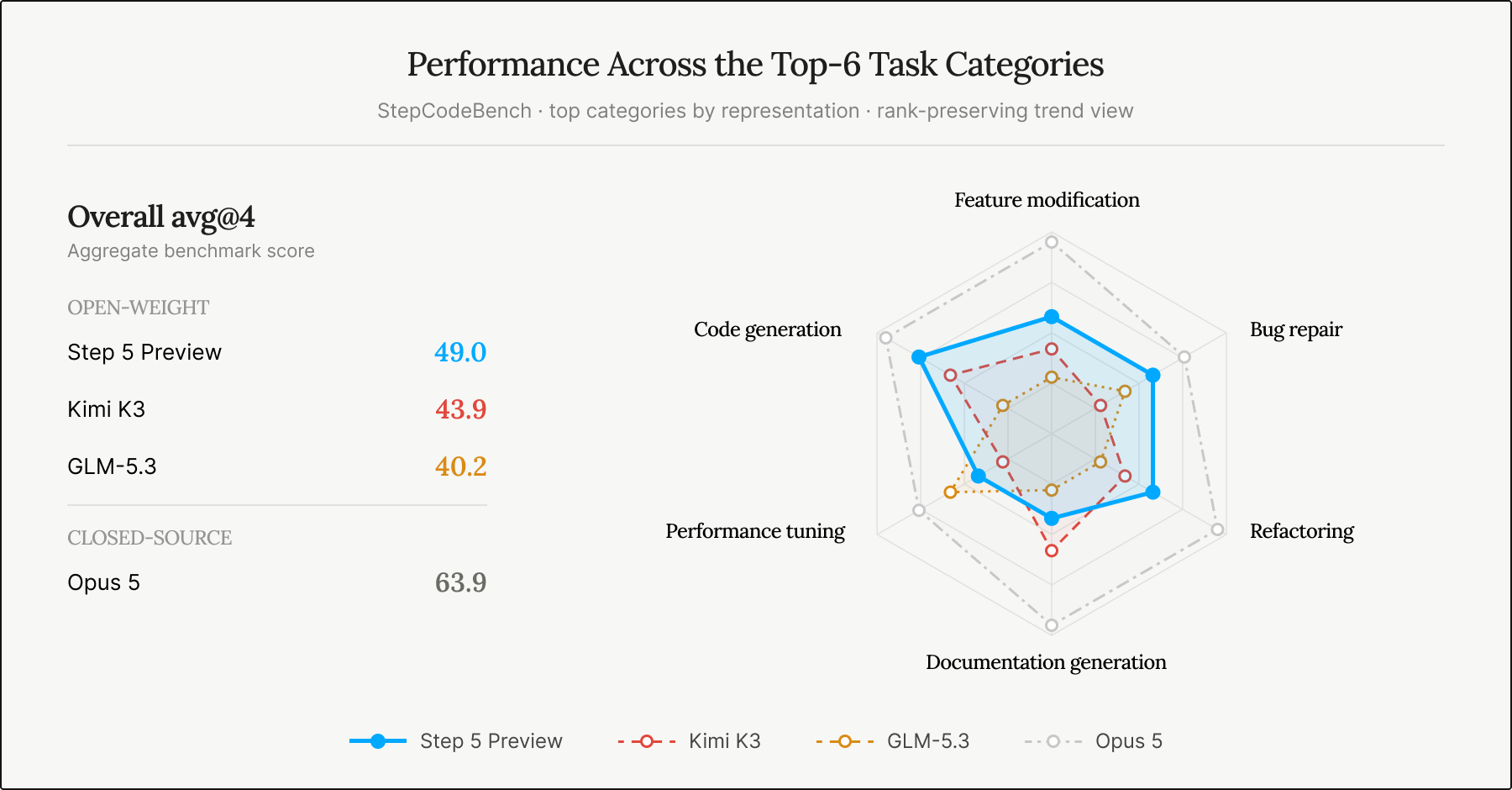 Figure: Official radar chart comparing StepCodeBench across six task categories. Source: StepFun announcement
In static code completion and bug-fixing tasks, open-weight models have steadily closed the gap with frontier closed-source models like GPT-6 Astra (74.1). StepFun emphasizes that StepCodeBench evaluates 553 distinct repositories across 9 task categories and 33 programming languages. On domain-specific benchmarks such as ProgramBench and FrontierFinance, Step 5 notched 80.5 and 66.4 respectively—ranking first in the open-weight category and approaching Claude Opus 5 in targeted financial reasoning.
According to StepFun, roughly 70% of internal and external expert evaluators agreed that the model can autonomously complete medium-to-high complexity programming assignments. These static benchmarks portray a tool model with exceptional punch in bounded technical domains.
A 3.47-Second Latency Hobbles Multi-Step Terminal-Bench Execution
Yet isolated victories on static leaderboards cannot conceal Step 5’s fragility in dynamic, multi-turn environments. On Terminal-Bench v4, which evaluates complex interactive terminal workflows, Step 5 managed only 33.3—well behind GLM-5.3 (41.9) and far adrift from GPT-6 Astra (57.9). Long-horizon agentic workflows require far more than syntactically valid code in a single turn; they demand state stability across dozens or hundreds of filesystem reads and tool calls without context drift.
Telemetry from OpenRouter sheds light on this performance cliff: Step 5 registers an end-to-end P50 latency of 13.05 seconds alongside a 15.15% structured output error rate. In test suites requiring sequences of a dozen or more terminal commands, a P50 time-to-first-token of 3.47 seconds compounds exponentially. As Hacker News discussions emphasized, in agentic scenarios, single-step latencies exceeding 1.5 seconds rapidly erode any throughput advantages.
A 15.15% structured output error rate presents serious friction for tool-use loops. While its baseline tool-calling error rate sits at just 1.81%, schema deviations in JSON formatting or command syntax introduce subtle drift, causing agent loops to abort mid-execution. Step 5 can parse vast codebases and generate precise diffs with ease, but the moment it is asked to run self-correcting terminal loops, high latency and formatting drift become fatal bottlenecks.
Lagging on Composite Indexes: Why Systems Architecture Rewards Outliers
Confronted with this dichotomy, developer sentiment has diverged sharply. On Hacker News, several users cited Artificial Analysis rankings showing Step 5 with an overall composite index of 44, arguing that it fails to stand out across generalized metrics. Others countered that composite leaderboards serve model marketing rather than production engineering: systems architects select models based on the height of their best spikes, not their average baseline.
Since the Step 3.5 and 3.7 iterations, StepFun has focused steadily on tool calling and sub-agent orchestration. As community practitioners observed, Step 5 is not built to chase generic chatbot benchmarks. It is tailored for a specific architectural role: serving as a specialized execution node in personal assistant clusters, ingesting vast code context to output targeted solutions rapidly.
Through architectural sparsity and a 95% cache hit rate, Step 5 converts low operating costs into an explicit design objective rather than a rationalization for compromised quality. Its principal engineering breakthrough lies in dragging 1M-token context windows and specialized code generation into a drastically cheaper cost regime. While its deficits on multi-step benchmarks like Terminal-Bench remain glaring, developers equipped with external orchestration frameworks to mitigate latency traps will find this foundation model’s price-to-performance ratio remarkably compelling.
Reference Links:
- Step 5 Preview Official Announcement
- OpenRouter Model Page
- Hacker News Community Discussion