On November 16, 2026, Alibaba’s Qwen team released Qwen4-Max, the fourth generation of its flagship closed model: a 2.4-trillion-parameter sparse Mixture of Experts with 71B parameters activated per token, native vision, and 1M context. The narrative emphasis has moved. What carries the launch is no longer a stack of benchmark scores but a set of cost figures from Work360 — average cost per task cut from $4.43 to $1.67, a 62% reduction.
An agent that burns $4.43 per run lives inside demo videos; at $1.67, it can actually get scheduled into daily production. That’s the move Qwen4-Max is making: shifting the axis of flagship competition from “how well does it answer” to “how completely does it deliver.”
Cost per Task: From $4.43 Down to $1.67, a 62% Cut
Work360 is Alibaba’s in-house office-task evaluation framework, covering 26 top-level domains, 182 second-level subdomains, and 721 third-level specializations. Qwen4-Max scores 52.69 on it, up from 47.74 for the previous generation Qwen3.8-Max — a 5-point gain alongside the 62% cost drop. Five points is an incremental capability step; the 62% is something else entirely: token consumption went down.
Token usage on Work360 fell roughly 24% and 35% at the Xhigh and High thinking levels respectively, and roughly 48% and 49% on Terminal-Bench 4.0. The bulk of a long-horizon agent’s bill is thinking tokens; the per-token API price is the minor line item. Domestic API pricing dropped from ¥12/¥36 to ¥10/¥30 per million tokens — just 16.7%. Cache-hit pricing dropped to ¥0.5/M, about 66.7%; on the international site, QwenCloud cache hits cost $0.075/M, roughly one-twentieth of input price. Agent sessions routinely run dozens of tool calls, and cache hit rate is the variable that decides whether a long-session bill is survivable.
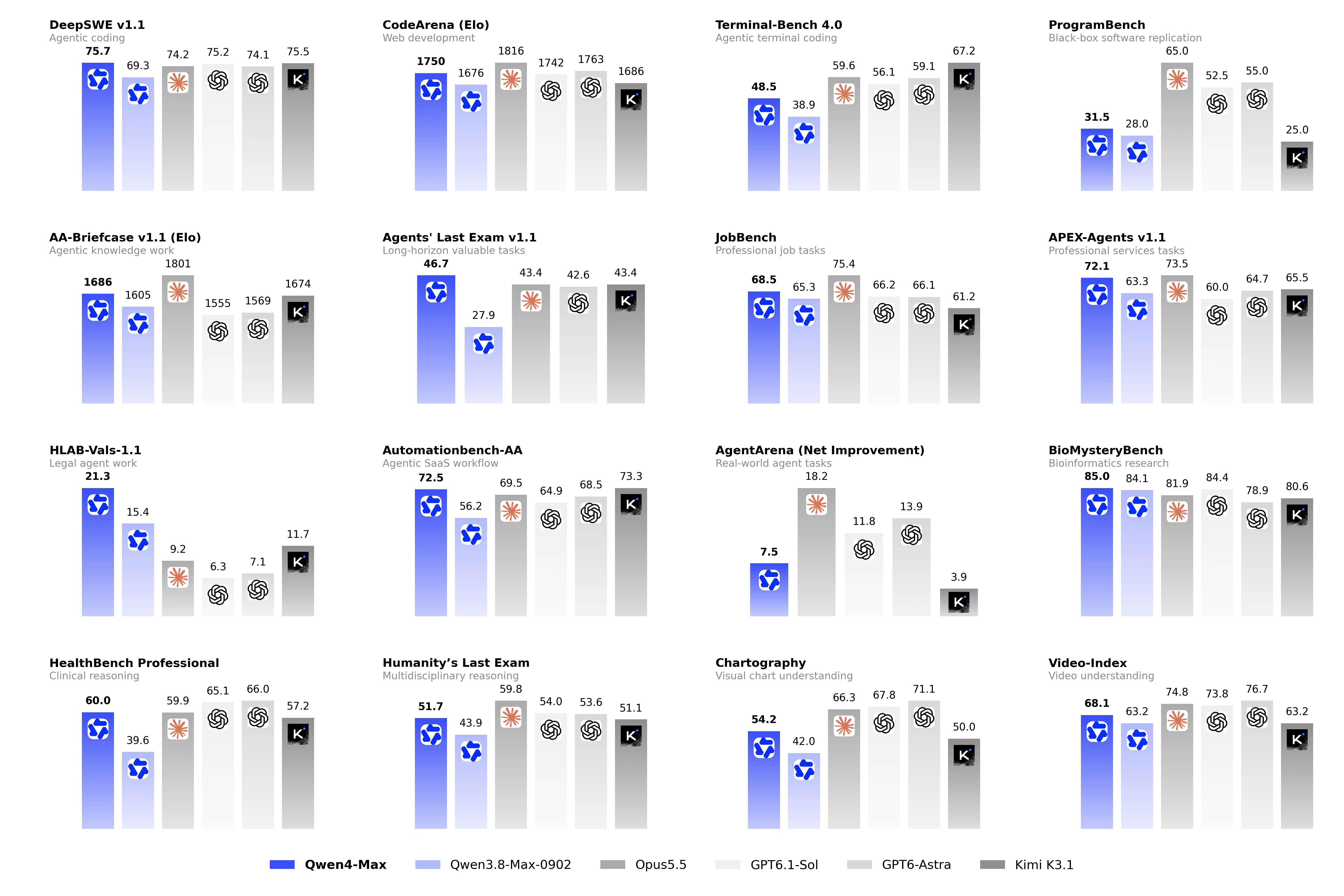
Image: Official composite comparison of Qwen4-Max against the previous-generation Qwen3.8-Max across coding, office, and long-horizon tasks. Note the comparison target is Alibaba’s own prior model; independent third-party evaluations haven’t caught up yet. Source: Qwen official blog
2.4T Parameters, 71B Active: An Architecture Aimed at the Bill
Total parameters sit at 2.4 trillion with 71B activated per token, plus 328B N-gram Embedding parameters — the kind that expand model capacity with almost no added compute. Three architectural changes, each with its own job: GDN (Gated DeltaNet) plus Qwen Sparse Attention (QSA) handles long-context cost, Gated Residual handles training stability, and N-gram Embedding handles local token-pattern representation.
QSA’s approach: each layer first compresses history into a fixed-size state via three layers of Gated DeltaNet, then a lightweight indexer selects relevant context at micro-block granularity, driving down both attention cost and indexing cost on long sequences. Gated Residual uses dynamic read/write gates to control cross-layer information flow across four parallel residual branches, with the payoff landing in training stability. The evidence is straightforward: the 2.4-trillion-scale pretraining run showed a smooth, spike-free loss curve throughout — an achievement that remains rare at trillion-parameter scale.
The math checks out at the Base layer too: on an in-house four-domain evaluation (Knowledge / Code / QA / STEM, 10 × BPB, lower is better), Qwen4-Max-Base’s BPB is roughly 5–13% lower than the previous generation with 25% fewer active parameters — increased sparsity without trading away capability. Note that GLM-5.3 and Kimi-K3.1-Pro in the comparison are post-trained checkpoints; the official blog itself flags the comparability issue, so treat those numbers as vendor claims only.
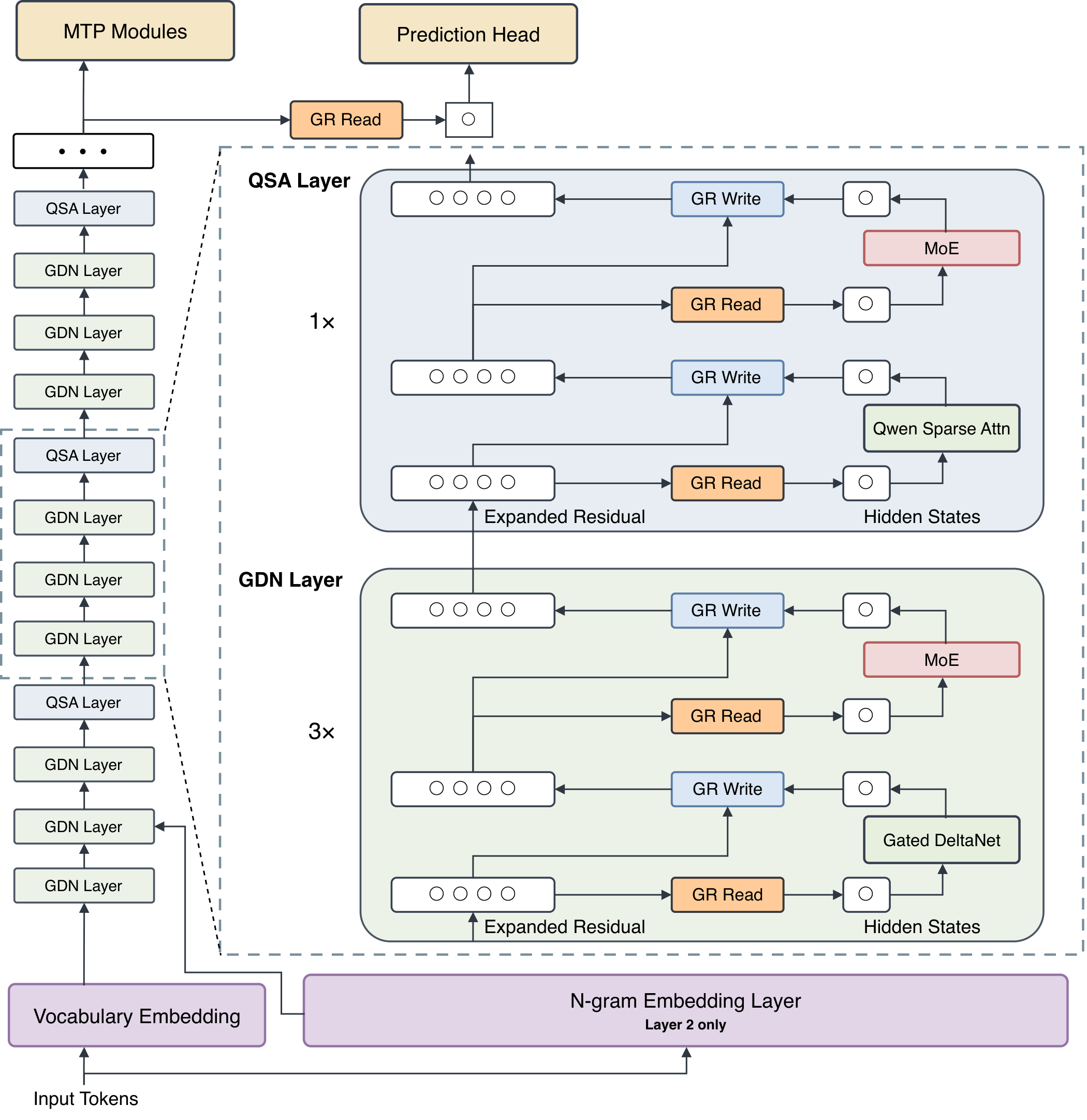
Image: Qwen4-Max architecture. Look at the three Gated DeltaNet layers ahead of QSA in each — history compressed into a fixed-size state is the structural basis for taming long-session attention costs. Source: Qwen official blog
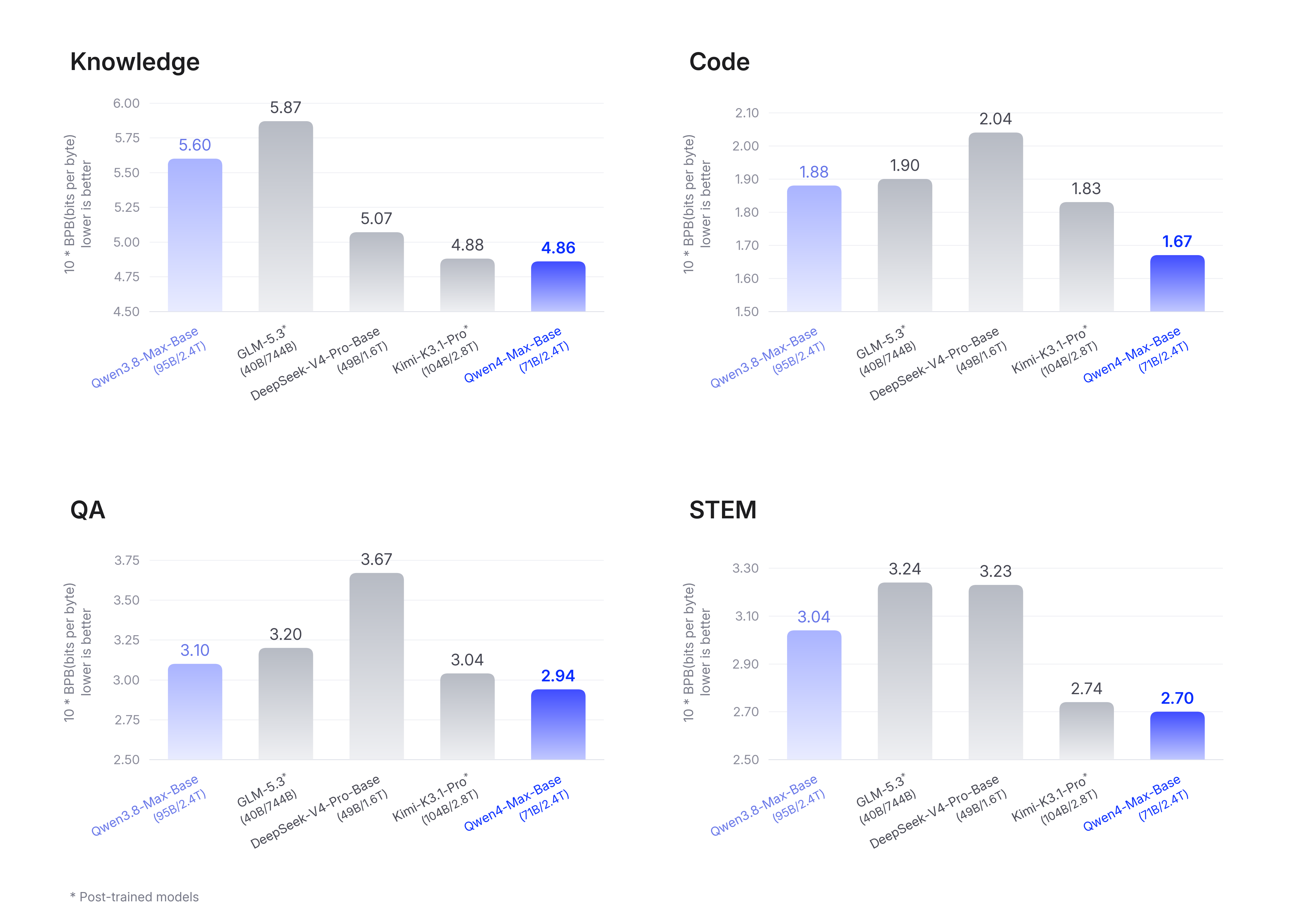
Image: Pretraining evaluation uses 10 × BPB (lower is better). Qwen4-Max-Base posts the lowest score across all four domains among five checkpoints, with 25% fewer active parameters than the previous generation. Source: Qwen official blog
Context is 1M tokens (standard input cap 991K), output cap 393,216 tokens including chain-of-thought, with five thinking levels from none to xhigh. An output cap approaching 400K tokens is enough for one agent run to complete an entire reasoning arc plus a full deliverable set; the five thinking levels are the cost-control dial — same capability, bill adjusted per scenario.
48 Hours, Zero Human Intervention, One Lab Project Completed
Connected to Deep Principle’s Mira wet-dry lab platform, the model ran a materials-discovery pipeline autonomously for 48 hours. The candidate space: 2.7 million molecules — structure screening, property prediction, first-principles calculations, retrosynthetic analysis, and experiment planning, followed by directing an automated wet lab through reagent prep, synthesis, purification, and testing. After four design→synthesize→test→active-learning cycles, the system produced a single experimentally validated new coolant molecule, targeting data-center cooling for next-generation high-power chips.
Tasks like this have feedback loops measured in days and sparse reward signals — historically impossible to hand to an automated system. Two preconditions used to block it: models couldn’t sustain long-horizon coherence, and each trial was too expensive. That second precondition is exactly the problem $1.67 is solving.
The cloud-scheduling case numbers come from real Alibaba Cloud operations: model-call scheduling cost for data labeling dropped 10.42% on average, idle-capacity hours for online GPU allocation improved 4.62%, and solver speed for offline CPU rescheduling hit the optimal target more than 14.61× faster. The 10.42% and 4.62% look modest, but they come from real business ledgers — the model is optimizing the very system that trains it, and the savings flow straight back into Alibaba’s books. The 14.61× solver speedup is unsurprising; writing constraints and tuning solvers is home turf for LLMs.
Drug discovery raises the trial-and-error density further: on DP Technology’s PharmMaster platform, an end-to-end study targeting the NLRP3 inflammasome in Alzheimer’s disease involved 454 tool calls, 3,239 computational metric evaluations, and 24 candidate molecules, with the top pick’s relative binding free energy (RBFE) estimated at roughly 3.6× that of the reference molecule — deemed worth advancing to wet-lab validation. Under the old cost structure, a research line with 454 decision points of trial and error would never have cleared budget approval.
The launch materials also list a string of industry deliverables: on real production lines at SANF and Pacific Union, per-part programming time fell from nearly 8 hours to 24 minutes — roughly 95%. 198 chaotically named legal source documents were sorted into 14 folders, producing an 86-page report covering 12 review domains with every conclusion traceable to a specific document. In critical care, one case with 1,433 raw images and tens of thousands of words of clinical notes completed the full pipeline from extraction to decision support in a single conversation. The common thread: clear acceptance criteria. Reports, runnable programs, production code — only verifiable deliverables earn agents a place in production workflows.
Leaderboard Firsts Are Vendor Data; the Price Sheet Isn’t
In DataLearner’s listings, Qwen4-Max ranks first on Agents’ Last Exam v1.1 (46.70, 1/26), BioMysteryBench (85, 1/26), AutomationBench-AA (72.50, 1/4), and Code Arena WebDev (1750, 1/4), among others — with the data sourced almost entirely from charts in the official blog. Independent leaderboards like Artificial Analysis and LMArena haven’t listed it yet. Work360 is Alibaba’s own framework, and every case video comes from the vendor. In-house benchmarks plus official-chart rankings: apply the appropriate discount to this evidence chain.
The pricing needs no discount. Domestic: ¥10 input / ¥30 output per million tokens. International: $1.5 input / $4.5 output, $0.075 cache hits. The price list is published on the platform — contract fact, with no room for methodology disputes.
The competitive boundary also deserves acknowledgment: on complex terminal engineering and black-box reproduction scenarios, Kimi K3.1 and Opus 5.5 still hold a significant scoring lead. Qwen4-Max scored 48.48 on Terminal-Bench 4.0, ranking 13/58, and 15/120 on Vibe Code Bench v1.1. Its cost-performance edge concentrates in high cache-reuse scenarios, long-context multimodal office work, and legal and bioinformatics agents — the hard nut of terminal engineering remains uncracked.
The hottest community discussion on launch day was the “pelican riding a bicycle” drawing test. Simon Willison ran it at all four thinking levels — none/low/high/xhigh — and commenters were quick to point out that such tests have long since made it into training sets. On launch day, the independent signals available to outsiders are essentially zero; that’s the standing dilemma of the evaluation ecosystem, and Qwen4-Max is just the latest specimen.
Flagship Stays Closed; Open Weights Await the Smaller Sizes
Qwen4-Max ships closed-weights only, via API and platform services, with interfaces compatible with both OpenAI and Anthropic formats. Alibaba says the smaller Qwen4 series models will be trained with the same techniques and open-sourced over time, but has made no commitment to open the Max flagship; anyone needing on-prem deployment is still stuck with Qwen3.8-Max’s released weights this generation. Closed flagship protects revenue, open small models feed the ecosystem — Alibaba has this playbook down cold.
One easily overlooked line: secure coding. On Last Secure Code Bench, the functional-level rate of passing both functionality and security checks rose from 22.0% to 31.8%; the rate of simultaneously secure generation across function, file, and repository granularity went from 8% to 14.7% — nearly doubled. The absolute numbers remain unimpressive: under 15% at triple granularity means human review of agent-written security-sensitive code can’t be trimmed by a single line. But the slope from 8% to 14.7% points the right way, and Alibaba has moved offensive-security data out of the training set, keeping only defensive tasks.
Step back, and the switch this launch flips is the cost curve: $1.67 lands inside the price range where enterprises will tolerate per-task trial and error; $4.43 doesn’t. Leaderboard scores can be questioned as vendor-chart artifacts; case videos can be suspected of staging. The price sheet leaves no room for dispute. Qwen4-Max hasn’t beaten Kimi K3.1 or Opus 5.5 at terminal engineering — what it has won is getting long-horizon agents scheduled on production budgets and into daily workflows for the first time. At the next flagship launch, parameter count will probably move to the second line of the spec sheet; the cost curve has already taken that seat.
References:
- Qwen official blog: Qwen4-Max launch announcement
- DataLearner model leaderboard listing
- Simon Willison: drawing test records across four thinking levels