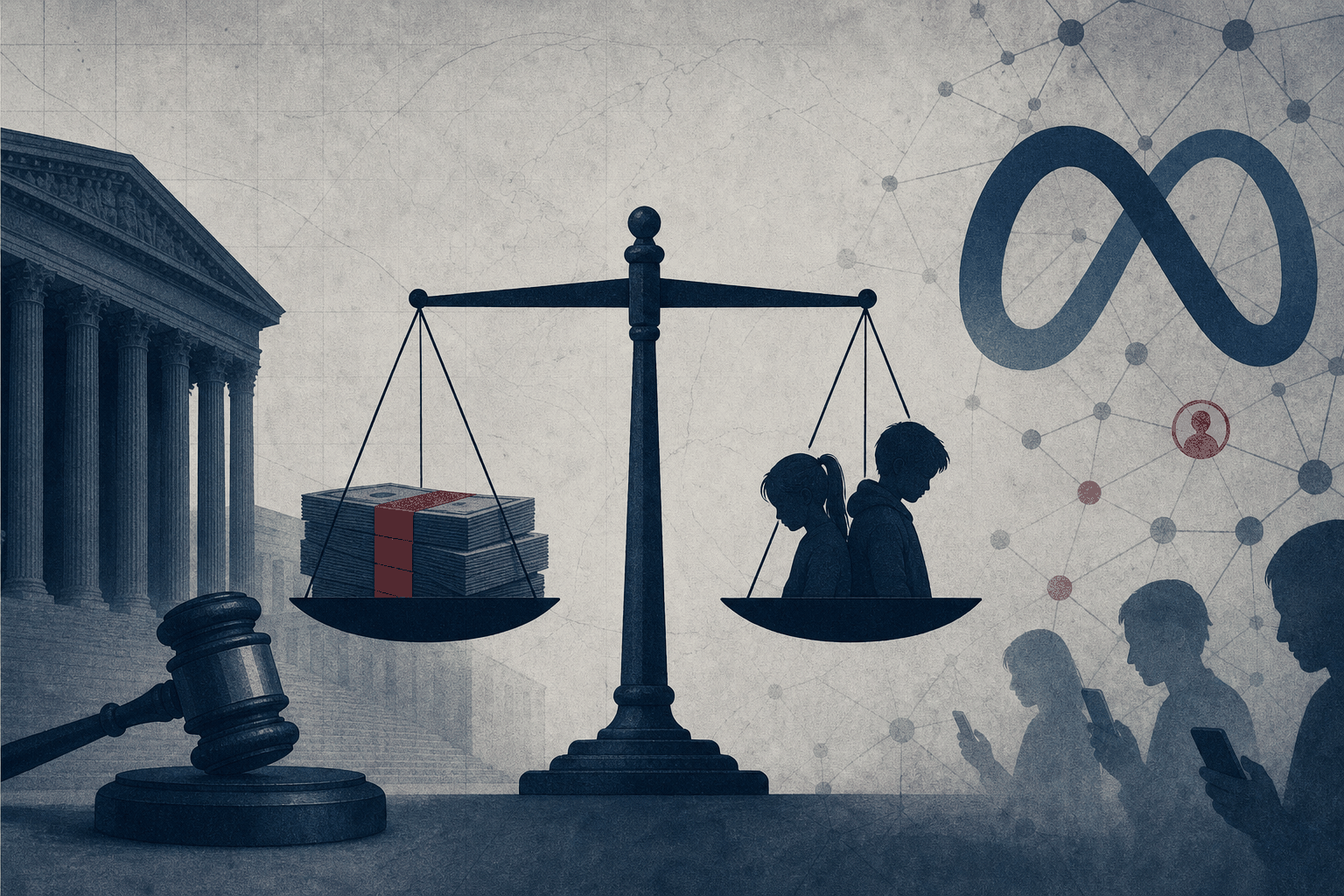
On August 6, 2026, a New Mexico court ordered social media giant Meta to pay $567 million in damages, finding that Facebook and Instagram caused harm to children’s mental health. Meta is the parent company of both platforms and one of the largest social networking corporations in the world.
This is the second order issued in the same lawsuit. In March of this year, a jury in the state ordered Meta to pay $375 million—marking the first time in US history that a jury held Meta liable for platform-related harms. Together, the two rulings total $942 million. The judgment clearly outlines how the funds must be spent: $420 million will fund mental health treatment for New Mexico youth, while the remainder is earmarked for preventive outreach, screening, and evaluation, distributed over a five-year period.
The funds will not be distributed directly to individual children; instead, they are entrusted to the state government to remediate the damage. Judge Bryan Biedscheid held in his ruling that Meta’s platforms constituted a “public nuisance”—drawing an analogy to a factory discharging pollutants into a river, but here polluting the mental health of children.
 Image: File photo of Mark Zuckerberg appearing in court in February this year. Source: theguardian.com
How a Small State of 2 Million Defeated a Tech Giant
In late 2023, New Mexico Attorney General Raúl Torrez filed suit against Meta and Mark Zuckerberg, presenting three levels of allegations: algorithms pushed inappropriate adult content to minors; product features were deliberately designed to foster addiction; and the company concealed internal findings regarding harm to children. New Mexico has a population of just over 2 million—roughly equivalent to a mid-sized city—yet it became the first state in the nation to win a court trial against Meta.
The key was evidence. Internal materials presented during the trial revealed that Meta’s algorithms actively directed adult users toward content published by teenagers; furthermore, company leadership had long known that Instagram posed mental health risks to teen girls but chose not to disclose it. A 2023 Guardian investigation also disclosed that Facebook and Instagram had served as contact points for child sexual exploitation, with former content moderators testifying that reported safety violations were left unhandled. Based on this evidence, the jury concluded that Meta intentionally harmed children’s mental health and concealed known risks, violating the state’s Consumer Protection Act.
What Were the Specific “Wrongs” Identified by the Judge?
The court ruling explicitly called out several product design choices: infinite scroll that prevents users from reaching the bottom of a feed; autoplay that feeds videos continuously one after another; visible like counts that compel users to check back repeatedly; and push notifications that constantly remind users that “someone liked your post.” The unified objective behind these features is to maximize user screen time. For adults, this is at most a time sink; for adolescents whose brains are still developing, these mechanics repeatedly hijack attention. In the judge’s words, teenagers are “particularly susceptible to features designed to maximize engagement.”
 Image: Instagram interface on a mobile device (file photo). Source: pbs.org
Beyond monetary damages, the court ordered mandatory product changes. In New Mexico, push notifications and total usage time for users under 18 will be capped at 90 hours per month (averaging roughly 3 hours per day), and like counts must be hidden. Meta is also required to overhaul its age verification system: deploying AI models based on friend connections and posted content to infer user age, developing an “under-13 prediction model” within two years; requiring users suspected of being under 13 to provide age documentation; offering a dedicated portal for schoolteachers to report suspected underage accounts; and purging data collected from users under 13.
One notable detail: the judge did not mandate strict, universal age verification for all users. First, US federal child privacy law (COPPA) prohibits platforms from collecting personal identification data on children under 13 to verify age; second, requiring age verification solely from Meta would create an unfair advantage for competing social platforms. The judgment sought to reform Meta’s behavior without setting rules that apply to only one player—a nuance reflecting judicial caution.
What Does $942 Million Mean for Meta?
Consider the macro scale first: Meta generated approximately $60 billion in net profit in 2025, meaning $942 million represents less than a single week’s earnings. On the evening of the ruling, Meta’s stock dropped by less than 0.5%. From this perspective, it is indeed a minor financial blip.
However, when calculated locally, the impact looks vastly different. Tech community members broke down the state-level economics: New Mexico has just over 2 million residents. Proportionally distributing Meta’s US and Canada revenue by population, the company earned roughly $1.5 billion to $2.0 billion in the state over the past five years. The $942 million verdict effectively wipes out more than two years of local revenue. For any corporation, losing more than two years’ worth of revenue in a regional market is significant enough to alter business strategy.
On a per-capita basis for affected minors: New Mexico has approximately 450,000 children under 18, including about 140,000 aged 13 to 17. Given nationwide statistics showing ~70% of teens use Instagram and ~30% use Facebook, the state has roughly 100,000 registered teen users, plus an estimated 30,000 under-13 users who bypassed age controls. This brings the total affected minors to around 130,000. Dividing $942 million by 130,000 equals roughly $7,250 per child. Commentators joked that this resembles a bounty paid to kids for “discovering a dangerous platform”—ironically funded by the advertising revenue Meta extracted from those very children.
Nevertheless, these funds are unlikely to be paid out immediately. Meta has firmly rejected the verdict and announced plans to appeal. In the US judicial system, large first-instance awards against major corporations are frequently reduced or overturned on appeal, and most HN discussions expect the final penalty to be scaled back. The key question is whether the court’s mandated product changes—usage limits, hidden likes, and revised age verification—will be enforced during the appeal process.
Why Is This a Landmark Precedent?
Because it serves as the first falling domino. Prior to New Mexico’s victory, “social media harm to minors” was largely a topic of public debate; after this court win, it established a legal blueprint that other states can replicate. Currently, over 30 US states are suing Meta: Tennessee’s trial is underway, and a federal court trial in Oakland, California opens this month as part of a 29-state joint action. Additionally, thousands of families have filed individual lawsuits; in late July, four families of teenagers who died by suicide jointly sued Meta, TikTok, Snap, and YouTube.
 Image: Meta faces multiple lawsuits over child safety allegations (file photo). Source: france24.com
Northeastern University researcher Laura Edelson, who studies social media safety, noted that while the US is unlikely to enact a blanket ban on social media platforms, states have finally discovered a legal mechanism to constrain tech companies when they know their product designs harm users. This assessment strikes at the core: the true value of this verdict lies in establishing the principle that profiting off algorithms that harm children will carry a heavy cost. Whether that principle holds firm will depend on how the appeals court rules.
For parents, this case does not offer a definitive answer on whether children should use smartphones, but it delivers a clear signal: when corporate profits conflict with children’s health, the law is beginning to side with the kids.
References
- The Guardian: New Mexico court orders Meta to pay $567m
- HN Discussion (item?id=49204352)
- New Mexico Attorney General’s Office Statement
- PBS NewsHour / AP: New Mexico court orders Meta to pay $567 million
- France 24 / AFP: Meta ordered to pay $567 million in New Mexico child safety ruling