
On October 7, 2026, a blog post titled “Why Industry Is Not Panicking Over DeepSeek 4.1 Flash” began circulating across the developer community. Its author, jonotime, presented an eye-opening metric: after a month of heavy usage across more than a dozen complex software development projects, his total invoice came in at under one dollar. In an industry accustomed to monthly subscriptions running tens of dollars per seat, a sub-dollar monthly bill is startling. When unit compute costs plunge to this level, they do more than trim monthly expenses—they fundamentally reshape how engineers allocate tasks to machines.
Even Desktop File Organization Becomes Worth Delegating to AI
In the post, the author candidly recounted his daily experience. Over four weeks of intensive development, whenever he refrained from checking the model name displayed in the top-right corner of his IDE, he honestly could not tell whether he was interacting with the premium Claude Opus or the dirt-cheap DeepSeek 4.1 Flash. In conversational flow, instruction adherence, and response latency, there was no discernible difference in everyday workflows. This field report upended a long-standing assumption in tech circles: that without paying top dollar for cutting-edge frontier flagships, high-quality engineering outcomes remain out of reach.
The pricing sheet reveals the mechanics behind this cost collapse. During off-peak hours, DeepSeek charges $0.15 per million input tokens and $0.60 per million output tokens. The true game-changer, however, lies in cache-hit pricing, which plummets to $0.003 per million tokens. One million tokens spans roughly two full-length novels; processing that much context costs less than a single piece of candy. This pricing structure turns previously unthinkable workflows into viable habits.
Previously, developers hesitated to delegate mindless, repetitive grunt work because every prompt burned compute budget. Now, the author casually delegates chores as mundane as reorganizing desktop files without a second thought. Spending $0.003 to save five minutes of manual effort is, for the first time, economically rational. Leaving an automated script looping in the background all day to iterate through trial-and-error tasks is no longer an extravagance requiring careful budgeting.
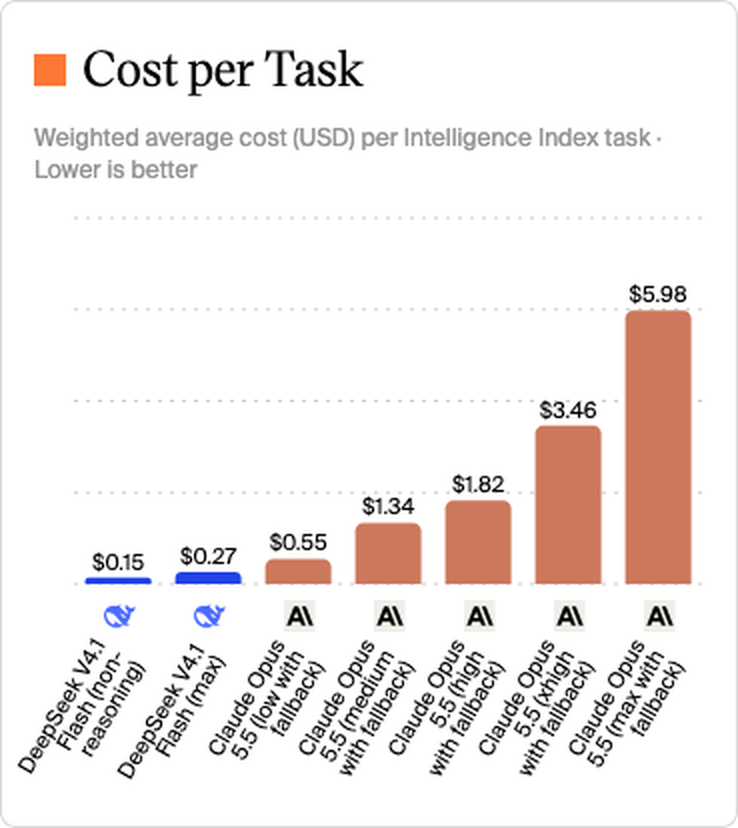 Figure: Estimated cost comparison across models for identical workloads. Source: dgt.is blog
Slashing Redundant Compute Memory by 437x
This dramatic price plunge is powered by architectural optimizations that eliminate redundant compute. The DeepSeek engineering team compressed the cache footprint used for context memory by approximately 437 times compared to their first-generation architecture. That 437x reduction is the primary technical lever determining whether large-scale AI inference can become universally affordable.
An LLM can be compared to an assistant with blazing reading speed but negligible memory retention. Historically, with each follow-up question in an ongoing dialogue, the assistant had to re-read the entire preceding conversational context from scratch just to interpret the latest instruction. This perpetual re-reading consumed massive amounts of expensive GPU VRAM—the single largest cost sink in long-context interactions.
The breakthrough lies in teaching the assistant to maintain ultra-compact notes. The system compresses previously read tokens into microscopic memory footprints and caches them long-term in GPU memory. Whenever subsequent turns in a conversation share the same prefix conditions, it retrieves the compressed cache directly, skipping the energy-intensive and resource-heavy re-reading phase. This engineering leap translated directly into a financial cliff for API costs.
 Figure: The orders-of-magnitude gap across DeepSeek’s three pricing tiers; the cache-hit rate is barely visible on the chart. Source: Mercatus AI pricing analysis
Self-Hosting Hardware No Longer Makes Financial Sense
When cloud API prices drop to fractions of a cent, the economics of hardware deployment unravel. Over the past few years, countless SMBs and independent developers invested heavily in dedicated GPUs and on-premise servers, primarily to escape steep per-token cloud bills. The hope was that running hardware continuously would eventually amortize the upfront capital expenditure.
Against this new pricing reality, buying hardware to save money becomes a sunk cost trap that never breaks even. At $0.003 per million tokens, an enterprise would have to run a rig at full throttle for years just for token savings to cover the initial down payment on a single high-end enterprise GPU. Expensive hardware depreciates and becomes obsolete far faster than cloud inference prices fall.
The final rationale for on-premise deployment has been data privacy—and even that moat is drying up. The optimization techniques shrinking memory footprints by hundreds of times are rapidly trickling down to the open-source community. It won’t be long before standard consumer PCs can smoothly run complex architectures that previously demanded enterprise-grade server clusters.
The $0.003 Price Tag Only Pays Off in Specific Workloads
Rock-bottom per-token pricing does not mean every task gets cheaper—a nuance where many stumble into a logical trap. In developer discussions, an engineer leading the implementation of a new programming language shared his empirical benchmark results. He initially positioned DeepSeek 4.1 Flash as the high-level orchestrator responsible for project planning and architectural decomposition.
The result was a precipitous quality drop. When faced with complex architectural decisions, the low-cost model frequently overlooked critical contextual dependencies, fabricating unsound system designs with no prior deliberation. Its generated documentation was verbose and unfocused. The engineer ultimately returned orchestration responsibilities to the expensive frontier model, delegating only well-specified, tightly bounded code implementations to the cheaper alternative. It excels at laying bricks, but cannot draw the blueprints.
A benchmark named “Pac-Man” illustrated this reality even more starkly. On an identical complex task, the expensive frontier model completed execution in 9.3 minutes, cost $1.99, and earned a score of 99. The cheaper model finished in 2.8 minutes, cost $1.89, but scored only 72. The total expense differed by a mere ten cents ($0.10), yet the quality gap was enormous. The $0.003 unit rate advantage vanished completely once the nature of the task shifted.
This sparked a parallel discussion: one contributor calculated that depending on numerical precision, hosting large frontier architectures requires between 416 GB and 1,664 GB of memory. Meanwhile, the memory chip manufacturing sector has historically faced antitrust fines for price-fixing cartels. High hardware memory pricing remains a steep barrier to widespread AI adoption. Driving compute costs down is a fight that extends well beyond algorithmic researchers.
Collapsing Compute Costs Shift the Gravity of AI Applications
Synthesizing these insights yields a grounded view of AI inference economics. Rock-bottom unit pricing is achievable only in workflows heavily dependent on high cache-hit ratios. As soon as a task demands extensive open-ended reasoning, architectural exploration, or autonomous planning, the unit-price advantage is instantly swallowed by low success rates and costly retry loops.
This explains an ongoing industry paradox: certain enterprises would rather purchase an array of tier-1 subscriptions and configure complex load balancers than refactor their underlying software architecture. When high-priority quotas run out, they vent on social media about compute bottlenecks. This highlights a persistent misunderstanding of how low-cost compute should actually be leveraged.
The significance of DeepSeek 4.1 Flash is not that it displaces elite frontier models in solving frontier scientific challenges. By slashing context memory requirements by hundreds of times, it opens up an entirely new operational tier: the category of “low-value chores unworthy of an AI” has been economically wiped out. Cheap tokens do not guarantee cheap tasks; when you task an affordable model with high-level architectural design beyond its capabilities, the trial-and-error cycle will still rack up heavy expenses. The next time we see sub-cent API rates, the key question is no longer how cheap it is, but what kind of work we feed it.
Reference Links:
- Why Industry Is Not Panicking Over DeepSeek 4.1 Flash
- Hacker News Discussion: Empirical testing on a new compiler project
- Mercatus AI Pricing Analysis Report


