Over the past decade, engineering teams in the lakehouse space have poured immense effort into teaching object storage how to behave like a transactional database. In cloud-native architectures, vendors defaulted to stringing together endless text files and log streams to cobble together system consistency. Released in April 2026, DuckLake 1.0 proposes a far more straightforward approach: moving table metadata out of JSON manifest files stored in object storage and into a genuine relational database.
Much of the complexity that plagued lakehouse formats over the past ten years stems from forcing object storage to handle tasks that fundamentally belong to a database. DuckLake returns the metadata plane to an ACID-compliant transactional database, eliminating the need to endure cumbersome compaction operations for snapshots, time travel, and small-batch writes. Yet a 1.0 specification is a far cry from production-ready software: this architecture of solving modern challenges with a classic tech stack faces its true hurdle in access control models and implementation maturity.
Moving Metadata Management Away from Object Storage
In mainstream practice, formats like Apache Iceberg require generating a new snapshot JSON, manifest list, and manifest files with every data write. While this static management mechanism works well for infrequent, large-batch ingestions, in workloads characterized by high-frequency, small-scale writes, the number of metadata objects can quickly outnumber actual data files. Simulating transactional mechanisms on object storage via static text files inevitably bogs down file listing operations as scale expands, sending API call costs soaring.
DuckLake cuts through this architectural bloat by decoupling the system into three distinct layers. At the bottom, storage remains Parquet files hosted on object storage or local disk; at the top, the compute engine remains fully pluggable. In between, the critical catalog layer becomes a full-fledged SQL database, currently compatible with PostgreSQL, SQLite, MySQL, and even DuckDB itself. By housing schema evolution, partition metadata, and column statistics directly inside relational tables, query engines no longer need to traverse mountains of tiny files just to resolve the current state of a data snapshot.
Writing metadata directly as database transactions eliminates the overhead of deploying and maintaining dedicated REST services such as Apache Polaris or Unity Catalog. In the Iceberg ecosystem, isolated catalog operations frequently turn into physical bottlenecks along the write path, dragging down the entire ingestion pipeline if mismanaged. DuckLake shifts the system’s performance constraints away from object storage I/O latency back toward the engineering world’s well-understood domain of database concurrent transaction processing.
Absorbing High-Frequency Small Writes with Relational Tables
To address the rapid data updates typical of real-time data warehouses, DuckLake introduces a dedicated data inlining mechanism. When small-batch insert, update, and delete operations arrive, they no longer immediately trigger a rewrite of underlying Parquet files; instead, the data is written directly into the catalog database. This design converts fragmented I/O requests into efficient internal database transactions, neutralizing the small-file problem right at the source.
Only when the backlog in the database reaches a configurable physical threshold does a background system process trigger a flush to compact and generate standard Parquet files. This deferred-write strategy eliminates the need for aggressive, compute-heavy compaction routines that run constantly just to clean up small files. At the same time, it substantially curtails network transfer overhead and read costs against object storage, allowing the system to sustain high-concurrency read/write workloads while preserving physical data block continuity.
Beyond buffering small writes, DuckLake supports designated sorting keys during underlying scans. During subsequent file compaction cycles, the engine strictly maintains the predefined physical order. Keeping underlying data files ordered allows the query engine to leverage range pruning and filter pushdown directly, skipping irrelevant storage blocks during the scan phase.
A Minimalist Spec Enabling Broad Compute Engine Integration
DuckLake positions itself as an open technical specification, having already garnered over 3.2k stars on GitHub. Commercial backer MotherDuck endorses the project and provides a free handbook. In official blog posts, the team candidly notes that the specification is so simple and transparent that even code-generation LLMs can quickly produce a compatible implementation for DataFrames directly from the docs. Lowering architectural complexity so an individual developer can reproduce it independently is an effective early strategy for winning over ecosystem contributors.
 Figure: The specification is simple enough that even LLMs can implement a DataFrame client. Source: DuckLake official blog card image
Decoupling the specification from any single query engine ensures the standard is not tightly coupled to DuckDB. As long as a target engine understands relational metadata and the underlying Parquet format, popular analytics frameworks like Trino and Apache Spark can readily connect as compute layers. In the Apache DataFusion ecosystem, open-source contributors have already built a dedicated lakehouse client written in Rust.
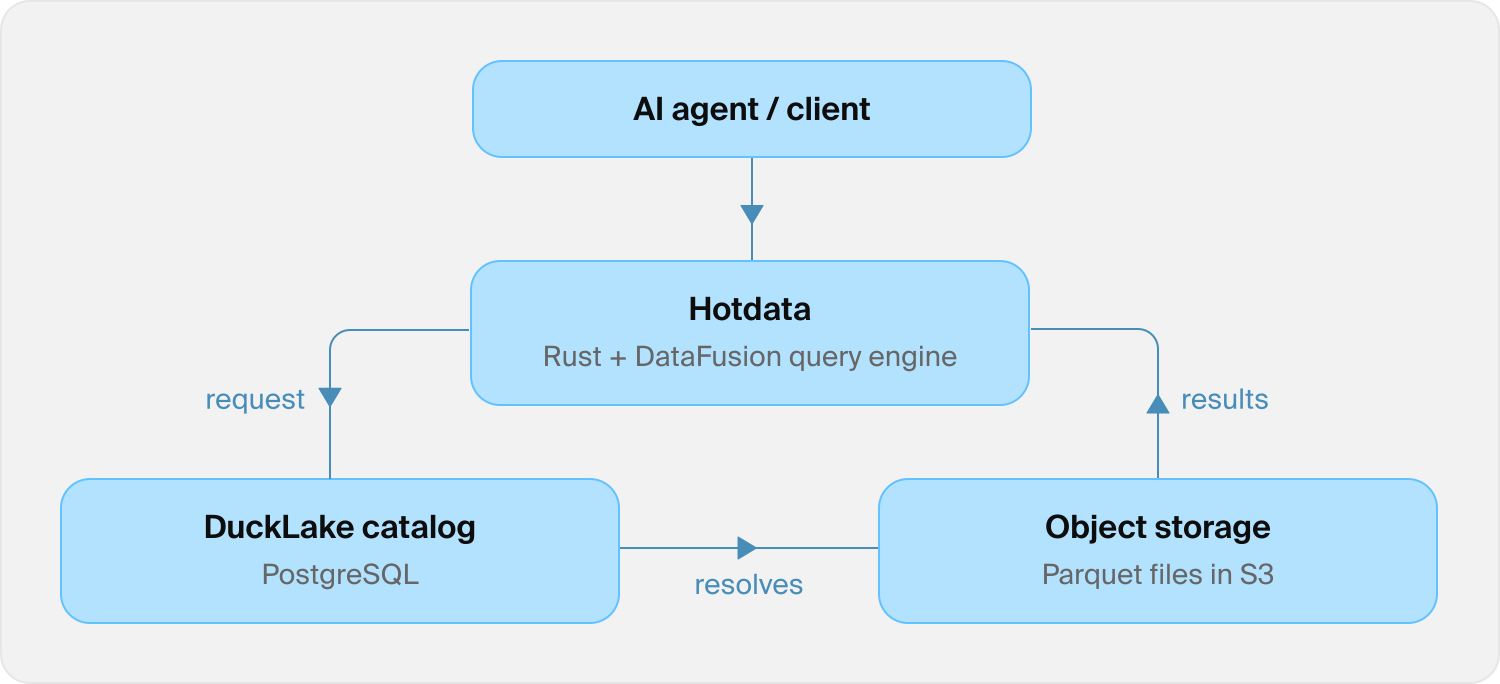 Figure: Architecture diagram of the DuckLake client within the DataFusion ecosystem. Source: DuckLake official blog card image
This community-developed client uses Postgres as its backend metadata store. Project maintainers report that even under intense concurrent query pressure, this lightweight architecture consistently delivers sub-second response times—matching the performance of custom metadata systems previously built for bespoke workloads. This demonstrates that offloading catalog management to mature relational databases delivers tangible engineering value in highly concurrent multi-reader scenarios.
Spec Releases Cannot Conceal Access Control Limitations
Although the 1.0 specification was released under the MIT license with a commitment to backward compatibility, community adoption reveals notable operational friction. Engineers testing v1.5.4 reported severe bugs where catalog filtering caused incorrect record counts. After switching to the main branch to pick up the fix, DuckDB’s built-in SQL parser suffered a catastrophic 10x performance regression. Such volatility between releases makes rigorous boundary and stress testing mandatory before any team introduces it into mission-critical pipelines.
Community discussions have converged on the system’s most glaring deficiency: its primitive access control model. Current permission enforcement is exceedingly coarse, limited only to granting or denying access at the underlying bucket level. The architecture completely lacks enterprise staples such as column-level access control, row-level security, and column masking for data obfuscation. Without these safeguards, the system resembles an unfortified reservoir.
Lacking a fine-grained security layer severely restricts this lakehouse architecture in corporate enterprise analytics. Unable to enforce secure data isolation across teams, the specification is currently best suited for internal developer sandboxes managed by a single team, rather than strict, multi-tenant production environments.
Lakehouse Format Wars Return to Transactions and Storage Architecture
On the compatibility front, DuckLake supports multi-table ACID transactions and historical time travel queries. Its underlying deletion vector mechanism adopts an implementation format directly compatible with Apache Iceberg. This allows the engine to handle row-level deletions without immediately rewriting massive Parquet blocks: delete commands simply record tombstone states in vector tables, deferring resource-intensive physical rewrites and shaving peak cluster compute loads.
Addressing community debates over why the core codebase was not rewritten in trendy modern languages, the team’s response highlights their pragmatic philosophy. Because DuckDB itself has been built on C++ since 2018, the lakehouse specification naturally inherits this foundation. Sticking with this technology choice avoids the architectural fractures of a massive rewrite, ensuring sequential consistency and long-term stability in the underlying execution engine.
Iterating on data lakehouse formats should not be about chasing buzzwords. Delegating complex snapshot state and transactional semantics back to relational databases battle-tested over decades is a pragmatic trade-off by the DuckLake team. It trades away granular file-level permissions—at least for now—to unlock blazing, highly concurrent metadata query performance. When the hype around lakehouse marketing fades, the true measure of engineering depth always returns to foundational software problems: underlying consistency and security granularity.
Reference Links:
- DuckLake GitHub Repository
- DuckLake Official Announcement
- Hacker News Community Discussion