By late 2026, commit frequency in OpenAI’s core monorepo had skyrocketed by 2,442% compared to two years earlier. Integrating Codex into daily engineering workflows reshaped the development cadence, allowing a single developer to drive dozens of branches simultaneously. At one point, availability on the legacy server dropped below 90%.
On November 2, 2026, OpenAI unveiled Pando, its in-house Git server backend. The new system transfers nearly 1 PB of data daily and cuts median push latency by roughly 80%. Supporting this massive wave of concurrent agent traffic required overturning two core architectural assumptions that had governed server-side Git for two decades.
The industry often blames version control bottlenecks on client-side quirks or sheer monorepo scale. Pando proves that the actual performance ceiling stems from server-enforced global consistency and on-the-fly packing. When concurrent agents push commit density by an order of magnitude, backend architectural foundations must be re-engineered.
A 24x Commit Spike Crushes Legacy Infrastructure
The explosion in commit volume caught engineering off guard. Early internal models projected a 1,378% increase by late 2026; the reality reached 2,442%. Autonomous agents took over code generation and test iterations, enabling individual engineers to launch dense streams of pull requests.
Every push triggered hundreds of downstream build containers. Massive fleets of jobs queried the latest commit in the exact same second, generating traffic spikes that overwhelmed existing interfaces. By late 2025, the legacy server suffered constant push queuing, merge failures, and fetch timeouts.
Availability dipping below 90% exposed the fundamental throughput ceiling of centralized Git servers. Once automated workflows took over, commit velocity was dictated entirely by concurrent agents generating data storms. Aging collaboration architectures simply could not keep pace with multiplied code churn, making a ground-up redesign inevitable.
Distributed Approaches Choke on Serial Locks
Faced with heavy concurrency, engineering teams typically turn to three-phase commit (3PC) replication. Each replica stores a full copy of the repository, and packfiles must persist across a quorum before references can be updated. Network latency and disk write speeds land squarely on the critical path, forcing branch ref updates into a strictly sequential bottleneck.
An alternative approach pairs shared object storage with write-ahead logs (WAL). While pushes can upload packfiles concurrently, ref updates still contend for manifest modification rights via compare-and-swap (CAS). CAS network round-trips impose a hard ceiling on repo-wide write throughput, and read-only replicas frequently lag behind while chasing index updates.
Both designs share the same fundamental flaw: attempting to maintain a globally consistent snapshot across the entire repository. Agents work largely on isolated feature branches, yet unrelated branch modifications end up throttling each other behind global locks. As long as a monorepo enforces global snapshot isolation, write throughput remains permanently capped by a single coordination point.
Trading Global Consistency for High-Concurrency Writes
Pando tackled the problem by challenging these legacy server assumptions from first principles. The system traded away repository-wide strong consistency, narrowing the consistency domain down to individual branch references. Unrelated branch updates remain completely isolated at the metadata layer, dropping the read/write metadata complexity along the write path to O(1).
Packfiles generated by client pushes are written directly to object storage as immutable blobs. The server simply appends a lightweight ref version to its metadata store, tracking the new commit along with its dependent ancestor versions. When clients fetch, they only need to traverse the version chain, keeping metadata lookup overhead bounded at O(log Δ).
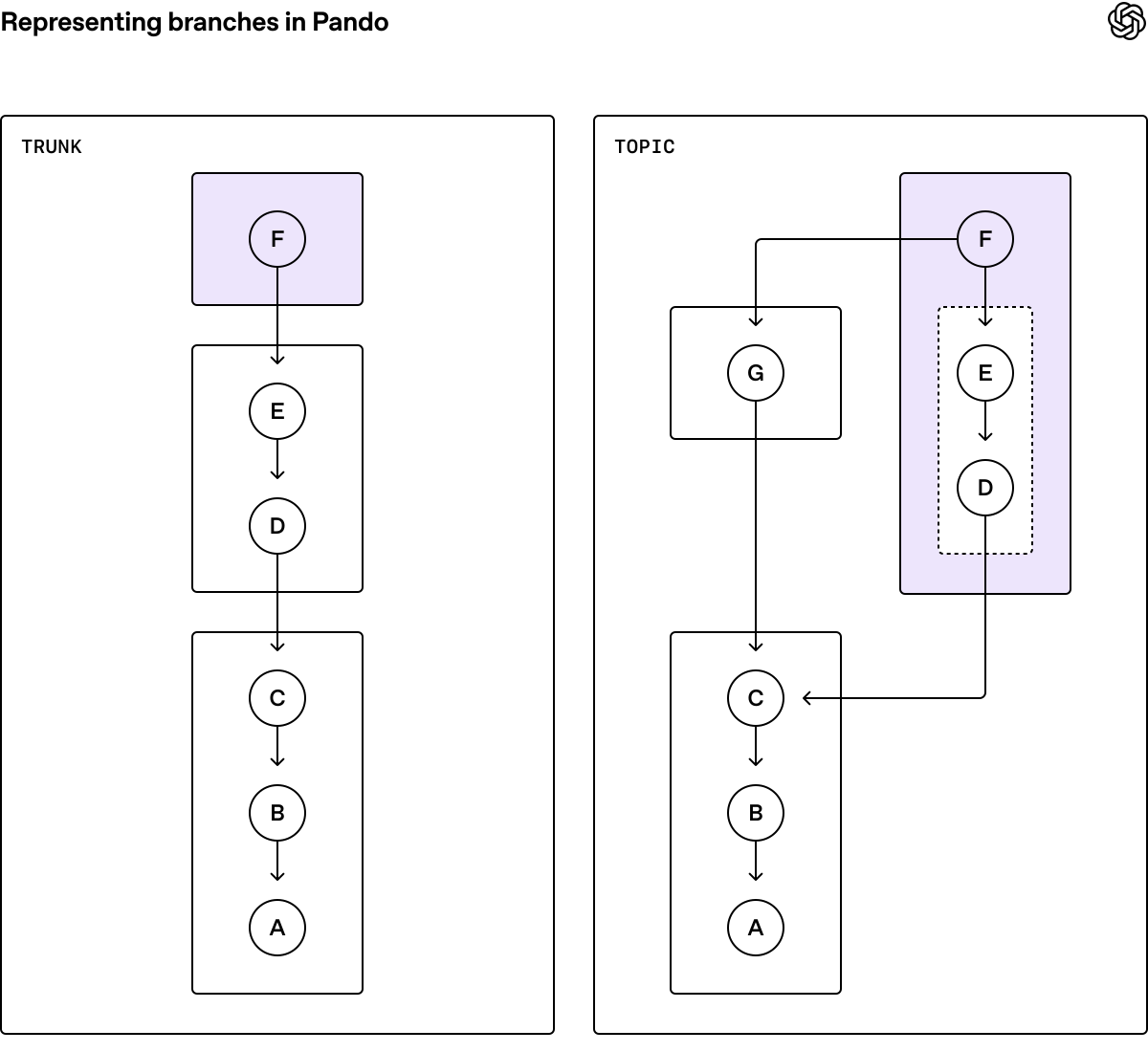 Diagram: Pando ref versions and packfile dependency graph. Trunk and topic diverge at commit C, with topic depending on commit G from trunk. Source: OpenAI Engineering Blog, “Scaling Git at OpenAI”
This structural pivot yielded immediate write performance gains. When clients read multiple branches concurrently, they no longer assume all refs originate from the same instant in time. Development workflows naturally only care about causal progression along a given branch. By substituting causal consistency for repository-wide strong consistency, millions of concurrent branches broke free from global locks.
Zero-CPU Serving via Cached Packfile Reuse and Skip Lists
Historically, the heaviest compute burden on Git servers has been pack generation during fetches. Whenever a client pulls, the server walks the object graph to compute diffs and compresses objects on the fly. Pando completely eliminates custom packfile generation, directly reusing the raw immutable packfiles uploaded during push. The backend effectively transforms into a static file distribution layer, burning virtually no CPU.
In a monorepo housing millions of branches, advertising all available refs can produce an initial response payload exceeding 100 MiB. Pando defaults to advertising only specified trunk branches, requiring clients to compute change sets strictly relative to trunk history. Under this approach, median push packfiles shrink below 20 KiB, with 99th percentile payloads staying under 3 MiB.
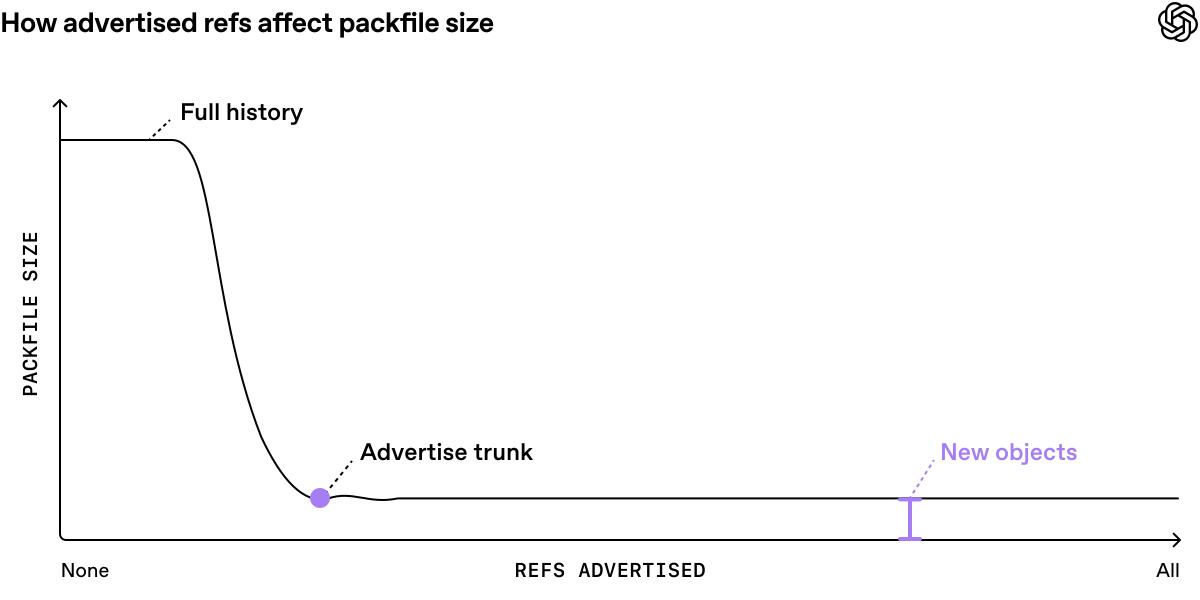 Diagram: Relationship between advertised refs and packfile size. Advertising only trunk branches dramatically cuts payload size while maximizing network efficiency and server reuse. Source: OpenAI Engineering Blog, “Scaling Git at OpenAI”
To serve static packfiles at line rate, Pando leans heavily on the packfile-uri feature. Standard Git responses return a minimal envelope while offloading bulk binary payloads to nearby Express regional edge caches. With disk cache hit rates exceeding 99%, the system saturates 10 Gbps network interfaces using just a handful of CPU cores.
Frequent small pushes inevitably create a multitude of tiny files. Pando handles this through a multi-tier compaction strategy inspired by Log-Structured Merge (LSM) trees. Pushes yield L0 base packs, which background workers periodically merge into consolidated packs covering wider revision ranges. These hierarchical packs act like a skip list, driving higher compression ratios while ensuring fetch negotiation resolves in logarithmic time.
Formal Verification and Navigating Architectural Trade-offs
The entire project moved from concept to production in just 10 weeks. A single engineer designed the core architecture, an agent swarm implemented the code, and a small deployment team rolled it out. By April 2026, the clean-slate Rust implementation was serving 100% of production traffic.
To ensure agent-generated code behaved flawlessly across complex edge cases, the team assembled a comprehensive conformance test suite benchmarking directly against canonical Git behaviors. GPT-6 Astra was tasked with writing Lean and TLA+ specifications to formally prove core safety properties. Autonomous agents ran continuous fuzzing loops for hundreds of hours to catch race conditions, complemented by red-teaming powered by Daybreak-tier models.
Achieving extreme throughput came with clear, accepted trade-offs. Reusing immutable packfiles means clients occasionally download objects they already possess outside the trunk baseline. Abandoning a global clock snapshot also required upgrading legacy analysis tooling that depended on unified repo-wide states. Engineering is fundamentally about trade-offs: when concurrent write throughput becomes mission-critical, bounded storage overhead is a price worth paying.
Git’s underlying directed acyclic graph (DAG) model remains as resilient as ever. Historical performance limitations were never a flaw of the data model itself, but rather a byproduct of centralized server-side assumptions. As autonomous agents redefine commit velocities, version control systems are transforming into causal data streaming pipelines. The future of development infrastructure belongs to backends designed to sustain frictionless human-agent collaboration.
Reference:
- OpenAI Engineering Blog, “Scaling Git at OpenAI”