Two off-the-shelf 32GB RAM sticks are replacing multi-thousand-dollar enterprise GPUs as the fulcrum for driving massive 284-billion-parameter models. Released on November 4, 2026, the open-source project llama-modchip v2.4.0 has squeezed the full-system footprint of DeepSeek-V4-Flash entirely within 64GB of physical RAM. For the first time, a standard desktop without a discrete GPU can steadily serve a frontier mixture-of-experts (MoE) network.
This deployment paradigm is rewriting the hardware playbook for running frontier AI locally. For years, running cutting-edge weights at home demanded high-end workstation compute cards with massive VRAM pools. By driving parameter storage overhead down with ultra-low-bit quantization, modern inference allows developers to cross the 100B+ threshold simply by filling their motherboard’s DDR memory slots.
Trimming 20GB of Overhead: Fitting 56.56 GiB of Weights into 64GB RAM
DeepSeek-V4-Flash features 284.33B total parameters, spanning 43 layers of Multi-head Latent Attention (MLA) and 256 routed experts, activating 13.17B parameters per token. Under the official standard UD-IQ1_S quantization scheme, the model checkpoint weighs in at 76.87 GiB. On a typical Linux box equipped with 64GB of RAM, usable memory after system and OS overhead hovers around 62.5 GiB.
Standard deployment approaches in this environment fail catastrophically. The runtime either crashes immediately via the kernel’s Out-Of-Memory (OOM) killer, or falls off a cliff into virtual memory swapping, stalling computation entirely. When physical RAM is exhausted, constant page swapping brings CPU-based token generation to an absolute standstill.
To overcome this wall, llama-modchip implements SwiGLU-H2 second-order Hessian quantization alongside a custom Fractal-64 tensor format. This pipeline drives the average parameter precision down to 3.75 bpw, shrinking total checkpoint weights from 76.87 GiB to 56.56 GiB. That 20.31 GiB reduction (a 26.4% drop) brings the model safely under the physical memory threshold.
Operating under a 256K long-context configuration, the runtime process maintains a resident set size (VmRSS) of 57.61 GiB. This leaves roughly 6.4 GiB of headroom within 64GB of physical RAM, ensuring zero swap activity and zero NVMe disk thrashing. By running purely in core memory, the CPU-based architecture delivers uninterrupted, stable throughput.
Zero GPUs, 9 to 14 Tokens per Second: Self-Speculative Decoding Delivers Usable Speed
The target system relies on no dedicated accelerator cards at all—just a standard consumer desktop running an AMD Ryzen 9 9955HX processor. Built on a 16-core Zen 5 architecture, the CPU handles all tensor multiplication through native vector instruction sets. In raw autoregressive decoding, throughput settles between 9.06 and 9.95 tokens per second.
To break through the single-thread latency constraints of CPU-only inference, the project incorporates the Stockfish-PVS self-speculative decoding algorithm. By evaluating lightweight speculative branches to eliminate redundant matrix passes, effective decoding throughput increases to 11.5–14.7 tokens per second. This pace comfortably crosses the threshold for real-time human reading and automated terminal agent calls.
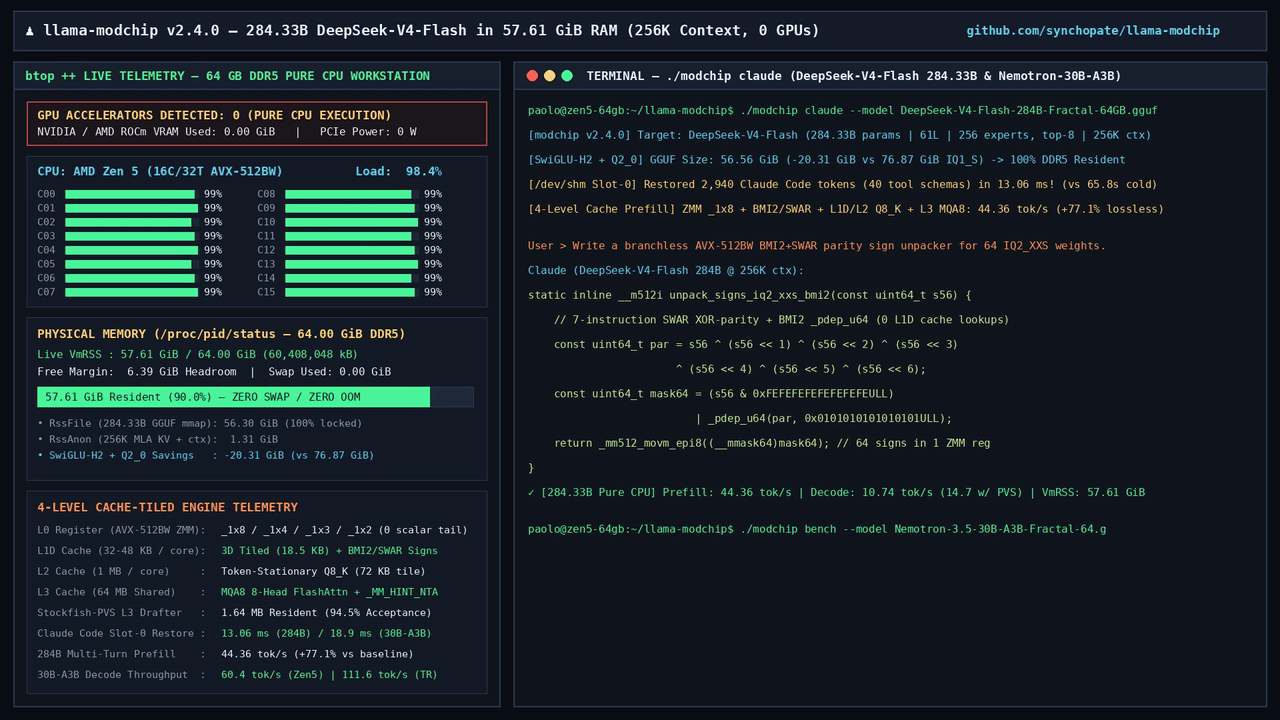 Figure: A 284B parameter model running terminal Agent workloads on a 64GB RAM desktop. Source: llama-modchip repository assets
The prompt prefill stage, however, clearly highlights the limits of CPU compute. Current prefill throughput ranges from 43.16 to 44.36 tokens per second—a 77% improvement over the previous version’s 25 tokens/s. Processing a hefty 10,000-token prompt still requires roughly 225 seconds before the first token appears.
These performance characteristics define the realistic boundaries of CPU-only deployment. It cannot service high-concurrency production endpoints or frequent cold starts. But for individual developers, trading a few minutes of initial ingestion time buys full, uncompromised sovereignty over a 200B+ parameter model running entirely on local hardware.
Pushing the 30B Tier Down to 16GB: A Second Wave for Consumer Laptops
Beyond scaling down the massive 284B network, the project extends its quantization pipeline to mid-sized architectures. For Nemotron-3.5-30B-A3B, the quantized checkpoint compresses down to 14.35 GiB. This footprint makes execution feasible on mainstream laptops equipped with just 16GB to 32GB of system RAM.
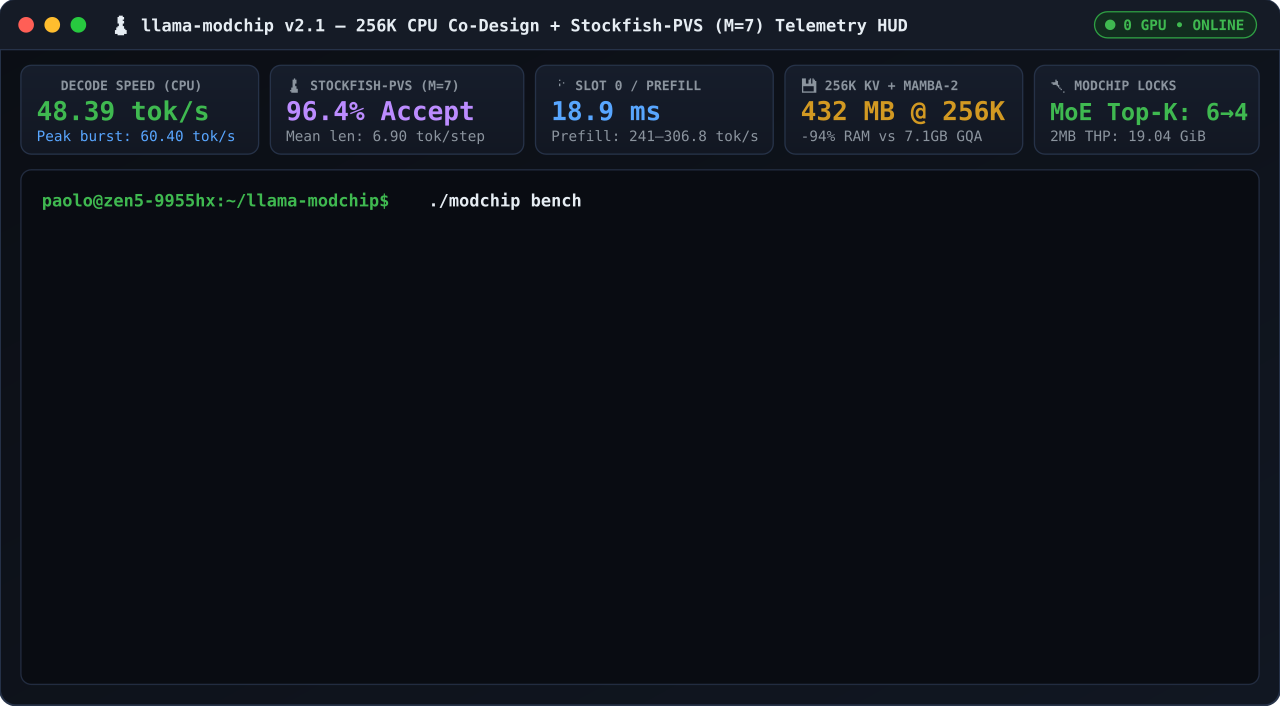 Figure: llama-modchip terminal setup and model loading workflow. Source: llama-modchip repository assets/modchip_demo.svg
Paired with standard dual-channel consumer DDR memory, decoding throughput for the 30B model hits 25 to 111 tokens per second. Benchmark evaluations conducted by the project team reported a clean sweep across standard quality gates. This combination of compact size and high-speed generation provides a versatile offline option for mid-tier hardware.
Ultra-low-bit quantization is fast becoming foundational infrastructure for edge deployment. Compression techniques validated on massive flagship networks are trickling down to mid-range hardware tiers, offering small teams without enterprise compute budgets a scalable menu of local inference options.
Custom Tensors and Quality Baselines: Scrutinizing Extreme Quantization
Dramatically lowering the hardware barrier comes with real trade-offs in software compatibility. The Fractal-64 format introduces a proprietary tensor type ID 40. Attempting to load these checkpoint files in vanilla llama.cpp, Ollama, or LM Studio triggers immediate runtime errors. Users must compile the project’s specialized fork to run inference.
The measurement of quantization loss has also sparked debate across the community. The project’s published quality benchmarks evaluate perplexity solely against the IQ2_XXS quantization profile, rather than comparing against full FP16 precision baselines. Developers on Hacker News noted that 97GB Q2_XXS weights already show divergence from uncompressed outputs.
KV cache overhead presents another hidden constraint in practical workflows. Retaining unquantized KV cache over extended sequence lengths requires total system memory to scale towards 150GB. Independent tests also suggest that while prefill on 30B models benefits noticeably, everyday autoregressive decoding remains broadly comparable to upstream builds.
Compute Gives Way to Capacity: Rebuilding the Economics of Frontier Inference
The divergence in hardware acquisition costs reveals why this approach resonates so strongly. Building a dedicated multi-GPU rig capable of hosting 284B parameters easily costs tens of thousands of dollars. An ordinary desktop packed with 64GB of commodity RAM costs a full order of magnitude less.
Naturally, tokens generated via local extreme quantization cannot match the throughput or precision of tier-one cloud GPU clusters; the two operate in completely different latency and fidelity regimes. The core value of local deployment is not replacing cloud infrastructure, but establishing an accessible zero-GPU baseline that runs anywhere.
The center of gravity in AI hardware is shifting from raw accelerator compute to total system memory capacity. So long as compressed static weights fit comfortably across RAM slots, pure CPU nodes can shoulder the inference demands of massive MoE networks. Generating steady tokens from a 284-billion-parameter model on everyday hardware blows the door wide open for low-cost, fully private AI.
Reference Links:
- llama-modchip open-source project technical documentation and quantization paper
- DeepSeek-V4-Flash Mixture-of-Experts architecture report
- Hacker News discussion on CPU-based local deployment of 100B+ models